

You can get away with messy invoice names for a while. Then a client asks for “that February bill,” your spreadsheet sorts 10 before 2, and your bookkeeper spends half an hour hunting down a number that should've taken seconds to find. That's usually the moment business owners realize invoice numbering isn't a clerical detail, it's part of the control system.
A good numbering system does three jobs at once. It helps you track cash, keeps your records audit-ready, and gives clients a clean reference point when they need to pay or dispute a bill. A bad one creates duplicate payments, lost invoices, and enough confusion to slow down month-end close.
Table of Contents
- Why Your Invoice Numbers Matter More Than You Think
- The Non Negotiable Rules Behind Every Invoice Number
- Comparing the Most Reliable Invoice Numbering Formats
- How to Build Your Own Invoice Numbering System
- Common Mistakes That Break Your Numbering Sequence
- Automating Invoice Numbers Without Losing Control
Why Your Invoice Numbers Matter More Than You Think
A lot of businesses treat invoice numbers like file names. That works until the first voided bill, the first partial payment, or the first time two people on the same team create invoices at the same time. Then the number stops being a label and starts acting like a control point, because everyone from the client to the accountant uses it to find the exact document in question.
The strongest reason to care is traceability. A clear sequence lets you match payments, answer client questions, and prove that the billing trail is intact when someone reviews your books. It also gives clients confidence that your process is organized, which matters when they want to look professional and get paid quickly.
There's a compliance angle too. Under the EU VAT framework, an invoice needs “a sequential number, based on one or more series, which uniquely identifies the invoice,” and that number can include alphanumeric characters (Avalara on sequential invoice numbering). That is a design constraint, not paperwork trivia.
Practical rule: if a number can't be found fast, can't be explained later, or can be reused by mistake, it's not a safe invoice number.
A clean system also reduces friction inside your team. When the same format appears on every invoice, everyone knows where to look, what comes next, and whether a document has been voided, replaced, or paid. That consistency keeps a small billing setup from turning into a weekly cleanup project.
The Non Negotiable Rules Behind Every Invoice Number
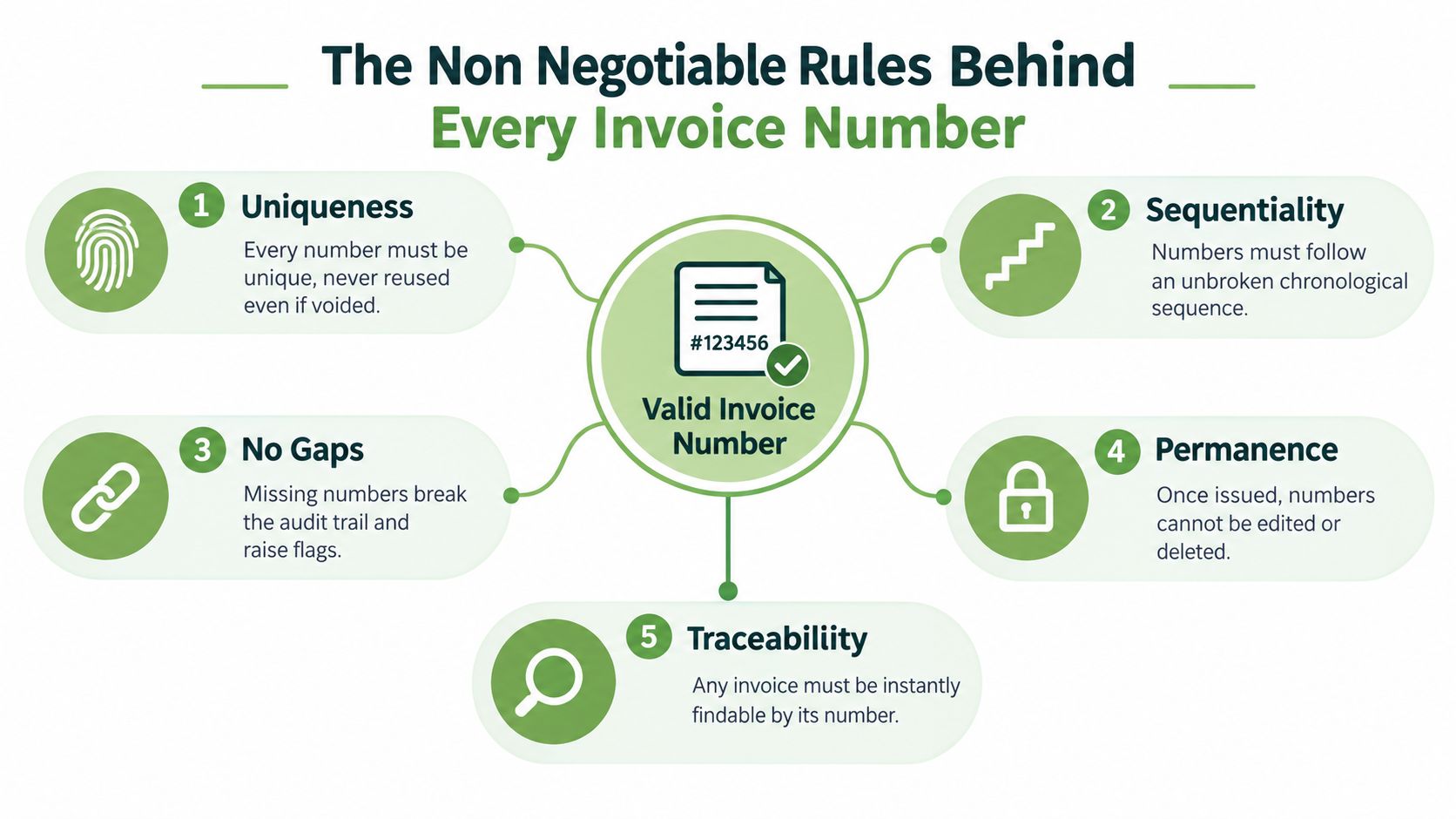
Start with one rule: each invoice number must be unique. EU VAT rules also allow one or more series, which is useful if you separate branches, document types, or legal entities, as long as each series stays continuous and no number is reused. That gives you room to design around real operations without weakening the numbering trail (Avalara on sequential invoice numbering).
What sequential really means
Sequential means the sequence can be followed without guessing. If you issue invoice 2026-001 and then 2026-002, you should not later find a second 2026-002 in another folder or a stray 2026-001 on a draft that was never meant to go out.
Gaps create work. They trigger questions from clients, accountants, and auditors, especially when nobody can show whether a number was voided, reserved, or issued by mistake.
What auditability requires
Auditability means the number leads back to the right invoice quickly, without a cleanup exercise. Spain's tax authority allows invoice series and numbers to use digits and uppercase letters, with separators such as hyphens, underscores, slashes, and full stops (Spain tax authority guidance). That matters because a system can stay readable and still work well for software and review.
The same discipline shows up in GetBill's terms of service, where issued records are expected to remain explainable. Once an invoice is out, the numbering needs to hold up under correction, cancellation, and later review.
A number is only useful if it still makes sense six months later, after a cancellation, a correction, and a tax review.
Permanence matters too. Once a number is assigned, do not rewrite it into something else just because the invoice changed. That turns the sequence into a proper ledger trail instead of a cosmetic label.
Comparing the Most Reliable Invoice Numbering Formats
A good invoice number format does three jobs at once. It sorts cleanly, stays readable, and keeps working when you add more clients, more entities, or more staff. The safest formats are usually the plainest ones. The choice is whether the number should show timing, client context, or both.
| Format Type | Example | Best For | Watch Out For |
|---|---|---|---|
| Plain sequential with padding | INV-0001 | Small businesses that want the cleanest structure | Can feel opaque if you need to identify timing or business unit fast |
| Year-based sequence | 2026-001 | Teams that reset every year and want easy sorting by period | Requires discipline at year-end so the reset is consistent |
| Client or project series | CL-01-001 | Agencies, consultants, and repeat-client work | Easy to overcomplicate if prefixes aren't standardized |
Plain sequential with padding
INV-0001 or INV-0012 is the least fussy option. Padding keeps the series readable and preserves sort order, which matters when spreadsheets or file lists would otherwise put 10 before 2 (Adobe on invoice numbering). It also gives the sequence room to grow without changing the look of every later invoice.
This format works well when one business wants a single trail across everything it bills. For freelancers and small teams, that usually means fewer edge cases and less confusion when a number has to be traced later.
Year-based sequences
2026-001 works well when the year needs to be visible immediately. It keeps invoices grouped by period and makes annual resets easier to handle.
The catch is process control. If the reset happens casually, the sequence can drift, and that creates questions later about which invoices belong to which period. Year-based numbering is strongest when the reset rule is fixed before anyone starts issuing invoices.
Client or project series
Client-coded or project-coded numbers are useful when multiple jobs overlap and the invoice has to be identifiable at a glance. They fit agencies and consultancies, especially when one account can generate several invoices under similar terms.
They only work if the prefixes stay standardized. If one person writes ABC-001 and another writes A-B-C-1, the system stops helping. That becomes worse in multi-entity setups, where the same client name can appear under different legal entities and the numbering needs to keep those records separate without confusion.
Best fit rule: if humans need to read the number quickly, keep the prefix short. If bookkeeping needs the number to stay strict, keep the sequence consistent.
How to Build Your Own Invoice Numbering System
Start with the smallest format that can hold up under growth. A lot of messy numbering systems begin with a decent idea and too much improvisation, so the goal is to define the structure once and stop changing it every time someone wants a tweak. In practice, that means deciding the prefix, the padding, the reset rule, and who can change anything.
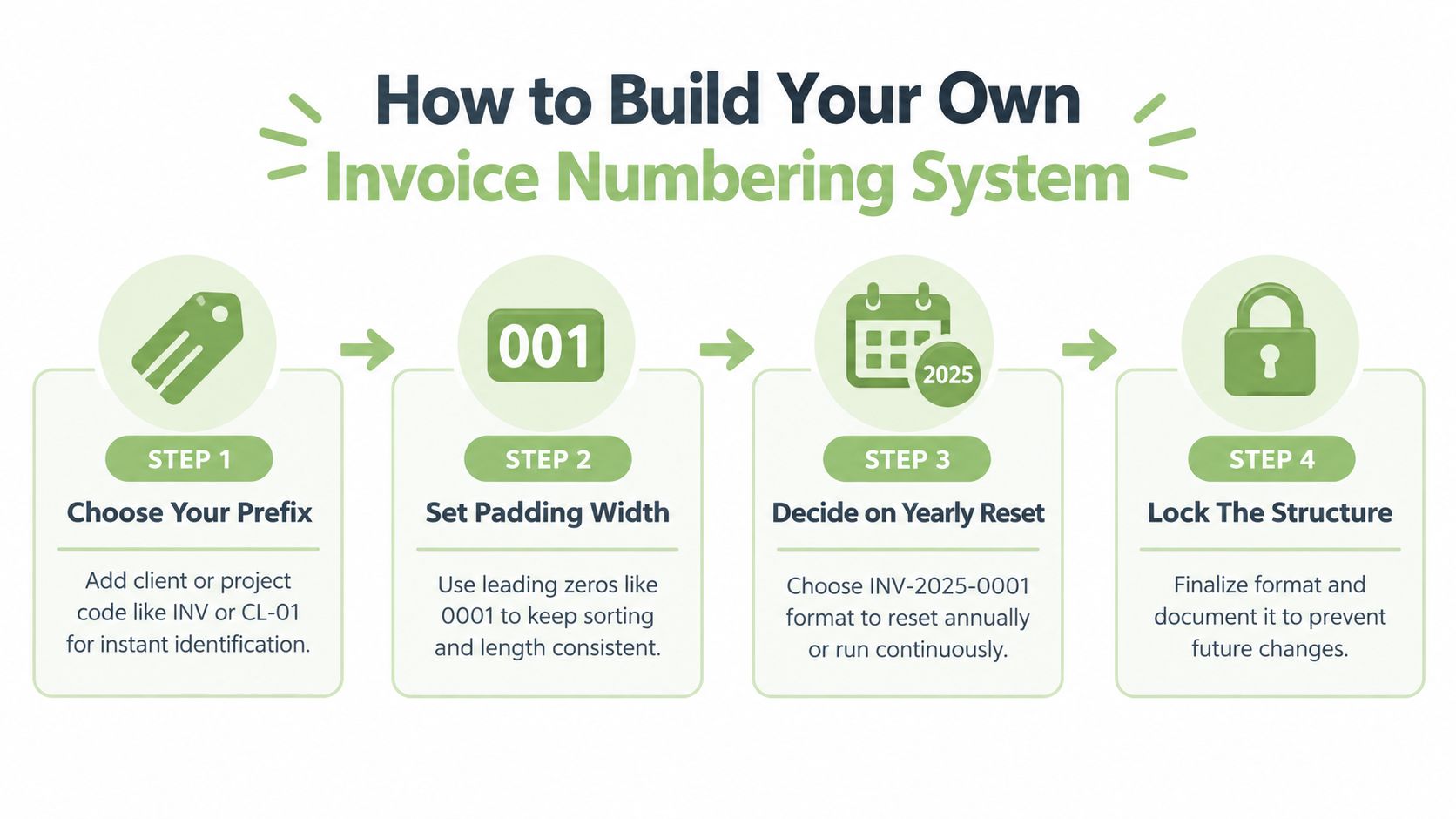
Choose the prefix first
A prefix tells you what kind of document you are looking at. INV is common for standard invoices, while separate prefixes can keep credit notes or other document types in their own series. Spain's guidance allows invoice numbers to use digits and uppercase letters, with separators such as hyphens, underscores, slashes, and full stops (Spain tax authority guidance).
Pick a fixed width
Use leading zeros so the sequence sorts correctly. 0001 is more durable than 1, because it avoids sorting problems and gives the series room to grow without changing the look of later invoices. That small formatting choice saves time once the volume starts moving.
Decide whether the sequence resets
A yearly reset works when your books are organized around financial years or when local rules expect that structure. The trade-off is control. If the reset happens casually, the sequence drifts and later reconciliation gets awkward. If you work across borders or across entities, set the reset rule before the first invoice goes out and keep it consistent.
Lock the format before launch
Once the structure is live, write it down and keep it fixed. That includes the prefix, the length, the reset rule, and the exceptions. If your setup needs to support future volume, build in room now. A practical target is a format that can handle growth without forcing a redesign, and a billing system should preserve the format you chose instead of rewriting it later. For teams that want software to keep that control inside the workflow, GetBill is one option.
Common Mistakes That Break Your Numbering Sequence
A numbering system usually breaks at the point where someone chooses convenience over control. One shortcut seems harmless, then duplicates, gaps, and mismatched records start piling up. By the time the problem is visible, the audit trail is already harder to trust.
Reusing voided numbers
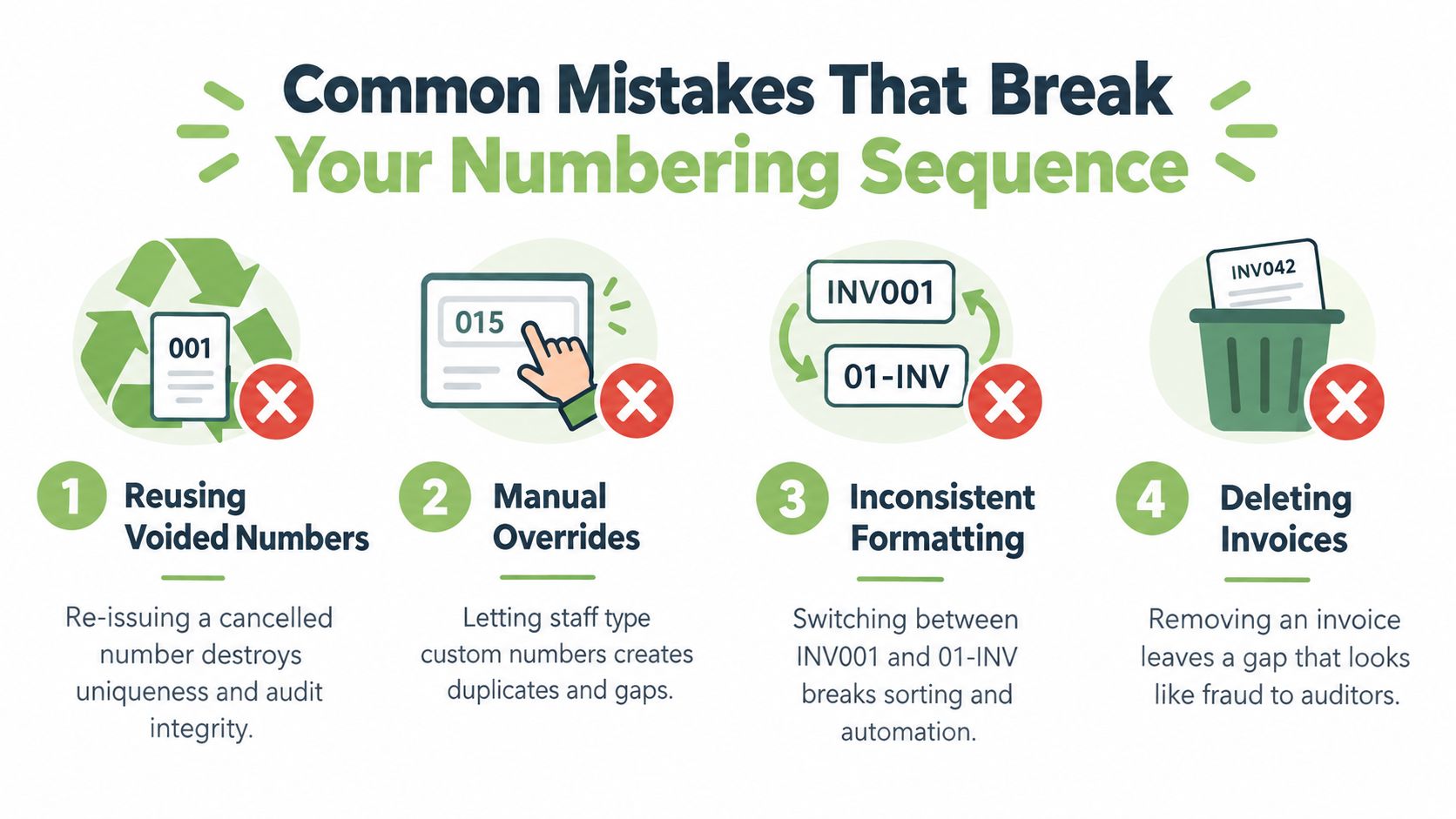
This is the clearest failure point. A voided invoice should keep its number, and a replacement should get a new one. If you reuse the old identifier, one number starts pointing to two separate events, which breaks the record trail and makes review harder later.
Letting manual overrides creep in
Manual edits usually start as a quick fix. Someone types a custom number to get past a temporary issue, then duplicate numbers, skipped numbers, and format drift follow. The safer setup is simple, restrict who can change the sequence and check each invoice before it goes out.
Ignoring jurisdiction-specific limits
Some formats are not just messy, they are out of bounds for the tax rules you work under. In India's GST context, invoice numbers need to stay unique within the financial year, stay within 16 characters, and use only letters, numerals, hyphens, and slashes. tools.town invoice numbering best practices If your template ignores those limits, it may work internally and still fail the compliance test.
Colliding across entities
This trips up freelancers and small operators more often than expected. A sole prop and an LLC, or two brands run from the same back office, can easily overlap if they share one sequence. Separate prefixes or separate series solve the problem before it turns into a collision.
Cross-entity setups need extra care because the risk is not just duplicate numbers, it is duplicate numbers that look legitimate. If two teams can create invoices on their own, the numbering structure has to keep them apart every time.
Operational rule: if two people or two entities can generate invoices independently, they need a structure that cannot overlap by accident.
Automating Invoice Numbers Without Losing Control
A live invoicing setup needs automation that removes typing, not judgment. The system should assign the next number on its own, preserve the sequence, and keep voided or corrected documents from being reused. It also has to make status changes visible, so partial payments and converted estimates do not turn into records that are hard to trace later.
Voided invoices should keep their number. Reissued invoices should get a new one. Corrections belong in a credit note, then a fresh invoice, so the audit trail stays intact. Automation should protect that trail, not make it easier to overwrite. If your software cannot separate those states cleanly, it is creating more work than it saves.
A workable setup starts with a locked format and no freeform edits. Document what happens when an invoice is voided, partially paid, or replaced, then keep that process consistent across users and entities. If your platform syncs payment status automatically, it should reduce reconciliation work, not create a second numbering path. GetBill's blog shows how billing workflows are usually handled in practice.
Before you move a live business to automation, check three things. The format has to fit your compliance rules. The system has to keep a permanent record of canceled or corrected documents. And a human auditor should be able to enter halfway through the year and trace the sequence without guessing. For setup details that hold up in real use, invoice numbering best practices are worth reviewing once, then turning into internal rules.
If you can answer those questions clearly, the numbering system is ready.