


With roughly two-thirds of U.S. photographers working independently, the strongest photography sample invoice separates the service, deliverables, usage rights, expenses, payment schedule, and balance so the client can approve and pay without guessing. The document should turn a finished shoot into a clear payment plan, not just display one unexplained total.
A photographer may finish a portrait session, wedding, or commercial assignment and still need to explain what the client owes, what the fee includes, and when the remaining balance is due. A useful invoice translates the estimate and service agreement into itemized charges, licensing boundaries, travel expenses, delivery expectations, and payment milestones.
The seven formats below solve different billing problems. They also distinguish reusable invoice structures from tax and legal requirements that depend on the applicable jurisdiction. GetBill can support this workflow with itemized estimates and invoices, reusable client and service records, estimate-to-invoice conversion, branded PDFs, email or public-link sharing, supported online card payments through a connected Stripe account, and deposit or partial-payment tracking with remaining balances. Payment availability depends on Stripe and the user's account and region.
Table of Contents
- 1. Portrait Session Invoice with Sitting Fee and Print Options
- 2. Wedding Photography Invoice with Multiple Services and Timeline Payments
- 3. Event and Corporate Photography Invoice with Hourly Rates and Usage Rights
- 4. Product and Still-Life Photography Invoice for E-Commerce or Catalog Use
- 5. Real Estate Photography Invoice with Virtual Tour and Listing Support Services
- 6. Newborn and Maternity Photography Invoice with Session Packages and Bundles
- 7. School and Youth Photography Invoice with Bulk Order Processing and Parent Payments
- 7-Point Photography Invoice Comparison
- Final Thoughts
1. Portrait Session Invoice with Sitting Fee and Print Options
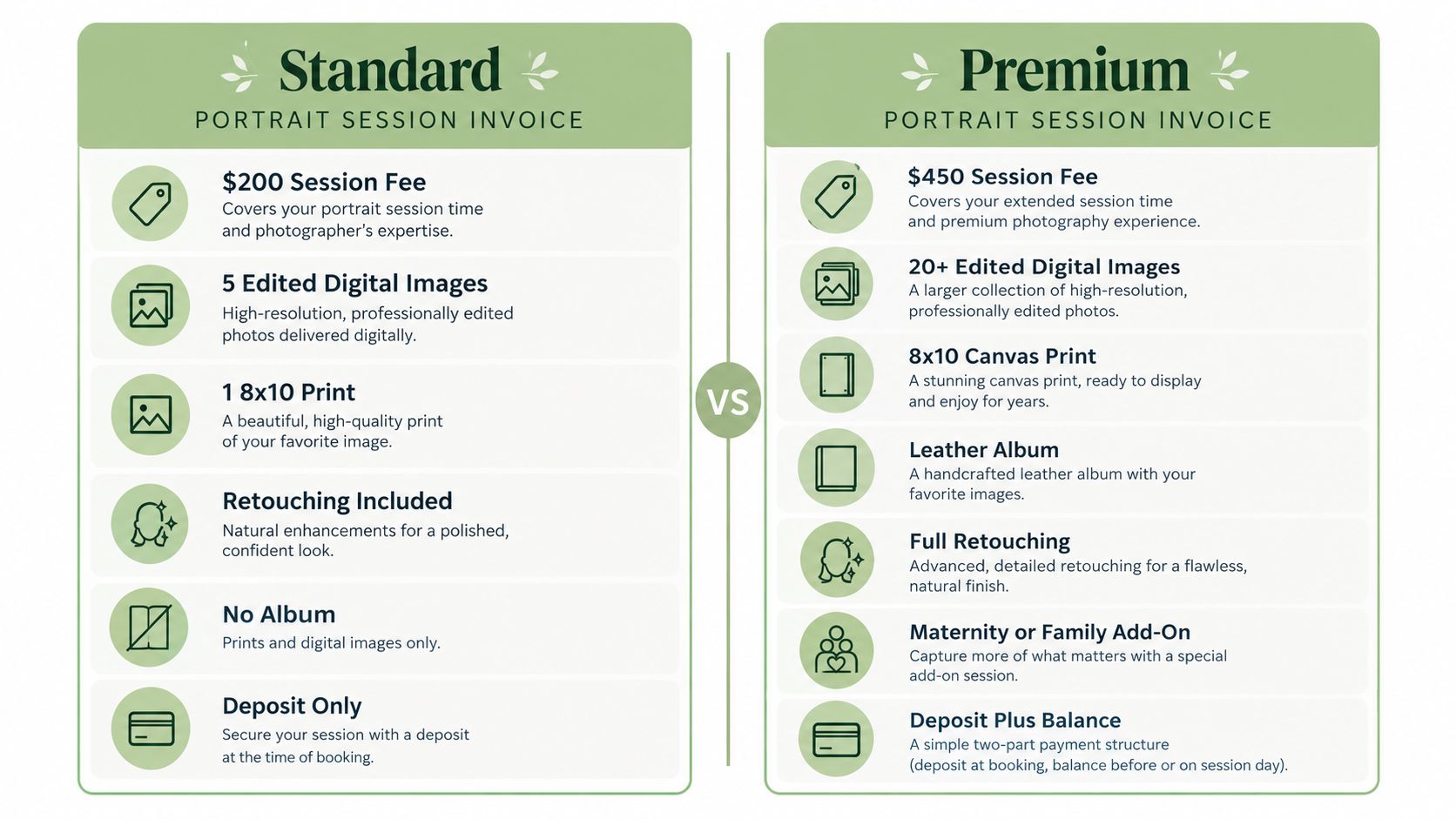
Portrait work becomes easier to price when the session itself is separated from everything purchased afterward. A portrait photography sample invoice can list the sitting or creative fee first, followed by digital files, retouching, prints, canvas products, framed artwork, and albums. That structure lets a client book the session without assuming every possible product is included.
A family portrait client may pay for an outdoor session, then select edited digital images and an album after viewing the gallery. A senior portrait client may choose a session with individual digital files, a canvas print, or both. The invoice should name each product precisely, such as “11x14 canvas print,” rather than using a vague line such as “print.”
Photography businesses should also distinguish included files from optional purchases. If the sitting fee includes a gallery but not high-resolution downloads, the invoice and agreement should say so plainly. If retouching applies only to selected images, the quantity and editing scope belong in the line item.
Practical rule: A package name can help clients compare options, but the invoice should expose the package contents.
A survey cited by the Photography Business Institute's pricing analysis found that 75% of respondents offered both digital and printed products, while 18% sold exclusively digital products. The same analysis reports that 60% of photographers selling prints charged less than $50 for an 8-by-10 print, even though Professional Photographers of America guidance estimated that the print needed to be priced at $51 merely to cover costs. Those figures show why product costs shouldn't disappear inside a session fee.
The invoice should also state the booking deposit, print turnaround, delivery method, and whether a balance remains before products are ordered.
2. Wedding Photography Invoice with Multiple Services and Timeline Payments
Wedding photography invoices solve a timing problem as much as a pricing problem. The photographer commits availability long before the event, while the client may receive edited images and albums much later. A useful invoice therefore connects each service to a payment milestone.
The document might separate engagement photography, ceremony coverage, reception coverage, album design, prints, travel, and rush editing. Instead of showing a single wedding package total, it can identify which items are covered by the initial retainer, which are due before the event, and which remain payable at delivery.
A documented wedding-pricing example uses a 33% retainer at signing, another 33% six months before the event, and the final 34% 30 days before the event. A comparable cancellation scenario would leave the photographer retaining $3,900 under that schedule. The same source describes a graduated cancellation schedule of 50% at six to twelve months, 75% at three to six months, and 100% within three months. These percentages aren't universal legal rules, so the photographer should align them with the signed agreement and local law. The wedding pricing and contract guidance provides the cited benchmark.
The invoice should identify the number of edited images, album type, print quantities, travel charges, and delivery deadlines. A wedding project priced around the professional average of approximately $3,000, cited from a study of more than 10,000 U.S. couples in Snappr's photography pricing overview, still needs a scope breakdown to be meaningful.
The due date should be unmistakable. Photographers can also review guidance on separating invoice dates from due dates when setting up milestone billing.
3. Event and Corporate Photography Invoice with Hourly Rates and Usage Rights
Corporate event billing usually starts with time, but it shouldn't end there. A conference, gala, or promotional shoot may require coverage hours, travel time, equipment, assistants, editing, and a defined license for the finished images.
An event photography sample invoice should show the agreed coverage period and the rate for additional time. Travel can appear as a separate expense or as a distinct time-based service, depending on the agreement. Equipment charges should also remain visible when specialized lighting, cameras, or support equipment affects the project cost.
Usage rights deserve their own line. “Images provided for internal corporate use only” has a different commercial meaning from “Client may use images for social media and web publication.” The invoice should identify territory, duration, media, exclusivity, permitted reuse, and whether copyright ownership changes. A license grants defined permission. It isn't automatically an ownership transfer.
A low creative fee paired with unrestricted advertising use can cost the photographer more than a higher, clearly licensed quote.
A current industry billing framework identifies creative fee, usage-rights license, pre-production, post-production, expenses, and retainer credit as separate categories. Its example usage multipliers range from 1.0× for personal use and 1.25–1.5× for small-business use to 4.0–5.0× for national advertising and 6.0–8.0× for a buyout. Those ranges appear in the photographer day-rate and usage-rights framework, and they should be treated as pricing references rather than fixed rules.
The invoice should also state delivery format, gallery or drive delivery, expected turnaround, and the authorization method. A signed estimate or agreement before the event prevents the client from discovering usage limits only after publication. A guide to hourly-rate invoice templates can help structure time-based line items without hiding licensing inside the hourly charge.
4. Product and Still-Life Photography Invoice for E-Commerce or Catalog Use
A product list can change after the estimate is approved. A retailer may start with plain-background images, then add styled scenes, alternate angles, background removal, color correction, or print-ready files. Each request changes the labor, so list it separately instead of absorbing it into one broad “product photography” charge.
Build the invoice around the billing decision each line resolves: what is being photographed, how much preparation it needs, and what the client receives. Identify each product or SKU, image type, quantity, styling requirements, retouching level, and delivery format. Plain-background images can use one rate. Lifestyle images with props, models, locations, or complex compositions need their own line. Itemize clipping paths, background removal, file optimization, and master files as separate services.
Ask for product dimensions, materials, packaging constraints, and preferred angles before confirming the estimate. These details affect setup time and may reveal products requiring special handling. Define revisions in practical terms. Minor color adjustments or repositioning differ from a reshoot, so “unlimited revisions” should not appear without a stated boundary.
Scope control starts before the first product reaches the studio.
State whether delivery includes PSD, TIFF, or JPEG files, the intended web or print resolution, the standard turnaround, and any rush-service charge. A catalog client may need a cloud gallery for approvals. An e-commerce team may instead need structured filenames tied to product identifiers.
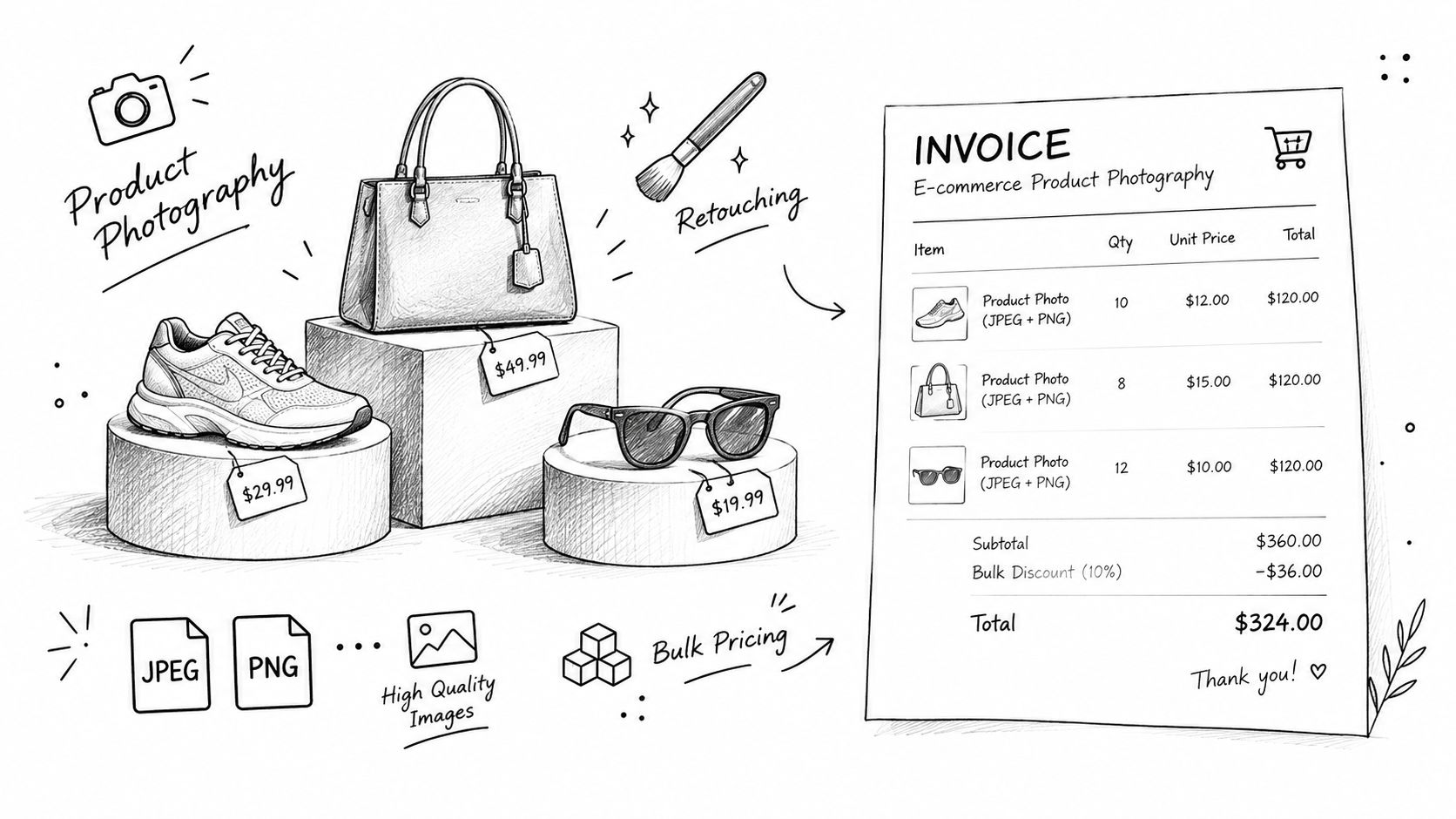
The usage line should state whether the images cover product pages, marketplaces, packaging, paid advertising, catalogs, or reseller sites. Keep retouching and usage rights separate so added products or new media can be priced without rebuilding the estimate. A single package total hides those decisions and becomes difficult to revise when the product list expands.
5. Real Estate Photography Invoice with Virtual Tour and Listing Support Services
Real estate assignments often combine several services that clients may purchase separately. Property photography, virtual tours, drone imagery, twilight work, MLS optimization, and listing support should not be bundled into one unexplained “listing package” line.
A basic invoice can offer photography only, a standard option that adds a virtual tour, and a premium option that includes aerial or twilight imagery. Each option should still identify the number of edited images, tour type, delivery format, and any property-size assumptions. An extensive property may require more shooting time and post-production than a smaller listing.
Travel needs a clear boundary. The invoice can state the included service radius and list mileage or location charges for properties outside it. Additional images should have a defined rate, especially when the client requests extensive coverage after the original estimate.
The California Department of Tax and Fee Administration's photography guidance explains that California tax treatment may include tangible photographs, production labor, reproduction rights, sitting fees, travel, rentals, assistants, and studio costs. The rule is jurisdiction-specific, so it shouldn't be applied to every state. A California photographer should distinguish digital delivery, physical prints, albums, and service charges, then verify the applicable treatment before issuing the final invoice.

Usage restrictions matter here because a property image may be reused for another listing, by another agent, or in broader advertising. The invoice should identify the client, property, permitted use, duration, and whether third-party sharing is allowed. The contract should control ownership and licensing. The invoice can reinforce those terms, but invoice wording alone isn't a substitute for legal advice or a complete agreement.
6. Newborn and Maternity Photography Invoice with Session Packages and Bundles
Newborn and maternity work benefits from packages, but package names should never replace deliverable details. A client needs to know whether a package includes the sitting fee, edited images, album, announcement cards, framed artwork, or only the time spent in the studio.
A maternity and newborn bundle can show both sessions as separate services, then apply a clearly labeled bundle adjustment. That approach makes the discount visible without disguising the value of either session. It also helps the photographer revise one appointment if the client books the sessions on different dates.
The invoice should specify image quantities, album type, print dimensions, file format, and product delivery. A product menu or pricing sheet can accompany the invoice so the client can add artwork after viewing the gallery. Post-session add-ons should be issued as additional line items rather than absorbed into the original package.
A package should make buying easier, not make the scope harder to inspect.
Deposits and date changes deserve careful wording. A photographer may state that a deposit is non-refundable but transferable to another date, subject to availability and the signed agreement. That policy should be reviewed under applicable local law. A reshoot promise also needs a defined scope, such as whether it applies to technical failure, illness, weather, or client dissatisfaction with artistic style.
The invoice should connect payment status to the booking date and product order. If the client pays in installments, each payment should appear with its date, amount, and remaining balance. The document can refer to the contract for cancellation, rescheduling, model releases, and product policies rather than attempting to replace those terms.
A small studio should also account for editing time, props, assistants, travel, and delivery. A low package price may look attractive while leaving products or post-production underpriced. Clear line items allow the photographer to review which parts of the service cover their direct and indirect costs.
7. School and Youth Photography Invoice with Bulk Order Processing and Parent Payments
School and youth photography requires a different invoice logic because one assignment may produce many separate orders. The photographer may contract with a school, sports organization, or parent group, then fulfill prints and digital files for individual students or teams.
A bulk-order invoice should identify the organization, photo date, class or team, package choices, order deadline, delivery method, and payment responsibility. Individual order forms should use sequential order numbers or student identifiers so the photographer can match each purchase to the correct image and fulfillment package.
The client may choose a school-paid arrangement, where the institution pays a flat fee for class or team coverage. That model simplifies collection and reduces parent follow-up. A parent-paid arrangement can offer more product choice, but it requires an order process, payment tracking, and a firm fulfillment deadline.
The invoice should separate photography services from printed products, digital downloads, retouching, shipping, and any school-specific administrative work. Physical prints and digital files delivered on physical media can receive different tax treatment from digital delivery, depending on the jurisdiction. In California, for example, the state guidance on home-based photography businesses treats printed photographs and electronic files delivered on physical media as tangible forms that are generally taxable unless an exemption applies.
For contractors, recordkeeping also matters. The IRS states that business payments for services to a nonemployee generally become reportable at $600 or more for payments made before 2026, while the threshold is $2,000 for payments made after December 31, 2025. The IRS guidance on Form 1099-NEC explains that the payer must file the form and provide it to the contractor. An invoice or payment record doesn't replace that obligation.
7-Point Photography Invoice Comparison
| Invoice Type | Implementation Complexity | Resource Requirements | Expected Outcomes | Ideal Use Cases | Key Advantages |
|---|---|---|---|---|---|
| Portrait Session Invoice with Sitting Fee and Print Options | Low–Medium: simple itemization; possible follow-up invoices for prints | Basic invoicing, product price list, delivery/retouch tracking | Clear separation of session vs product revenue; upsell potential | Studio/outdoor portrait sessions, family, seniors | Transparent pricing; flexible post-session print sales |
| Wedding Photography Invoice with Multiple Services and Timeline Payments | High: multi-stage payments and many line items | Contracts, milestone payment tracking, timeline & delivery management | Secured bookings, steady cash flow, risk mitigation | Weddings, multi-day events, premium clients | Tiered payments; scope protection; justifies premium pricing |
| Event and Corporate Photography Invoice with Hourly Rates and Usage Rights | Medium: hourly tracking plus legal/licensing language | Time-tracking, usage-rights agreements, travel and equipment logs | Accurate time-based billing and legal protection for image use | Conferences, corporate events, promotional shoots | Straightforward hourly billing; clear licensing; flexible add-ons |
| Product and Still-Life Photography Invoice for E-Commerce or Catalog Use | Medium: per-product pricing and retouching scopes | Detailed product lists, retouching workflow, file delivery systems | Predictable per-item costs; scalable bulk orders | E-commerce catalogs, product listings, catalog shoots | Easy per-product budgeting; bulk discounts; clear licensing |
| Real Estate Photography Invoice with Virtual Tour and Listing Support Services | Medium: property-specific pricing and multiple deliverables | Specialized gear (drone/3D), travel, editing and MLS optimization tools | Modular sales with high-value add-ons; repeat agent business | Real estate listings, brokers, property marketing | Modular packages; premium virtual/drone add-ons; MLS-ready deliverables |
| Newborn and Maternity Photography Invoice with Session Packages and Bundles | Medium: tiered packages and timing-sensitive scheduling | Studio/props, retouching, flexible scheduling, guarantee management | Higher average sale via bundles; stronger client satisfaction | Newborn and maternity clients, family milestone sessions | Simple package choices; bundle upsells; reshoot/guarantee options |
| School and Youth Photography Invoice with Bulk Order Processing and Parent Payments | High: bulk tracking, many payers, strict deadlines | Order management system, parent forms, fulfillment/logistics | Efficient bulk sales and predictable institutional revenue | Schools, sports teams, yearbook and youth group photography | Bulk invoicing reduces admin; consistent package pricing for parents |
Final Thoughts
A photography sample invoice works best when it answers the client's practical questions before payment becomes disputed. What service was performed? Which images, products, or edits are included? Where may the client use the images? What expenses were reimbursed? Which payment has already been received, and what balance remains?
The seven formats solve different problems. Portrait invoices separate sitting fees from products. Wedding invoices connect a long project to milestone payments. Corporate invoices protect the distinction between creative labor and usage rights. Product invoices control changing quantities and revision requests. Real estate invoices separate listing services and jurisdiction-specific tax questions. Newborn and maternity invoices make packages and products easier to compare. School invoices organize bulk fulfillment and multiple payers.
The invoice should remain consistent with the estimate and signed agreement. If the client expands usage, requests additional images, adds travel, or orders a physical product, the change should appear in a revised estimate or additional invoice line. A vague package total may look simple, but it gives both parties less evidence of what was approved.
Cash-flow clarity matters before the shoot begins. Recent U.S. small-business research reported that 56% of businesses had unpaid invoices outstanding, with an average amount owed of $17,500, while 47% reported invoices more than 30 days overdue. The QuickBooks report on small-business late payments also says 85% of freelancers experience late payment at least sometimes, and 21% are paid late or not at all more than half the time. Those findings reinforce the value of a visible deposit, due date, payment status, and remaining balance. They don't mean invoice wording alone creates enforceable rights.
Payment methods and any associated fees need clear disclosure. The FTC Rule on Unfair or Deceptive Fees applies to live-event tickets and short-term lodging; it does not establish a general rule for photography service invoices. Before adding a card surcharge or processing fee to a photography invoice, check the applicable laws in your jurisdiction and the terms of your payment processor and card network. Clearly explain the supported payment methods and any applicable fees before the client pays.
GetBill can support the repeatable parts of this workflow by storing client and service records, creating itemized estimates and invoices, converting estimates into invoices, producing branded PDFs, sharing documents by email or public links, and recording deposits or partial payments with the remaining balance. Tax treatment, contracts, licensing decisions, and legal compliance still require jurisdiction-specific review.
Photographers can use GetBill to build itemized estimates and invoices for sessions, products, licensing, travel, deposits, and remaining balances. Visit GetBill to create branded billing documents and connect supported online card payments through Stripe, subject to account and regional availability.