

A client's invoice can be perfectly clear, correctly addressed, and still sit unpaid. The estimate was approved, the work was completed, and the invoice went out with payment instructions. Then the read receipt turns blue, two weeks pass, and the business owner starts checking the bank account between jobs.
A reminder to pay works best when it does more than ask for money. It should identify what remains due, remove administrative friction, and help reveal why payment hasn't arrived. A forgotten invoice needs a neutral nudge. A disputed line item needs a review path. A cash-strapped client needs a documented conversation, not an endless stream of automated emails.
The sequence below treats payment collection as a practical operating process. It covers timing, message structure, channel choice, diagnosis, and measurement, so each contact has a clear purpose.
Table of Contents
- Why Most Reminders to Pay Get Ignored
- The Three-Stage Reminder Sequence That Works
- Anatomy of a Reminder That Actually Gets Opened
- Diagnosing Why the Invoice Is Unpaid
- Choosing Channels and Using Automation Carefully
- Measuring Whether Your Reminders Actually Work
Why Most Reminders to Pay Get Ignored
A vague message such as “Just following up on this” creates work for the recipient. The client has to search for the invoice, work out the balance, find the payment details, and decide what “following up” requires. Many recipients postpone that work, especially when the message arrives among ordinary project email.
Late payment also creates a serious working-capital problem. An EU evaluation found that fewer than 40% of business payments were made within the contractual deadline, and it reported that approximately one in four businesses entered bankruptcy because of late payments. In construction, where small and medium-sized businesses often sit throughout the supply chain, the reported ratio was approximately one in three. The evaluation estimated that reducing payment delays by one day could save EU businesses about €158 million in financing costs (EU evaluation of late payments).
That context changes the role of a reminder. It isn't an apology for asking a client to honor an agreed term. It's a cash-flow control that gives the customer a fair chance to correct a lost invoice, missing purchase order, unclear balance, or payment error before the issue becomes a dispute.
A reminder needs a job
Every message should answer four questions quickly:
- What is this about? Include the client name, invoice number, service or project, and amount.
- What is due? Show the remaining balance after deposits or partial payments.
- When is action required? State the exact due date or the number of days overdue.
- What should the client do? Provide one payment route or one clear reply path.
A useful sequence also separates payment barriers. No open may indicate a delivery or contact problem. An open without payment may indicate forgetfulness, friction, or a dispute. A partial payment can show willingness to settle while revealing a cash constraint.
Practical rule: A reminder should make payment easier, but it should also make the next conversation more specific.
The rest of the process should therefore avoid one-off chasing. It should use controlled timing, accurate invoice data, and a deliberate shift from automated contact to human conversation when the evidence points to a problem that a template can't solve.
The Three-Stage Reminder Sequence That Works
A late invoice rarely has one cause. The client may have forgotten it, be disputing part of the work, lack cash for the moment, or be delaying payment deliberately. A useful sequence changes the message as evidence accumulates, rather than sending the same notice three times.
Stage one starts before the deadline
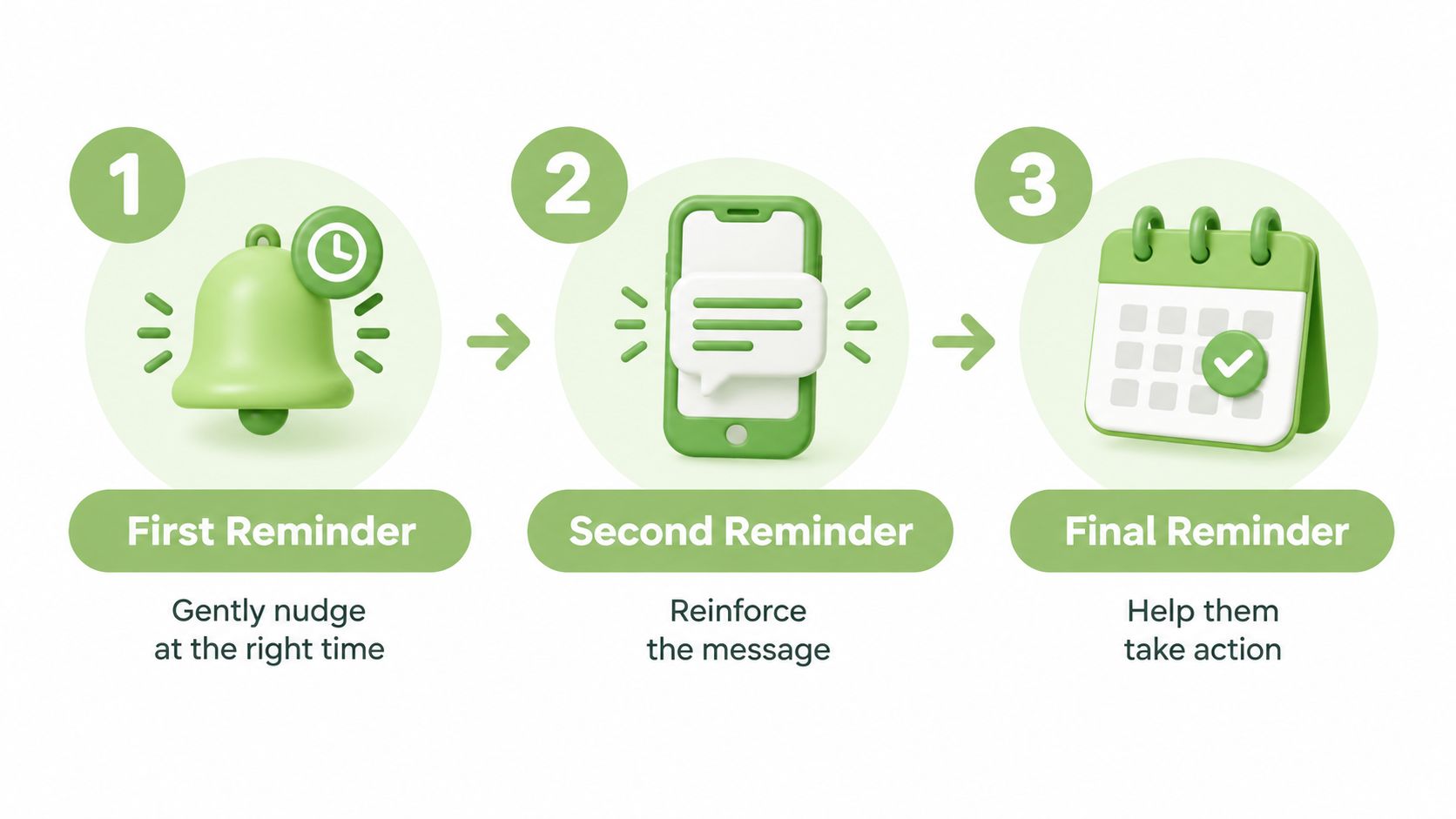
Send the first reminder three to seven days before the due date, following the operational guidance in Stripe's payment-reminder guidance. Include the invoice number, exact balance, due date, accepted payment method, payment instructions, and a contact route for questions.
Treat this as an administrative checkpoint. A client who forgot the invoice should be able to pay without embarrassment or extra correspondence. If the invoice includes a deposit, show the original total, the amount already paid, and the remaining balance. Clear arithmetic also helps expose an account or approval problem before the deadline.
Stage two addresses the missed deadline
If payment has not arrived, send an overdue notice on the first or second day after the due date. Ask for one specific action: confirm receipt, pay the balance, or reply with the reason the invoice is blocked. A reply that mentions an incorrect deliverable or missing approval points toward a dispute, while silence may justify a firmer follow-up.
A field experiment with Australian business taxpayers found that a reminder letter increased the probability of paying overdue tax debts by about 25 percentage points compared with no letter. Changing the reminder timing within a three-week window did not change eventual payment probability over seven weeks, although earlier letters accelerated payment (Gillitzer and Sinning, tax-payment reminder study). These tax-collection results do not establish the effect of reminders on service invoices.
Stage three moves to a conversation
After the follow-up interval set by the contract and normal business practice, stop sending interchangeable notices. Call the client or send a personal message that names the possible barrier: is the invoice disputed, incomplete, missing approval, temporarily unaffordable, or being held for another reason? The answer determines whether to correct the bill, agree a payment arrangement, or set a firmer escalation point.
Keep a record of every contact and response. If the customer has paid part of the invoice, every later notice must show only the remaining balance. Demanding the original total after recording a deposit damages trust and can create an avoidable dispute.
A practical unpaid-invoice follow-up workflow helps preserve the billing context as routine reminders give way to direct resolution.
Three-Stage Reminder Sequence at a Glance
| Stage | When to send | Core contents | Exit trigger |
|---|---|---|---|
| Pre-due reminder | Three to seven days before due date | Invoice number, remaining balance, due date, payment route, reply option | Payment received or deadline reached |
| Early overdue notice | First or second day after due date | Balance, days overdue, specific requested action, dispute contact | Payment, reply, or defined escalation point |
| Human escalation | After the agreed follow-up interval | Personal explanation, issue diagnosis, proposed next step, written record | Payment arrangement, dispute review, or formal collection decision |
Anatomy of a Reminder That Actually Gets Opened
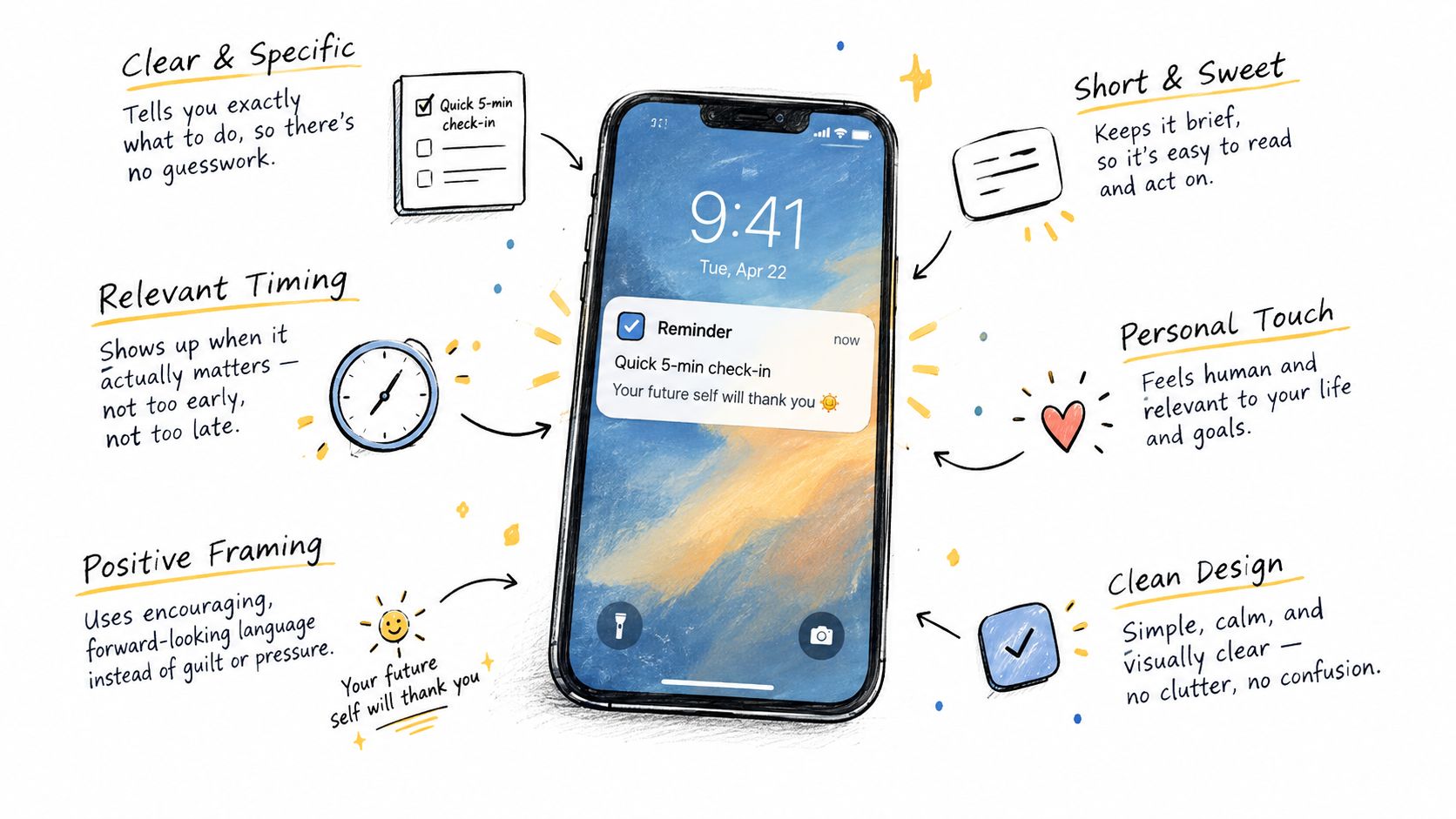
A payment reminder earns attention by removing uncertainty quickly. The reader should see who sent it, which work it concerns, what remains unpaid, and exactly what to do next without searching through a long project history.
The message needs the recipient's name, invoice identifier, remaining amount, due date or days overdue, accepted payment method, and one direct reply path. Add a recognizable service or milestone description, especially when the client has several projects with the same provider. The wording should also fit the likely barrier. A forgotten invoice needs a clear restatement, while a disputed invoice needs a route for review.
What belongs in the message
For a photographer, a useful reminder could read:
Hi Jordan,
Invoice PH-104 for the remaining $900 balance for the wedding photography package is due on [agreed due date]. Payment can be made through the payment link in the invoice. Please reply if the invoice needs to be corrected or if there's a question about the balance.
Thank you,
[Business name]
The amount is an example of the format, not a recommended invoice value. The client can identify the service, match the invoice, confirm the balance, and take one action. For a full breakdown of what belongs on the invoice, see what payment information to include when sending an invoice.
Compare that with:
Hi, just checking whether you had a chance to pay the invoice. Let me know.
This version conceals the invoice, amount, deadline, and requested action. Its open-ended question also makes postponing a reply easy. Give the recipient a clear choice: pay, report a problem, or explain what approval is still pending.
Personalization should be functional
Using a first name is only the starting point. Personalization means matching the reminder to the account state. A client who paid a deposit should receive the current balance. Someone with several open invoices should receive the relevant invoice number and service reference. A client who raised a dispute should receive a review route instead of another generic payment button.
A controlled field experiment involving unpaid hospital bills in Latvia found that messages containing the recipient's name improved payment rates, while generic reminders did not significantly outperform no message. Payment rates ranged from 0.6% to 1.7% across the experimental conditions (Saulitis, 2024 hospital-debt field experiment). These findings concern overdue hospital debts and should not be treated as a predicted collection rate for service invoices.
Do not add pressure to make the message sound stronger. Social-norm appeals were ineffective in one debt-collection setting, while personalization produced a meaningful difference in the cited experiment. One call to action is easier to follow than a payment link, scheduling link, survey, and several competing contact options.
A reusable pattern for a consultant, designer, cleaner, or tradesperson is:
Subject: Payment reminder for invoice [number], due [date]
Message:
Hi [client name]. Invoice [number] for [service or milestone] has a remaining balance of [amount]. Payment is due [date], or is now [number] days overdue. Payment can be made using [method or link]. Please reply to this email if the invoice is disputed, incomplete, or needs an administrative correction.
Check the balance, dates, and service description before sending. A polished template cannot correct inaccurate billing details.
Diagnosing Why the Invoice Is Unpaid
“Friendly reminder” is a tone, not a diagnosis. The same wording shouldn't be used for a forgotten invoice, a missing purchase order, a disputed line, and a client who can't pay in full.
A 2024 UK government study based on 300 business interviews found that 36% of businesses attributed late supplier payments to administrative errors, 31% to disputed invoices, and 23% to technical problems such as invoices being lost or failing to reach the recipient (UK government late-payments research). Small businesses were more likely than businesses overall to say customers took longer than agreed terms, with 49% compared with 36% in the study.
That evidence supports a repair-first approach. The business owner should identify the likely barrier from the available signals, then change the message.
Four barriers require four responses
Forgotten or misplaced invoice: Use a neutral restatement. Include the invoice number, service, balance, due date, and payment path. Don't imply bad faith when the customer may have missed the document.
Missing purchase order or approval: Ask which purchase order, approver, or accounts-payable contact is required. Send the invoice to the correct address and record the correction. A short question such as “Does your accounts-payable team need a purchase order reference before payment can be released?” is more useful than another demand.
Disputed line item: Acknowledge the concern without conceding the invoice. Ask the client to identify the disputed service, date, or amount, then propose a review. Keep undisputed work separate where the contract allows it, and document the outcome.
Cash constraint: Move to a human conversation. A short installment arrangement can be practical when it's written down, states each payment date and amount, and doesn't waive the original rights unless the business intends to do so.
A 2025 U.S. survey reported that 56% of small businesses surveyed were owed money from unpaid invoices. Businesses with unpaid invoices were owed about $17,500 each on average, and 47% of respondents reported that some invoices were more than 30 days overdue (QuickBooks small-business late-payments report). These figures do not establish why an individual client has not paid.
Read the response pattern
No opens suggest a delivery, address, or channel problem. Opens without payment call for a direct question. Partial payments require an updated balance and may indicate a cash constraint. A written dispute should move the account into review, not trigger a sequence of increasingly aggressive templates.
Late fees and service suspension should come from the client agreement and applicable state law. A reminder can state an agreed consequence, but it shouldn't invent a new fee or present a threat unsupported by the contract.
For reliable handling of dates, the invoice should distinguish the date it was issued from the date payment is due. A clear record of both supports the workflow described in guidance on invoice dates and due dates.
Choosing Channels and Using Automation Carefully
Email remains the best default for business invoices because it creates a searchable record. Use it for estimates, signed approvals, itemized invoices, payment links, and written dispute details. It also gives a forgotten client an easy way to find the original amount and due date.
SMS suits a short balance or deposit when the client has consented to business messages and can pay from a phone. Research on reminder experiments indicates that text reminders can affect payment behavior, but that does not justify texting every overdue client. Consent, local rules, time zones, language, accessibility, and communication preference still determine whether SMS helps or irritates.
Choose the channel according to the barrier:
- Email: Use for formal invoice delivery, pre-due reminders, supporting documents, and dispute records. It is usually the clearest route for a forgotten invoice.
- SMS: Use for concise prompts when consent exists and the payment path works well on a phone. Keep the message focused on the invoice and next action.
- Messaging app: Use only when the relationship and consent support it. Copy the outcome into the billing record, especially if the client raises a dispute or requests more time.
- Phone: Use when the account needs clarification. A call can identify a missing approval, disputed item, or temporary cash problem faster than another template.
A cash-strapped client needs a conversation about a realistic arrangement. A client disputing the work needs the disputed item addressed. Strategic delay calls for a clear deadline and the agreed escalation path. Automation cannot make those decisions reliably unless the workflow separates these barriers.
Automation should insert current invoice data rather than recycle stale text. Before enabling a sequence, verify the client name, invoice number, remaining balance, due date, payment method, and escalation trigger. The sequence must stop or change after a payment, dispute, or documented arrangement.
GetBill can convert an estimate into an invoice, record deposits and partial payments, and show the remaining balance. Those functions support reminders that reflect what the client owes. Availability of supported online card payments depends on the connected Stripe account and region.
Before automating, check:
- Agreement terms: Confirm the due date, late-charge language, and suspension rights.
- Consent: Record permission for SMS or other non-email channels.
- Client context: Respect time zones, language, accessibility, and communication preferences.
- Exit rules: Stop routine reminders after payment, a dispute, or a documented arrangement.
- Recordkeeping: Preserve the sent message, invoice version, payment history, and replies.
Measuring Whether Your Reminders Actually Work
Judge a reminder process by faster settlement and stronger final collection, not by reply speed alone. A client who forgot an invoice, disputes the work, lacks cash, or is delaying strategically will respond differently. Report results by payment barrier where your records allow it. Otherwise, a high reply rate can hide unresolved disputes and overdue balances.
Track four measures each month:
- Average days to payment, measured consistently from either the invoice issue date or due date.
- Invoices paid within terms, showing whether payment performance is improving.
- Invoices requiring escalation beyond stage two, identifying where routine reminders stop working.
- Partial-payment frequency, which can point to cash pressure, misunderstood deposits, or unclear milestone billing.
Time-to-payment deserves particular attention. As noted in the three-stage sequence above, earlier reminders can bring payment forward even when timing does not change the eventual chance of payment. A reminder that produces a quick acknowledgement but leaves the balance unpaid has not solved the collection problem.
Test one variable at a time, such as the subject line, send time, channel, or placement of the payment instruction. Compare similar invoice types and client groups, then record payments, partial payments, disputes, barrier category, and days to settlement.
Good records also support U.S. tax administration. For a U.S. independent contractor operating a trade or business, service payments generally belong on Schedule C. A payer may report service compensation on Form 1099-NEC even when the recipient does not use a separate business entity (IRS guidance for independent contractors and self-employed individuals). The IRS states that the reporting threshold is $600 for payments made through December 31, 2025, and $2,000 for payments made after December 31, 2025 (IRS Form 1099-NEC guidance). This reporting rule does not justify delaying revenue records or ignoring an unpaid invoice.
GetBill helps independent professionals create estimates and itemized invoices, convert approved estimates, record deposits and partial payments, and track remaining balances. Visit GetBill to assess whether its workflow fits the business's invoicing and follow-up process.