

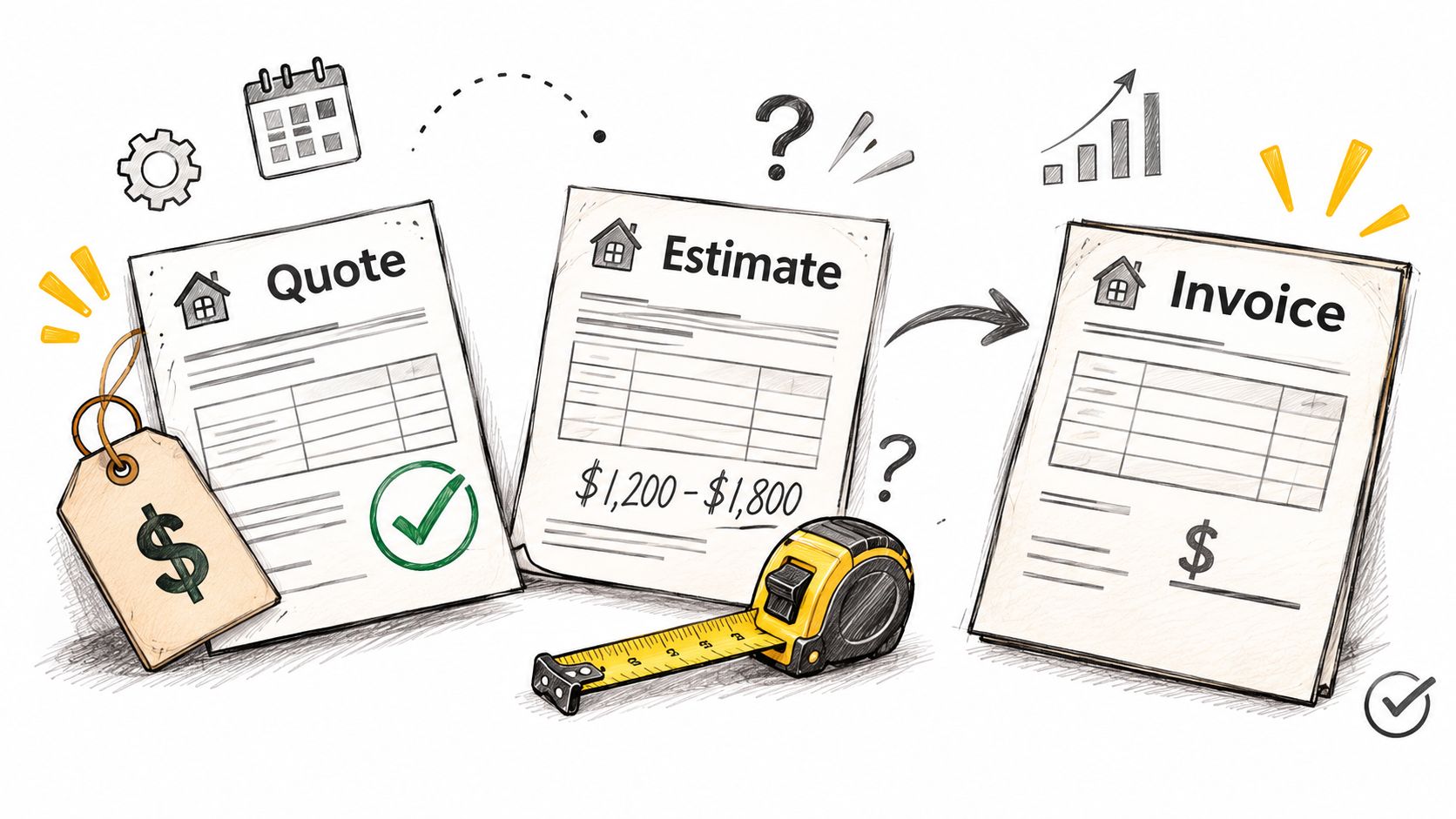
A quote is a defined offer to complete work for a specified price, while an estimate is a best judgment of what uncertain work will probably cost. The difference between quote and estimate is not formatting. It's the promise the client thinks they've received.
Most disputes start subtly. A cleaner sends a rough number after a phone call, a designer labels a range as a quote to look decisive, or a handyman starts work before anyone records what's excluded. Weeks later the invoice lands, the client compares it with the first number they saw, and both sides insist they agreed to something different. The document label, the assumptions under it, and the record that follows acceptance decide whether that final invoice looks fair or feels like a surprise.
Table of Contents
- Quote and Estimate Side by Side
- What Makes a Quote Binding Once Accepted
- Estimate Uncertainty and What It Promises
- Choosing the Document and Checking Your Label
- Converting an Estimate into a Quote
- Converting an Accepted Quote into an Invoice
- Handling Changes and Deposits After Acceptance
- Legal Limits to Check Before You Label a Document
Quote and Estimate Side by Side
A quote offers to complete clearly defined work for a specified price. An estimate gives a best judgment of probable cost when the work isn't yet fully defined. That distinction drives everything after the client says yes.
New Zealand's government guidance in Consumer Protection guidance on quotes and estimates states that once a customer accepts a quote, the provider generally can't charge more than that amount unless the customer agrees to extra work or the project scope changes. The same guidance says an estimate isn't a fixed price, the final amount may be higher or lower, and the final price should generally remain within 10-15% of an estimate.
Quote versus estimate on the criteria that matter
| Criterion | Quote | Estimate |
|---|---|---|
| Purpose | Offers to complete defined work for a specified price | Gives a best judgment of what the work will probably cost |
| Price status | Fixed amount once accepted; changes need the customer's agreement | Not a fixed price; final amount may be higher or lower |
| Commitment | Can become a binding contract once offered and accepted | Planning baseline, not a guaranteed total |
| Best used when | Scope, quantities, rates and assumptions are documented | Discovery, labor hours, materials or site conditions are still uncertain |
| Link to the final invoice | Invoice should match the accepted quote except for documented variations | Invoice may differ, so record the assumptions behind the estimate |
That table matters during negotiation too. A client who wants to discuss price before committing is usually reacting to scope, exclusions, and what drives the total, which is why practical guidance on how to negotiate painting costs is useful context for any trade that prices site work. It shows why a lower number without a defined scope rarely stays lower.
The label sets the customer's expectation of the final number, so it must be chosen before work starts, not corrected after the invoice is questioned.
Legal effect isn't universal. It depends on jurisdiction, contract terms, and whether the customer authorized variations, so a US business shouldn't treat another country's guidance as its own rulebook. Use it for the operational principle, then verify local requirements.
Before sending anything, the owner should decide which column the current job fits. If the scope can't yet support a promise, calling the document a quote doesn't make the business look firmer. It makes the eventual invoice harder to defend.
What Makes a Quote Binding Once Accepted
Acceptance turns an offer into the reference point for the job. The accepted wording, price, and conditions become the benchmark for scheduling, purchasing, changes, and the final invoice. A vague quote creates a vague agreement, even if both parties acted in good faith.
Say a handyman quotes $1,800 to replace a 12-foot section of fence with cedar boards, and the client accepts by email. During removal, the crew finds rot in two posts that weren't visible at inspection. Replacing those posts is extra work outside the quoted boards and section, so it needs a written variation before the crew proceeds, not a quiet addition to the invoice.
What an accepted quote needs to contain
- Scope in plain terms: State the exact work, location, materials, and deliverables so completion can be recognized.
- Quantities and unit rates: Show measurable amounts where they affect price, such as feet, hours, rooms, or images.
- Exclusions: Name likely adjacent work that isn't included, including hidden damage or client-supplied items.
- Assumptions: Record access, existing conditions, utilities, and responsibilities the price relies on.
- Validity period: Give the date after which material prices, availability, or scheduling may require a revised offer.
- Payment terms: State deposits, milestones, due dates, and accepted payment methods before work begins.
- Change approval process: Explain who can approve extra work, how approval is recorded, and when the revised price is confirmed.
Recurring service providers face the same drafting problem over a longer term. Anyone setting up repeat visits can borrow the discipline used to structure your HVAC maintenance agreements, where included tasks, visit frequency, and excluded repairs have to be separated clearly.
The final test is simple. Could a stranger read the accepted quote and tell what's included, what's not, and what event would trigger a new price? If not, it isn't ready to send.
Estimate Uncertainty and What It Promises
An estimate is conditional by design. It's built from assumptions, unknown quantities, and the information available at the time, so presenting it as a single guaranteed total misstates what the business knows.
Professional cost planning makes uncertainty visible. The Washington State construction cost assessment describes design contingency of 10–15% at concept level, with some estimates reaching 30% when design information is limited. It also explains that this allowance reduces as the design is completed. These are construction-planning examples, not standard margins or permitted overruns for small service jobs.
Those figures belong to construction and infrastructure projects. They don't set a standard for cleaning, photography, design, or consulting, and they shouldn't be copied onto a service estimate as a permissible overrun. Their value is narrower. They show that mature estimating practice prices uncertainty openly instead of hiding it inside a precise-looking number.
Home projects follow the same logic at a smaller scale, and kitchen budgeting advice from Aureli Construction reflects how early figures shift as finishes, layout, and site conditions become specific. The estimate improves when unknowns are replaced with decisions.
A service example that states its limits
A cleaner estimates a post-renovation clean at three to four hours, assuming moderate dust, empty rooms, standard access, and working water and power. The document states that paint overspray, adhesive removal, or blocked access triggers a re-estimate before extra time is charged.
Every estimate should show three things:
- The range: Give the expected low and high figures, or the unit rate and expected quantity.
- The assumptions: List the conditions the range depends on.
- The change trigger: Name what finding or client request requires a new figure before work continues.
That structure doesn't weaken the estimate. It gives the client a planning number they can use without mistaking it for a ceiling the business never promised.
Choosing the Document and Checking Your Label
The decision rule is scope certainty. When scope, quantities, and rates are settled, send a quote. When hours, materials, or site conditions are unknown, send an estimate that states the planning figure and the assumptions underneath it.
Which document fits each situation
| Situation | Document | Reason |
|---|---|---|
| Scope, quantities and rates are settled | Quote | The customer can rely on a defined price |
| Hours or site conditions are unknown | Estimate | Assumptions must be stated and the price is not fixed |
| Client wants a budget range before deciding | Estimate | The figure is clearly labeled as a planning number |
| Repeat job with the same standard checklist | Quote | A standard scope supports a fixed price |
| Discovery visit before any work begins | Estimate | Pricing depends on what the visit finds |
Two businesses can handle the same client request differently and both be right. A photographer quotes a fixed package for six hours of coverage and 300 edited images because the deliverables, time, and editing output are defined. A consultant facing unknown stakeholder interviews gives an hourly estimate with a not-to-exceed cap, because the rate is known but the number of hours isn't.
The cap deserves care. It limits billing without turning every assumption into a fixed deliverable, and work should stop for approval before the cap is crossed. Without that stop point, a cap becomes decoration.
Labeling a rough number as a quote to win approval is the expensive shortcut. Clients remember the label and the total, not the caveats buried below them. The distinction also matters when a persuasive document enters the process, so owners comparing document types should keep the difference between a proposal and a quote separate from the price decision itself.
Five checks before sending
- Price readiness: Are scope, quantities, and rates documented well enough to fix a price? If not, label it an estimate.
- Commitment test: Is the business willing to hold the price if the client accepts today?
- Client expectation: Does the label match what the client will reasonably expect the final number to be?
- Written safeguards: Are assumptions, exclusions, validity, and the change process in the document?
- Jurisdiction check: Have the rules for the business state and the client's state been checked?
Delivery should preserve that clarity. GetBill customers can create links that let recipients view invoices or estimates without signing in, which helps the client review the actual document rather than relying on a number copied into a message thread.
The deciding question is practical. What's the one unknown that would most change the price? If that unknown can move the total materially, the document is an estimate until the unknown is resolved.
Converting an Estimate into a Quote
Many jobs need both documents in sequence. An estimate covers discovery, then a quote replaces it once the business knows enough to commit.
- Record the findings: Document access, existing damage, measurements, quantities, and client decisions from the discovery visit.
- Resolve each assumption: Replace it with a confirmed figure, or move the unresolved risk into a clear exclusion.
- Remove planning language: Delete the range and set either a fixed price or a specific not-to-exceed cap with a stop-and-approve rule.
- Add commercial terms: Include validity, payment terms, and the process for approving changes.
- Relabel and retain: Issue the new document as a quote, keep the dated estimate on file, and make sure the client accepts the quote itself.
The fence job shows the handoff. A handyman first estimates a storm-damage inspection because the extent of failure is unknown. The visit finds rot in two posts and confirms a 12-foot damaged section. The resulting quote prices cedar board replacement at $1,800 and excludes hidden damage beyond the identified posts.
Conversion rule: An estimate becomes a quote only when its material assumptions have been confirmed, excluded, or priced. Changing the heading alone changes nothing except the client's expectation.
The trade-off is real. A quote gives the client certainty and can leave the business committed to a price that proves too low. Convert only when the documented scope is firm enough to absorb that risk.
Converting an Accepted Quote into an Invoice
Billing starts at acceptance, even if the first invoice is only a deposit request. The task is to bill the agreed scope without changing the agreed price.
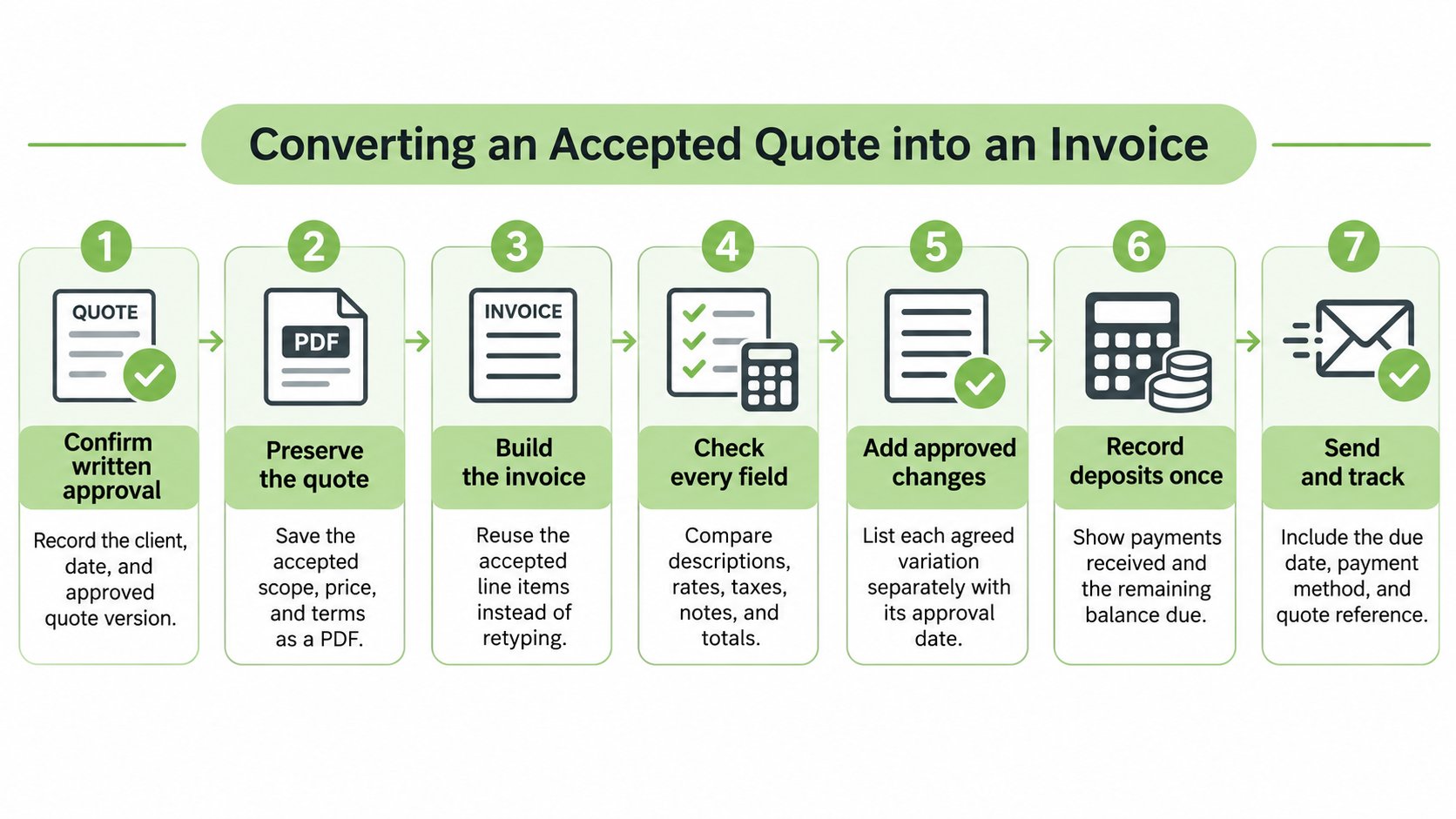
Seven steps from acceptance to invoice
- Confirm written acceptance: Record who accepted, the date, and the exact version approved. A verbal yes is where version disputes begin.
- Preserve the accepted version: Save it as a PDF so later edits don't overwrite the agreed scope, price, taxes, or terms.
- Build from the accepted document: Create the invoice from those line items instead of retyping them. Retyping is where quantities and prices drift.
- Compare every field: Check descriptions, rates, taxes, notes, and totals against the accepted version before sending.
- Separate approved variations: Add each change as its own line with the approval date. Don't bury extras inside the original service description.
- Apply payments received: Show the agreed work and approved changes, record the deposit once as a payment received, and display the remaining balance due. The accounting treatment should be confirmed with an accountant.
- Send with enforceable instructions: Include the due date and the payment method allowed by the contract, plus the quote reference the client can match.
The common failures are mundane. A technician updates a material price from memory, an administrator copies an older estimate, or extra work gets billed because it was discussed on site but never approved in writing. None of those errors requires bad intent to damage trust.
With GetBill, estimates can include custom items, taxes and notes and can be shared by email or public links. Keep the client’s written approval separately, for example by email or signed document, and convert the estimate into an invoice without re-entering its line items. These features support the quote to invoice workflow; check the agreed terms before billing.
The closing test fits on one line. Does the remaining amount due equal the agreed total plus approved variations, less credits and payments already received? Show the full agreed charges and each payment clearly so the client can distinguish the invoice total from the balance still owed.
Handling Changes and Deposits After Acceptance
A clear price doesn't eliminate payment risk. After acceptance, cash flow depends on whether changes are approved before they're performed and whether every payment stays tied to the project total.
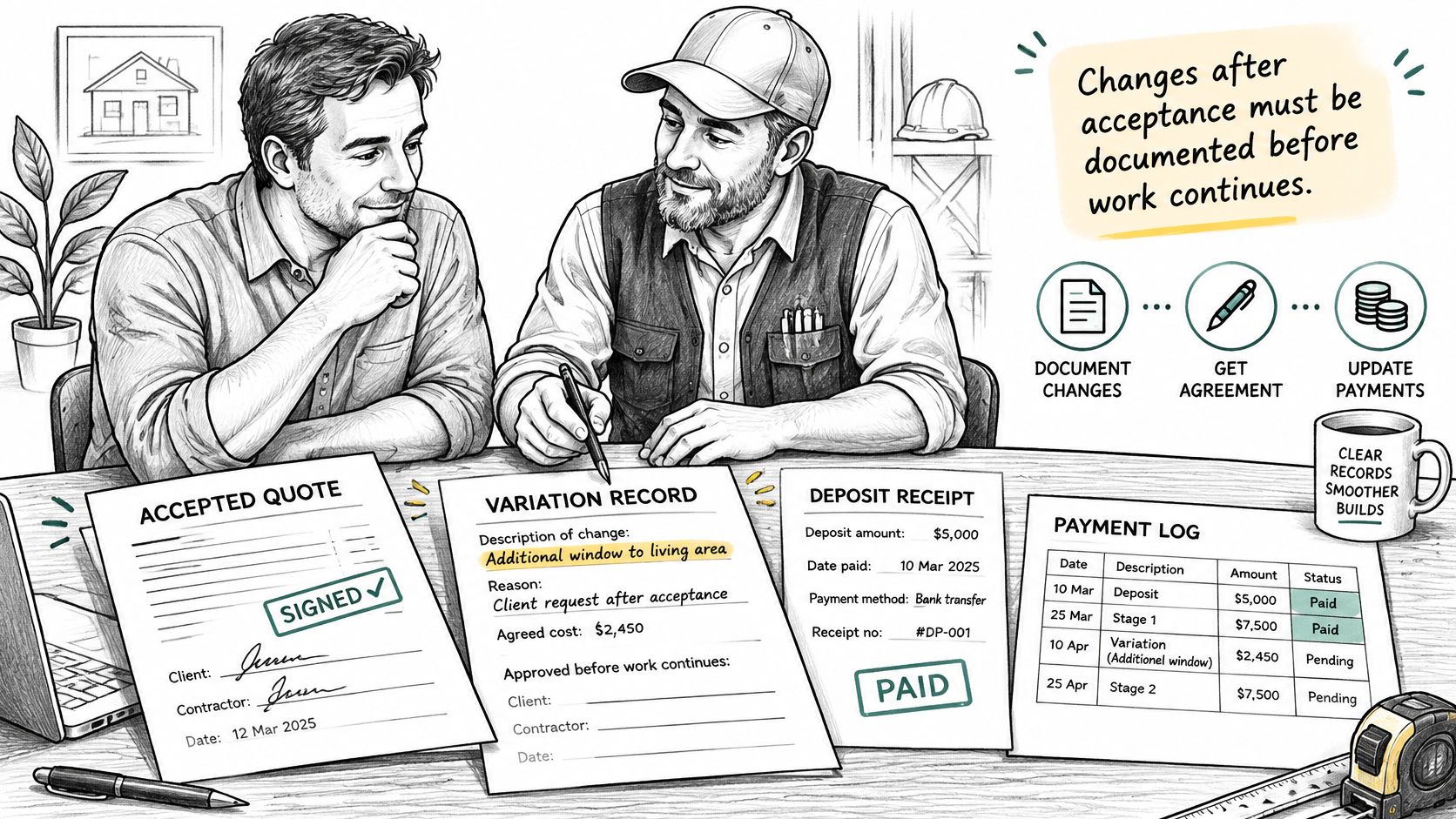
A usable variation record has four parts:
- The change: Describe the added or removed work in plain language.
- Price impact: State the amount added or deducted.
- Timing impact: State whether the schedule or delivery date moves.
- Approval evidence: Record the client's approval date and method, such as a signed form or email confirmation.
Say a kitchen design project is accepted at $6,000 with a 30 percent deposit and milestone invoices. The client later requests an additional revision round for $400. That round shouldn't begin until the client approves it in writing, even if the amount feels small compared with the project. Documenting those expectations alongside estimate terms and conditions keeps the variation process from being invented mid-project.
Reconciling the kitchen project
| Item | Amount (USD) |
|---|---|
| Accepted quote total | 6,000 |
| Deposit paid (30 percent) | 1,800 |
| Approved revision round | 400 |
| Revised project total | 6,400 |
| Balance outstanding after deposit | 4,600 |
A deposit is a payment against the project total, not a separate pool of money detached from the job. Each partial payment should appear against that total so the client and the business see the same remaining balance. Before collecting deposits, the owner should confirm the treatment against the contract, local rules, and advice from an accountant.
Payment mechanics should stay equally visible. Clients can pay invoices through Stripe-hosted checkout, and funds move directly to the business's connected Stripe account, but the project ledger still needs to show what each payment was applied to.
One running record prevents most reconciliation arguments. The business should always be able to state four figures without searching messages: accepted total, approved changes, payments received, and balance outstanding.
Legal Limits to Check Before You Label a Document
A common mistake is treating the FTC Rule on Unfair or Deceptive Fees as a general pricing law for service invoices. It isn't. According to the Federal Trade Commission's guidance on the Unfair or Deceptive Fees Rule, the rule became effective May 12, 2025, and covers businesses that offer, display, or advertise live-event tickets and short-term lodging.
For those covered industries, advertised prices must clearly and prominently disclose the total price including mandatory fees, and businesses may not misrepresent a fee's nature, purpose, amount, or refundability. That doesn't impose the same specific total-price advertising obligations on ordinary handyman, photography, cleaning, or consulting estimates.
The narrower scope doesn't excuse vague pricing. A service business should still state scope, price, mandatory charges, taxes where applicable, payment terms, and refund or cancellation conditions clearly in its own documents. The effective date and industry coverage of any rule must be confirmed before the rule is applied.
State questions to verify
- Binding effect: When does an accepted quote become binding under applicable state law and the contract terms?
- Deposits: Are deposits permitted for this work, and how must they be held, applied, or refunded?
- Charges and tax: What rules govern cancellation charges, late-payment fees, and sales-tax treatment in the business location and the client's location?
GetBill does not provide legal, tax, accounting, financial, or professional advice, and it does not warrant that documents or records generated through the service will meet legal, tax, accounting, or regulatory obligations. A qualified attorney or accountant should confirm local requirements before the business relies on a label, deposit term, or fee.
For the next job that is still uncertain, send an estimate with its assumptions stated. Retain the client’s written approval and convert the agreed document into an invoice without re-entering its line items. GetBill supports this estimate-to-invoice workflow for small service businesses, with deposits and partial payments recorded against the remaining balance.