


A quote prices work the client already understands, while a proposal designs the solution the client hasn't yet defined.
A client has asked for a price, but the job description still leaves important questions unanswered. Sending a total immediately may win approval while leaving the business responsible for work it never intended to include. Writing a lengthy proposal for a routine job creates the opposite problem: unnecessary preparation and a slower decision.
The useful proposal vs quote distinction is what happens after acceptance. The document should establish what the business will deliver, what the client will pay, and how that agreement will carry through to the invoice.
Table of Contents
- Proposal vs Quote at a Glance
- What Each Document Must Contain
- Legal Effect Depends on Wording and Jurisdiction
- How Payment Timing and Tax Treatment Differ
- How to Turn an Accepted Quote Into an Invoice in GetBill
- Choosing a Document for Each Job
Proposal vs Quote at a Glance
Proposal and quote compared on key traits
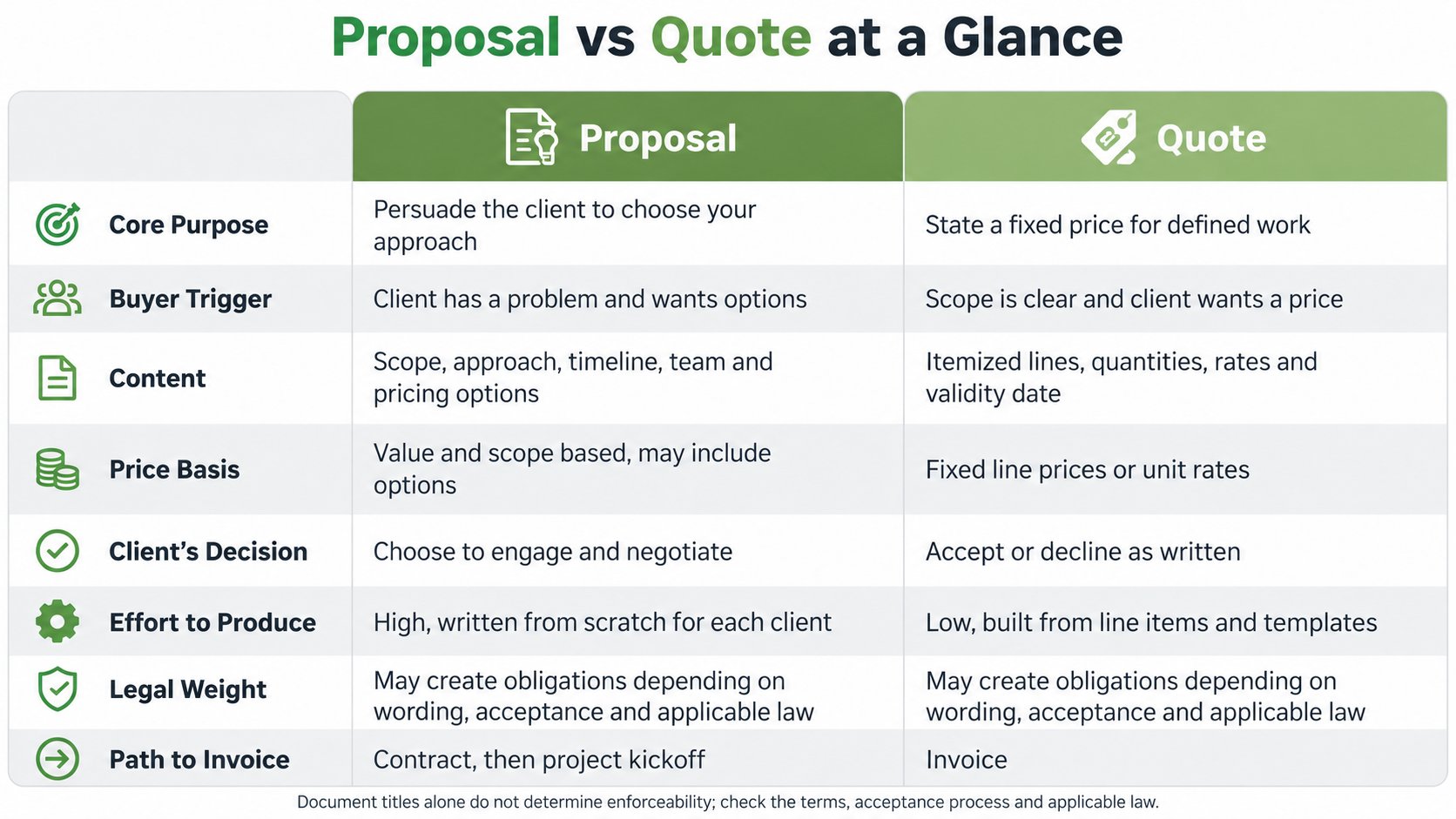
| Trait | Proposal | Quote |
|---|---|---|
| Core purpose | Persuade the client and define a solution | Price a defined requirement so it can be compared |
| Typical trigger | Client knows the problem but not the solution | Client knows the exact work and needs a price |
| Main content | Scope, approach, timeline, qualifications, price | Itemized price, quantities, specifications, validity, payment terms |
| Price basis | Fixed fees, hourly or unit rates, milestones, expenses | Line-item or unit prices on stated scope |
| Client's decision | Weighs approach and capability as well as price | Compares price on equivalent scope |
| Effort to produce | Longer, often with a discovery step | Shorter, built from a reusable service record |
| Legal weight | Can be an offer capable of acceptance, depending on wording | Can be informational and invite the buyer to make the offer, depending on wording |
| Path to invoice | After scope, terms, and any required deposit are confirmed in writing | After written acceptance, using the same line items |
A business proposal is a seller's written offer to a prospective buyer. Its emphasis is the solution: scope, approach, qualifications, implementation method, timeline, and value. A quote primarily gives the buyer a price for defined goods or services.
The distinction appears in the Institute for Advanced Study's purchasing policy, which identifies an RFQ as appropriate when specifications are standard or readily comparable. That's a useful business principle, not a procurement rule that ordinary service businesses must adopt.
The decision matters more than the layout
Both documents can contain service descriptions, assumptions, validity dates, and payment terms. A polished quote may look much like a short proposal, particularly when both use the same branding and pricing schedule. They still ask the client to make different decisions.
For a photography package, the client might choose between equivalent coverage options. For a brand redesign, the client must first decide whether the proposed research, creative direction, and approval process solve the underlying problem.
The following chart provides a visual comparison. Its legal-weight labels are shorthand, not universal rules; neither the document title nor a signature alone settles enforceability.
A quick test before preparing either document
The owner should ask whether the client could describe the exact work well enough for competing providers to price substantially equivalent services. If so, a quote is usually sufficient.
If the client needs the provider to determine the deliverables, sequence, or implementation method, a proposal is more appropriate. Sending a price before resolving those questions doesn't eliminate uncertainty. It merely leaves the uncertainty inside the price.
What Each Document Must Contain
A useful document follows the client's reading order: what's being purchased, what's included, when it will happen, what it costs, and what approval means. Pricing shouldn't require the client to reconstruct the agreement from emails and attachments.
Build the quote around comparable work
For a quote, start with the client and job details, then list descriptions, quantities, unit prices, specifications, and the total. Follow with completion timing, the validity period, payment terms, relevant qualifications, assumptions, exclusions, tax treatment, deposit requirements, and the change-order rule. An explicit expiration date is clearer than a vague statement that prices may change.
Say a contractor prepares a hypothetical quote for 12 shrubs, mulch measured in cubic yards, a completion window, and a 14-day validity period. The planting specification should identify what's included in site preparation and whether disposal, watering, or replacement plants are excluded.
For a proposal, lead with the client's problem and objectives, then explain scope, deliverables, methodology, timeline, roles, assumptions, risks, relevant experience, and acceptance criteria. The Legal Services Corporation's procurement guidance supports distinguishing solution evaluation from straightforward price comparison. A garden-redesign proposal, for example, should explain the design and approval phase before presenting the planting schedule.
Keep the pricing schedule separate and usable
A proposal's pricing model should distinguish fixed fees, hourly or unit rates, reimbursable expenses, milestones, deposit triggers, and out-of-scope work. The MyOfficeOps guide to pricing professional services is a useful companion when deciding how to structure those charges.
The same line-item discipline belongs in both documents. If planting labor and materials appear separately in the accepted schedule, the later invoice shouldn't replace them with an unexplained project total. Clear descriptions make deposits, approved additions, and final billing easier to reconcile.
For document preparation, the guide to writing an estimate provides a practical starting point. GetBill estimates can be sent instantly and can include custom items, taxes, and notes; the owner still has to supply accurate scope and commercial terms.
A proposal without a separate price schedule asks the client to approve a story, not a number.
Legal Effect Depends on Wording and Jurisdiction
A quote approved online can create a record of what the client accepted, but its legal effect depends on the wording, acceptance process, jurisdiction, and commercial context. A proposal can also be an offer capable of acceptance. As the fynk explanation of contract proposals illustrates, procurement distinctions do not automatically determine how a private service agreement works.
Review the commitment, not just the title
A document labeled quote may set out a firm scope, expiry date, deposit requirement, cancellation terms, and acceptance language. Review those terms together. The heading alone does not tell you whether approval commits either party.
Set the terms out plainly:
- Acceptance effect: Say whether approval creates an agreement or whether a separate contract is required.
- Validity: Give the offer an expiration date and explain what happens if approval arrives afterward.
- Scope boundaries: Identify assumptions, exclusions, and how changes are approved.
- Start authorization: Require written approval before work begins, and distinguish that approval from any deposit requirement.
For electronic approval, a third-party overview of electronic signature laws with Closer Innovation Labs can help frame questions for counsel. The applicable jurisdiction and the actual acceptance process still need review.
Don't apply an industry-specific fee rule to every invoice
The FTC's Rule on Unfair or Deceptive Fees FAQ says the federal rule covers live-event tickets and short-term lodging. It is not a blanket pricing requirement for a $1,500 handyman bathroom-repair proposal. Covered businesses face upfront total-price disclosure requirements, but the rule does not prohibit a particular fee amount or pricing strategy.
Other service businesses still need to handle labor, materials, travel charges, taxes, exclusions, and conditions under applicable state consumer-protection and contract laws. Identify the state whose requirements apply when reviewing a template.
Practical safeguard: Digital approval records what the client accepted. It does not establish that every term is lawful or enforceable.
GetBill does not warrant that invoices, estimates, reports, calculations, templates, payment links, tax settings, or business records generated through the Service will meet legal, tax, accounting, or regulatory obligations. Have a local attorney review standard estimate terms before reuse, and check the wording against each job's scope.
How Payment Timing and Tax Treatment Differ
A client may approve a $1,200 cleaning quote in December, pay a $300 deposit that month, and receive the service in January. The approval, payment, completed work, and tax reporting may fall at different times. The quote sets out the expected work and price; the invoice requests payment under the agreed terms.
Separate the tax method from the billing schedule
For US federal income-tax purposes, the IRS's Publication 583 explains that cash-method taxpayers generally report income when received, while accrual-method taxpayers generally report it when earned. Under the cash method, the cleaner's deposit is generally income when received. Under the accrual method, treatment follows when the income is earned and any applicable advance-payment rules.
Client approval alone does not automatically make the quoted amount taxable revenue. The business's accounting method and applicable rules determine the treatment.
The signed contract's payment terms govern invoicing instructions, partial deliveries, and progress payments. For example, a hypothetical $10,000 contractor job could call for a $2,000 mobilization deposit, a $3,000 rough-in payment, and a $5,000 final payment.
Example milestone schedule for a $10,000 contractor job
| Milestone | Amount | Trigger | Balance shown on invoice |
|---|---|---|---|
| Mobilization deposit | $2,000 | Written acceptance and start date | $8,000 after payment |
| Progress payment | $3,000 | Rough-in completed and approved | $5,000 after payment |
| Final payment | $5,000 | Work completed and approved | $0 after payment |
| Total | $10,000 | Matches the accepted total | Equals the accepted quote |
These balances assume each listed payment has been received, not merely requested. Later invoices should identify the milestone, credit prior payments, and distinguish the amount due now from the remaining contract balance. If work remains unfinished, a progress payment may raise repayment questions, so the contract and applicable rules matter.
Plan collections and taxes separately
A photographer who accepts a $6,000 event proposal and collects a $2,000 deposit should update projected taxable income rather than wait for the final invoice. The IRS's estimated-tax guidance explains the federal individual-income-tax obligation generally associated with expecting to owe $1,000 or more when filing.
Collection planning is a separate issue. Accountant She Ltd.’s guide to get paid faster in your business addresses payment collection, while this invoice template with VAT guide covers document presentation, not whether VAT applies to a US service.
A bookkeeper or tax adviser can align deposits, invoices, and bookkeeping entries with the chosen accounting method. Federal income-tax rules do not settle state sales-tax or state estimated-tax questions.
How to Turn an Accepted Quote Into an Invoice in GetBill
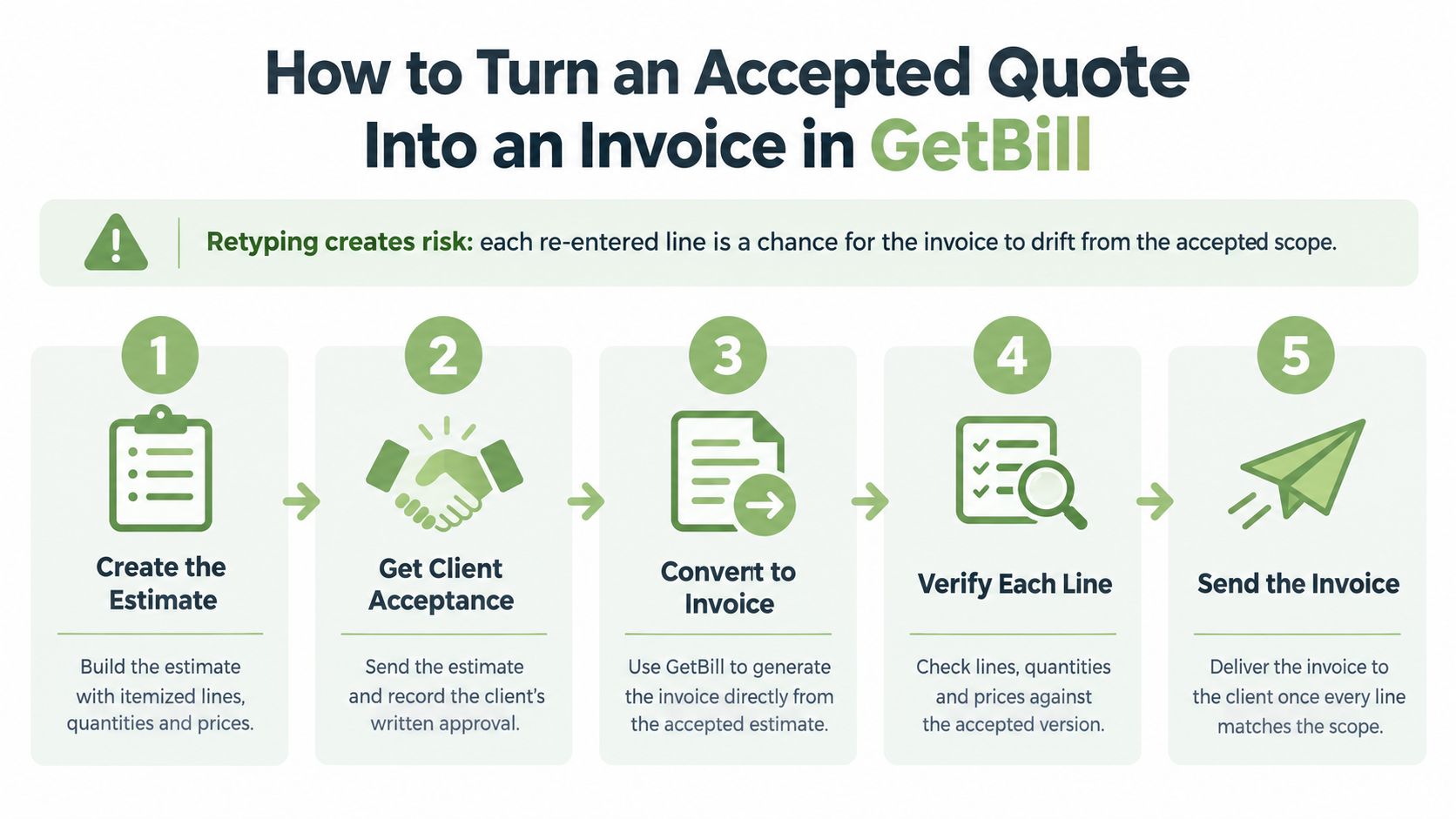
Retyping creates risk: each re-entered line is another opportunity to change the description, quantity, price, or tax treatment. Direct conversion removes the copying step, but the owner still needs to check that the invoice matches the approved work.
Preserve the agreement through conversion
- Create the estimate. The application uses estimate for this document. Build the itemized scope with quantities and prices, then add applicable taxes and notes. The wording should make clear whether the price is fixed, approximate, or subject to a stated change process.
- Send the document only to the intended client. Estimates can be shared by email or a public link, and recipients can view a valid public link without signing in. Anyone who obtains that link may be able to view the document, so it shouldn't be treated as a private client portal.
- Keep the approval record. Obtain and retain the client's written approval by email or another agreed channel. Keep the approved estimate and any separately agreed scope or payment terms as the billing reference.
- Convert the accepted estimate into an invoice with one click, without re-entering data. Then compare the converted descriptions, quantities, prices, taxes, and notes against the accepted version. A discrepancy should be corrected openly, not hidden inside the invoice.
The visual workflow highlights the conversion and checking stages.
Reconcile payments before sending the balance
- Record the deposit as a partial payment. The invoice should distinguish the agreed total, payments already received, and the remaining balance. A deposit must not appear both as a credit and as a reduction in the original service price.
- For supported online payments, clients pay through Stripe-hosted checkout, and funds move directly to the business's connected Stripe account. Availability depends on Stripe and the business's account and region. That payment mechanism doesn't decide when a deposit is contractually due or how it should be reported for tax purposes.
- Approve additions before delivering them. If the client requests extra work, issue a revised estimate for written approval before starting. Preserve the original acceptance record, identify the addition, and invoice the approved extra work separately when that produces the clearest billing trail.
A useful final check is to compare the invoice against both the approved estimate and the payment record. Matching only the total can miss a changed deliverable or an uncredited deposit.
GetBill supports document creation, estimate-to-invoice conversion, and payment recording. Obtain and retain the client's written approval; the software does not determine whether the agreed terms are enforceable.
Choosing a Document for Each Job
Choose the document by the decision the client must make, not by the size of the fee or the owner's preferred template. A costly but fully specified job may need only a quote. A modest engagement can still require a proposal when the provider must design the work.
Start with scope, then evaluate the buying process
The first question is whether the work is sufficiently defined to price responsibly. A bathroom repair with an agreed task list, known materials, and clear access arrangements is different from a request to investigate an unresolved leak.
Next, determine whether the client needs to evaluate the provider's approach. A brand redesign involves choices about research, positioning, creative development, and implementation. A total price without that explanation gives the buyer little basis for selecting the right engagement.
Then consider whether competing providers will be compared mainly on price. Comparable quotes require comparable scope. If a cleaner includes supplies and periodic deep cleaning while another excludes them, the totals alone don't establish which offer is better value.
Finally, follow the buyer's required format. The GSA's explanation of RFIs, RFQs, and RFPs distinguishes obtaining price, delivery, and related information for a defined requirement from requesting a complete solution. A buyer-issued form may require details that a standard service template omits.
Match the document to the client situation
Document choice by client situation
| Client situation | Document to send | Main reason |
|---|---|---|
| Fixed-price bathroom repair with a clear list | Quote or itemized estimate | Scope is defined and the client compares price |
| Photography package with set hours | Quote with package terms | Deliverables are standard and packages are comparable |
| Brand redesign for a new client | Proposal | Approach, timeline, and deliverables need evaluation |
| Multi-phase consulting engagement | Proposal, then a quote for each phase | Overall plan needs approval; each phase is priced separately |
| Renovation with hidden-condition risk | Proposal with allowances and exclusions | The client must accept the pricing assumptions |
| Recurring cleaning visit | Quote with frequency and exclusions | Scope repeats and the client compares providers |
| Formal public bid request | Buyer's required format | Buyer rules determine the form and evaluation method |
Public purchasing provides a concrete example of format requirements: North Dakota's procurement competition thresholds place purchases of at least $10,000 but below $100,000 in a category allowing informal bids or quotes, an informal RFP, or internet quotes from at least three vendors, while purchases of $100,000 and above enter a formal-purchase category. Those are North Dakota procurement requirements, not thresholds for choosing documents in an ordinary private service business.
The practical lesson is to confirm the buyer's process before preparing the response. A well-written proposal won't help if the solicitation requires a specific pricing form and mandatory attachments.
Use a scoping proposal when the job is still vague
A vague project shouldn't receive an artificially precise fixed price. A short scoping proposal can define the investigation, site visit, discovery work, or planning deliverable needed before the main job can be priced.
For a renovation, that might mean proposing an assessment before committing to remediation work. For consulting, it could mean approving discovery and an implementation roadmap before quoting execution. The scoping engagement should identify its own deliverable and explain what remains unpriced.
This staged approach has a trade-off: the client must approve an additional step. In return, both parties avoid treating unresolved assumptions as settled obligations.
A pro forma invoice isn't a substitute for that planning work. If a client asks for one during purchasing, the explanation of what a pro forma invoice is can help distinguish preliminary commercial documentation from the agreed scope and the later invoice requesting payment.
Make the document useful after approval
For repeatable services, a concise quote can be more effective than a persuasive proposal. It gives the client a clear approval decision and gives the owner an itemized basis for collecting payment.
For uncertain projects, a proposal earns its preparation time by resolving decisions that would otherwise become unpaid discussions or disputed additions. Its value comes from defining the engagement, not from adding pages.
Before sending either document, the owner should confirm:
- Client need: Is the buyer approving a plan or comparing a defined price?
- Commitment: Does acceptance authorize the work, or is another agreement required?
- Commercial limits: Are expiry, deposits, exclusions, and change approval explicit?
- Billing continuity: Can the approved items be carried into the invoice without reinterpretation?
If the client could write the scope themselves, send a quote. If the client needs the provider to design it, send a proposal.
The concrete action is to review an upcoming job before sending its price. Resolve the unanswered scope and payment questions first, then choose the shortest document that records the decision accurately.
GetBill offers itemized estimates and conversion of estimates into invoices without re-entering data. If the current workflow requires retyping approved work, visit GetBill and review the estimate-to-invoice process, checking the client's written approval, agreed scope, and any recorded deposit before sending the invoice.