

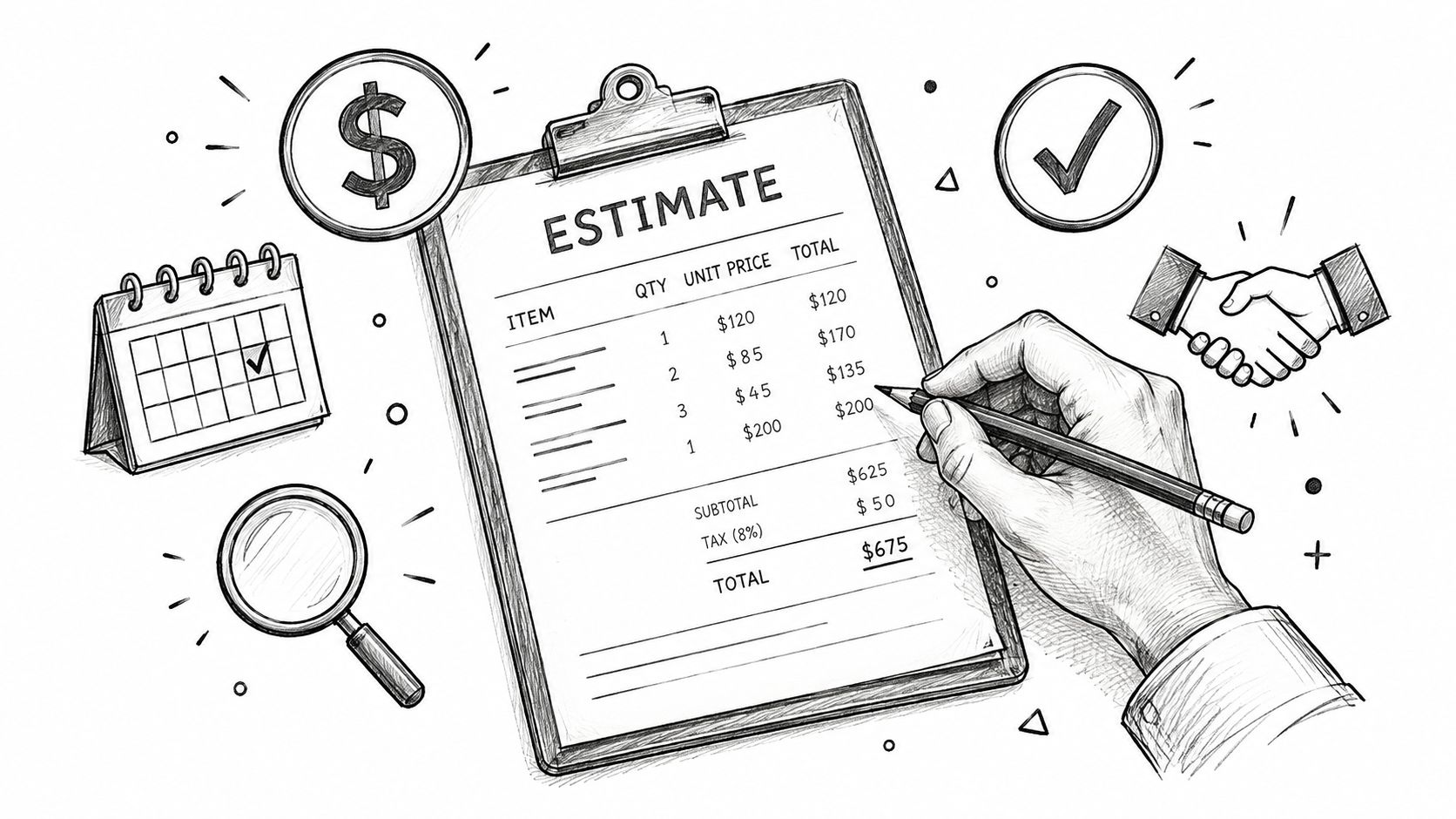
A photographer can spend an afternoon preparing an estimate, win the booking, complete the shoot, and still discover that the client's payment schedule leaves the business carrying every cost. A handyman can quote a repair without stating whether hidden damage is included. A consultant can agree to “help with the launch” and later argue over what help means.
That's why writing an estimate is more than adding prices to a page. It's a forecast of the work, a record of the assumptions, and a cash-flow plan for the job. A strong estimate makes the client's decision easier while showing exactly when money is due, what the price covers, and what happens when the work changes.
Table of Contents
- The Estimate Quietly Decides Who Carries the Risk
- Fields Every Estimate Should Carry
- Choosing the Right Pricing Format for the Job
- Structuring Payment Timing Inside the Estimate
- Defining Scope, Exclusions, and Change-Order Rules
- Turning an Accepted Estimate Into a Paid Invoice
- A Short Checklist You Can Apply to Your Next Estimate
The Estimate Quietly Decides Who Carries the Risk
A photographer sends a polished estimate for an event. It lists coverage, edited images, and a total price. The client accepts, but the document says nothing about a booking deposit, the date the balance is due, or what happens if the client adds another location. The photographer has won the job, yet the estimate has made the photographer the project's lender without clearly saying so.
The same pattern appears in other service businesses. A handyman buys materials before collecting money. A designer completes several rounds of revisions before billing. A consultant delivers a discovery phase and waits until the entire engagement ends to invoice. In each case, the price may be reasonable, but the timing of payment creates the financial risk.
An estimate should answer four practical questions:
- What is included: Which services, deliverables, quantities, and phases belong in the price?
- What is due now: Does the client owe a deposit before work or materials are committed?
- What becomes due later: Which payment follows a milestone, delivery, or completion?
- What changes the price: Which assumptions, exclusions, or client decisions trigger a revised estimate?
For each service job, record how labor, materials, deliverables, and payment timing were estimated. After completing the work, compare those assumptions with the actual job requirements before preparing the next estimate.
Practical rule: Scope, payment timing, and change rules belong on the estimate itself. Follow-up emails can clarify a decision, but they shouldn't carry the entire commercial agreement.
The document on the screen therefore decides more than whether the client likes the total. It determines whether the client funds the job as it progresses or whether the service provider finances labor, materials, and waiting time. The fields, pricing format, payment schedule, and scope language below turn that risk into something visible and manageable.
Fields Every Estimate Should Carry
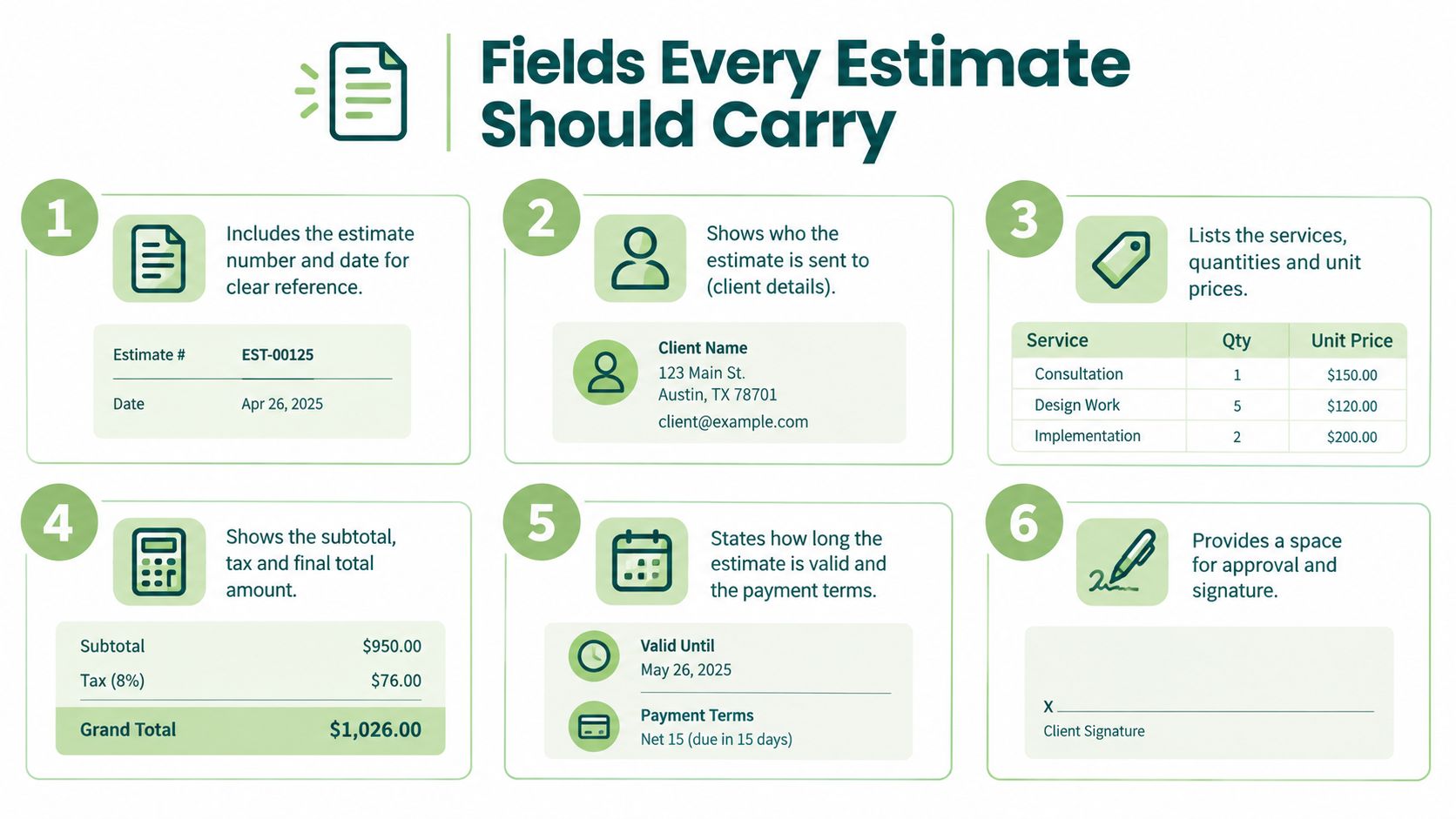
A useful estimate follows the order in which a client needs to understand the job. It starts with identity, moves through scope and price, and ends with payment and acceptance.
Start with the record
Business identity and contact details should show the provider's legal or trading name, address, email, phone number, and any relevant tax registration details. The shortcut that causes trouble is sending a document with only a personal name and a total, which makes later invoice matching harder.
Estimate number and date create a reference for approval, revision, and conversion into an invoice. If the client receives several versions, the number and issue date prevent an old total from being treated as the current one.
Client and project identification should name the customer, contact person, service location, project title, and requested completion date. “Kitchen repair” is weaker than a specific property address and a defined work description.
Show how the price was built
The center of the estimate should itemize services, labor, materials, quantities, units, rates, and phases. A photographer might list the session, editing, travel, and album separately. A contractor might separate demolition, materials, installation, and disposal. A consultant might divide discovery, analysis, recommendations, and presentation.
Subtotal, taxes, allowances, and total should be visually distinct. The client needs to see the estimated total, while the provider needs to distinguish confirmed prices from provisional amounts. A single unexplained total hides assumptions and makes later discussions personal.
Validity period states how long the quoted terms remain available. Material costs, availability, schedules, and client requirements can change, so an estimate shouldn't remain open forever.
When the scope is still uncertain, list the missing information and mark provisional quantities or allowances clearly. Update the estimate after an inspection or discovery step, and obtain written approval before work or costs move beyond the agreed scope.
Finish with commercial terms
Payment terms should state the deposit, milestone amounts, due dates or triggers, accepted payment methods, and balance timing. “Payment due upon completion” is incomplete if completion depends on client approval or if the client's accounts-payable process takes longer.
Assumptions and allowances identify items that depend on information not yet confirmed. Examples include an estimated quantity of materials, a provisional travel cost, or a client-supplied file that must arrive before work begins.
Exclusions prevent the client from assuming that every related task is included. The estimate can name permits, disposal, extra revisions, rush work, additional locations, or repair of concealed damage.
Acceptance lines should give the client a clear way to approve the work and authorize the provider to begin. A signature, typed acceptance, or written approval can be recorded according to the provider's contract process.
A reusable estimate and invoice template can help organize these fields, but the wording still needs to reflect the actual job. The shortcut to avoid is copying a generic template without changing its assumptions, exclusions, or payment triggers.
Choosing the Right Pricing Format for the Job
A fixed price is useful only when the provider understands enough about the work to stand behind the scope. It isn't automatically the most professional format. Choosing the wrong structure transfers uncertainty to the provider and invites a dispute when the actual work differs from the initial description.
| Format | Best when | Main trade-off |
|---|---|---|
| Fixed price | The deliverables, quantities, and conditions are clear | Easy for the client to approve, but the provider absorbs poorly defined risk |
| Price range | Discovery is incomplete or requirements may change | Honest about uncertainty, but the client may want a firmer commitment |
| Unit pricing | Work repeats by item, area, visit, or quantity | Transparent as quantities change, but the final total depends on measured units |
| Time and materials | The work is undefined, exploratory, or likely to evolve | Protects the provider from unknown scope, but requires trust, records, and a clear cap |
Match the format to the uncertainty
A wedding photographer with a defined package can use a fixed price. The estimate can name coverage, deliverables, editing, travel assumptions, and the number of included products. The trade-off is that extra locations or new deliverables need a written change.
A designer developing a new brand may begin with a range or a paid discovery phase. The client may not yet know the number of concepts, applications, or internal review stages. A range is more credible than a precise total built on guesses.
A handyman quoting deck repairs may use unit pricing for clearly measurable work, then state that concealed rot or structural repairs require approval. The client can understand the known work without treating an inspection-dependent allowance as a guarantee.
A consultant running discovery may use hourly or daily billing with a maximum authorized amount. That protects both parties when the questions are not yet clear, while giving the client a spending boundary.
A precise number built on uncertain inputs isn't certainty. It's an assumption wearing a cleaner shirt.
The format should also reflect cash flow. Fixed-price work often needs a deposit or milestone schedule. Time-and-materials work needs timely records and billing intervals. Unit pricing needs a clear measurement method. A range needs a decision point at which the provider will update the estimate before continuing.
Structuring Payment Timing Inside the Estimate
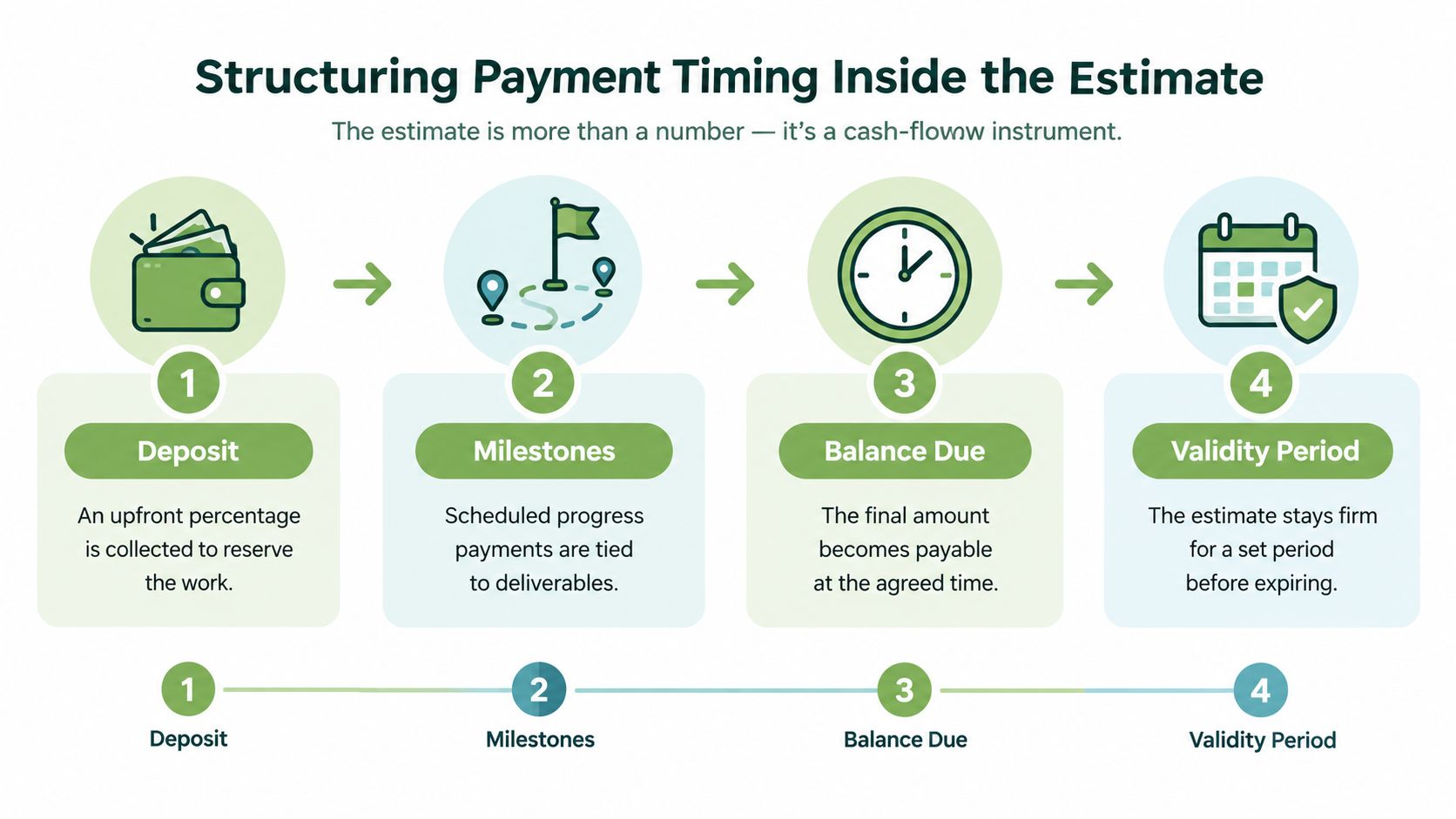
The estimate should show not only what the job costs, but also when the provider can use the money. A deposit reserves capacity and funds early costs. A milestone payment prevents a long project from becoming an interest-free loan. A final balance closes the work without leaving the provider exposed after delivery.
Build payment events around the work
A photographer might state a 40 percent booking deposit to reserve the date, with the remaining balance due before the edited gallery is released. A contractor starting a materials-heavy job might require a 50 percent deposit before ordering materials, then bill the balance at defined progress points. A designer could split payment across two milestones, one at approval of the direction and another at delivery of final files.
A small final balance due on completion can work when most of the project has already been funded. It becomes dangerous when the provider performs nearly all labor before collecting anything. The estimate should label “amount due now” separately from “estimated total”, so the client doesn't confuse the first payment with the complete project cost.
U.S. small-business survey data indicates that 59 percent of owners experience late payments at least occasionally, 28 percent have at least $5,000 tied up in unpaid invoices, and 29 percent have delayed paying themselves because customers paid late, according to Bluevine's small-business late-payment survey. Those figures make payment design a practical operating decision, not an uncomfortable add-on.
State timing and validity plainly
A payment trigger should be observable. “Due at design approval” is clearer than “due during the project.” “Due on completion of the listed installation” is clearer than “final payment after the job.” The estimate should also state how long the price remains valid, especially when materials, dates, or availability may change.
The provider should record deposits and partial payments against the invoice balance. A deposit isn't a second charge, and the remaining balance should show the total less payments already received.
A clear guide to invoice dates and due dates helps keep the estimate's payment language consistent with the later invoice.
Cash-flow principle: The client should fund the job in proportion to the cost and risk the provider carries, not only after every task is finished.
Defining Scope, Exclusions, and Change-Order Rules
Scope language protects the relationship when it is specific enough to guide decisions without pretending that unknown conditions are known. The estimate should separate included work, assumptions, exclusions, allowances, client responsibilities, and optional add-ons.
A designer might write, “Up to two revision rounds included.” A photographer might state, “Travel beyond 20 miles billed separately.” A contractor might use, “Additional site repairs require written approval before work begins.” These sentences are short, but each one creates an operational decision before the dispute exists.
The provider should also state how work outside the original scope is priced. That might be a fixed add-on, a unit price, or an hourly or daily rate. The estimate can require written approval before the extra work starts, identify the revised amount or cap, and explain whether the schedule changes.
HKA's 2025 CRUX analysis found scope change in 38.8 percent of covered projects, while a 2025 specialty-contractor survey found 60 percent of firms wrote down or wrote off change-order revenue at least occasionally, often because of missing documentation or pricing disputes, as summarized in the change-order analysis.
Use language the client can act on
A workable estimate might say:
- Included: Two design concepts, two revision rounds, and final files in the listed formats.
- Assumption: The client supplies approved copy and brand assets before the start date.
- Excluded: Paid stock assets, additional formats, and revisions beyond the included rounds.
- Change rule: Additional work requires written approval and is billed at the stated hourly rate.
- Allowance: Material selection remains provisional until the client approves the specified product.
False precision creates its own risk. A provisional quantity presented as an exact commitment encourages the client to treat it as guaranteed. A clear allowance is more honest than a polished number that cannot survive an inspection.
Vague scope also makes collection harder. When the provider sends an invoice, the client needs to connect the amount to approved work. If the estimate never recorded that work, a late-payment conversation quickly becomes an argument about memory rather than a review of agreed terms.
Turning an Accepted Estimate Into a Paid Invoice
Acceptance should create a clean hand-off, not a second round of data entry. Record the accepted version, preserve the client and project details, and use the same line items when issuing the invoice. Retyping a photographer's package, a handyman's materials, or a consultant's milestones creates avoidable errors.
The invoice should show the original total, the deposit or partial payment already received, the amount now due, and the remaining balance. For example, a contractor's materials deposit reduces the outstanding balance. It shouldn't appear again as a new charge. A designer's first milestone invoice should identify the approved phase rather than vaguely repeating the whole project total.
The provider can email the invoice or share a payment link, depending on the client's process. A tool such as GetBill can reuse client and service records, convert an accepted estimate into an invoice, record deposits and partial payments, generate branded PDFs, share documents by email or public link, and accept supported card payments through a connected Stripe account where available. Payment availability depends on Stripe, the account, and the user's region. The quote-to-invoice workflow is useful when the main problem is preserving estimate details during that hand-off.

Before sending the first invoice, confirm:
- Accepted version: The invoice matches the approved estimate.
- Payment credit: Deposits and partial payments are recorded once.
- Current balance: The amount due now is distinct from the project total.
- Payment trigger: The due date or milestone is clear.
- Scope record: Any approved change is attached or referenced.
A Short Checklist You Can Apply to Your Next Estimate
Before sending the next estimate, check scope, pricing format, amount due now, milestones, validity period, exclusions, and change-order approval. Keep invoices, payments, and payee information organized for recordkeeping. U.S. independent contractors may need estimated tax payments due April 15, June 15, September 15, and January 15 of the following year, with the next business day applying when a deadline falls on a weekend or legal holiday, according to IRS guidance for gig workers. The IRS recordkeeping guidance in Publication 583 also addresses information-reporting records.
The FTC fee rule concerns live-event tickets and short-term lodging, not ordinary handyman, cleaning, photography, or design estimates. Build clear pricing for the actual service and jurisdiction instead of applying that rule by default.
GetBill helps freelancers and small service businesses create itemized estimates, reuse client and service records, convert estimates into invoices, record deposits and partial payments, and share branded documents by email or link. Visit GetBill to review whether its estimate-to-invoice workflow fits the way the business collects payments.