

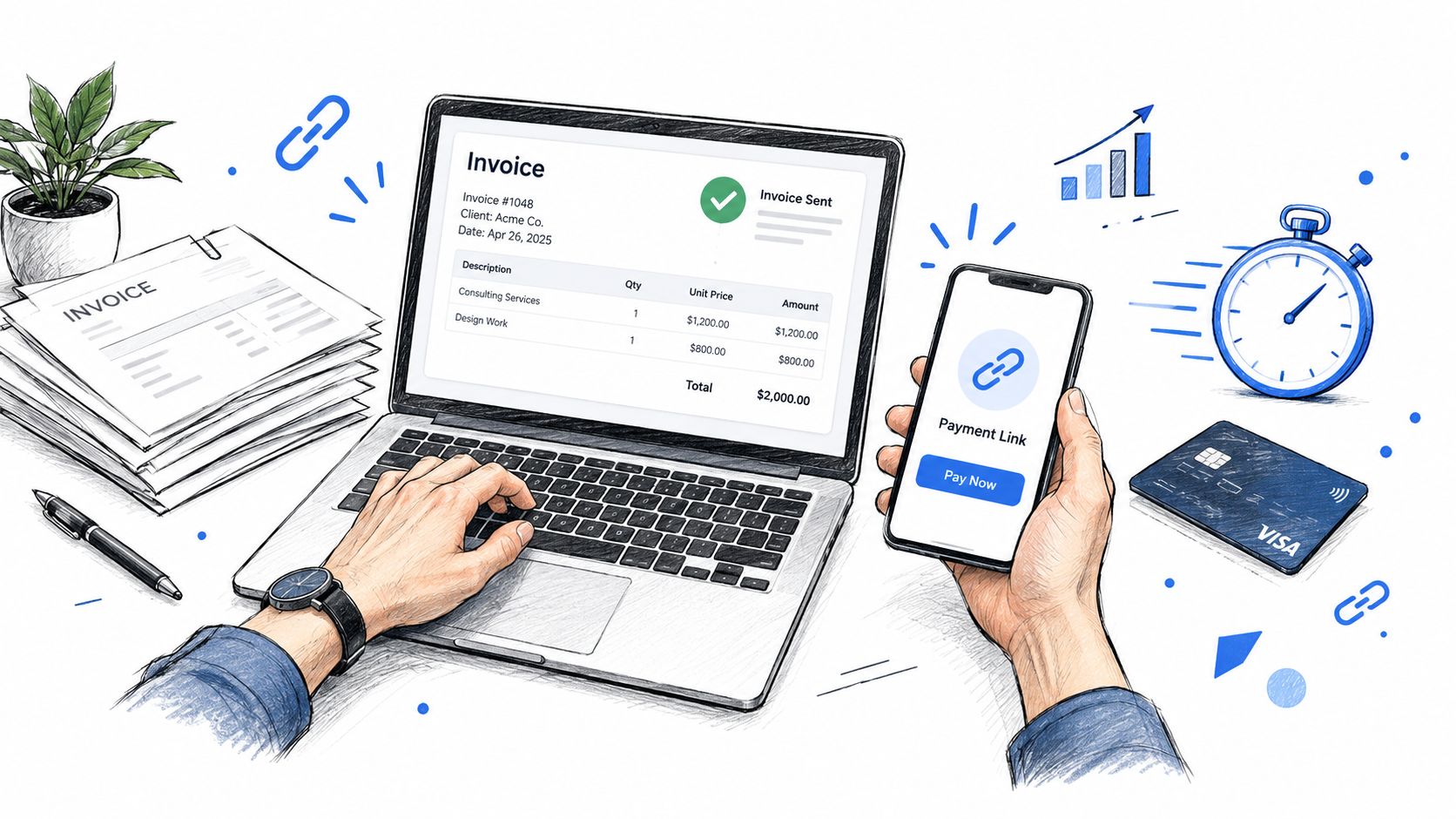
A supplier invoice lands in the inbox, the vendor expects prompt payment, and the business checking balance says otherwise. That's the tension for a small service business: paying a bill quickly can protect a relationship, but paying too quickly can starve the next payroll run, supplier order, or subcontractor payment.
Table of Contents
- The Hidden Challenge of Paying an Invoice
- Comparing Payment Methods for Service Invoices
- Handling Partial Payments and Deposits
- When to Hold Back Payment Despite Pressure
- Verifying Invoice Legitimacy Before Paying
- Recording Payments and Managing Cash Flow
The Hidden Challenge of Paying an Invoice
A lot of payment advice stops at the button click. In practice, the harder call is deciding when to pay an invoice, how to pay it, and whether the business should hold cash a little longer without damaging trust.
A cleaner, designer, or contractor can feel pressure from both sides at once. The vendor wants money on time, but the business owner may still be waiting on a late client payment and deciding which bill moves first. That tension shows up in the UK government's late-payments research, where 49% of small businesses said customers took longer than agreed terms, compared with 36% across businesses overall, and 32% of microbusinesses said they paid their own suppliers late because business customers had paid them late UK government late-payments research.
Practical rule: a payment method is never just a convenience choice. It also affects how fast cash leaves the account, how easy reconciliation will be, and how much room stays in the business for the next obligation.
For that reason, pay an invoice is never a single decision. It is a timing choice, a liquidity choice, and a recordkeeping choice, especially for service businesses that invoice directly and live off a small number of customer payments. The exact due date and invoice date shape that choice, as explained in this guide on invoice dates and due dates.
Comparing Payment Methods for Service Invoices
The right way to pay a bill depends on what the business is protecting. Cards can buy speed and a dispute path in some cases, while bank transfers usually cost less but tie up fewer protections and can be harder to unwind. Digital payment links sit in the middle, mainly because they reduce friction for the client, not because they solve every cash-flow problem.
| Payment Method | Speed | Typical Cost | Best Use Case |
|---|---|---|---|
| Credit card | Fast, often near-instant once approved | Usually higher because of processing fees | Urgent payments, small balances, or when speed matters more than margin |
| ACH bank transfer | Usually slower than card, but predictable | Usually lower than card | Routine vendor payments and larger invoices where fee control matters |
| Digital payment link | Fast for the payer, depending on the provider and funding method | Depends on the payment rail and provider | Client-facing invoices where convenience and tracking matter |
A card payment can make sense when the alternative is a missed deadline, but the fee burden can shrink the margin on a small job. Bank transfer is the cleaner option when the business wants lower cost and better control, but it doesn't always solve the immediate cash tension. Payment links are useful when the client needs a simple path from invoice to checkout, especially for mobile-first billing or remote work.
The invoice format matters too. A well-structured PDF or branded digital invoice helps the payer understand what they owe, which date applies, and where the money is going, and a clear billing file is easier to create with an invoice creator PDF workflow. For some owners, GetBill is one practical option here because it supports itemized invoices, branded PDFs, sharing by email or public links, and supported online card payments through a connected Stripe account, but it remains just one tool among many.
Handling Partial Payments and Deposits
Not every invoice should be treated like a single all-or-nothing event. For project work, partial payment can be the difference between keeping a job moving and draining the business before the remaining client balance arrives.
Start with the structure, not the apology
A deposit should be written into the estimate before work begins. That keeps the conversation commercial instead of awkward, and it gives both sides a shared reference for what gets billed now and what gets billed later. Service businesses that use estimates and invoices together avoid a lot of confusion when the scope changes or the work stretches across several weeks.
Make the remaining balance obvious
Each partial payment needs a clear paper trail. The invoice should show the amount received, the amount still due, and the next expected payment date if that was agreed in writing. A short note in the file works, but a payment record tied to the original estimate is cleaner, especially when a client asks why a balance remains open.
Pay the undisputed amount first, document the remainder, and confirm the next date in writing.
Use language that keeps the relationship intact
A payment request doesn't have to sound confrontational. A direct line such as “the deposit covers scheduling and materials, and the remaining balance is due when the work is complete” sets a normal business boundary. That wording works better than vague follow-up messages after the due date has already passed.
For teams that want a tighter balance trail, tracking partial payments and invoice balances is easier when the invoice system itself records deposits and remaining amounts. GetBill fits that workflow because it supports deposits, partial payments, and remaining balances without pretending those are the same thing as a fully paid invoice.
When to Hold Back Payment Despite Pressure
The fastest way to pay an invoice is not always the best use of cash. When client money arrives late, the key decision is which outgoing bill keeps the business steady today and which one can wait without creating a bigger problem.
Protect cash before you protect appearances
Late payments often force small firms to shuffle bills, and that pressure is usually felt first in day-to-day cash flow. The point is not to ignore suppliers. It is to pay in the order that protects operations.
Rank invoices by business impact. Payroll, critical materials, rent, and subcontractor payments usually come before non-urgent bills. If cash is tight, ask for revised terms before the due date instead of paying late and hoping the account can absorb it.
Don't use expensive money to solve a short gap
A credit card can create breathing room, but it also moves the pressure into the next cycle. If the card balance will sit longer than the vendor invoice would have, the business may pay more just to delay the same obligation. That trade-off can make sense for an urgent deadline, but it is a weak default.
Recent QuickBooks research found that 59% of businesses had invoices overdue by at least 30 days, up from 47% the previous year, and 27% said a missed payment below $5,000 made it harder to cover payroll or bills, including 12% affected by a missed payment below $1,000 QuickBooks late payments report. That kind of pressure explains why preserving liquidity often matters more than clearing every bill immediately.
Verifying Invoice Legitimacy Before Paying
A rushed payment can be worse than a late one if the invoice turns out to be wrong or fraudulent. Small service businesses often receive bills by email, PDF, or shared link, which makes a quick verification routine worth the extra minute.
Use a lightweight pre-payment check
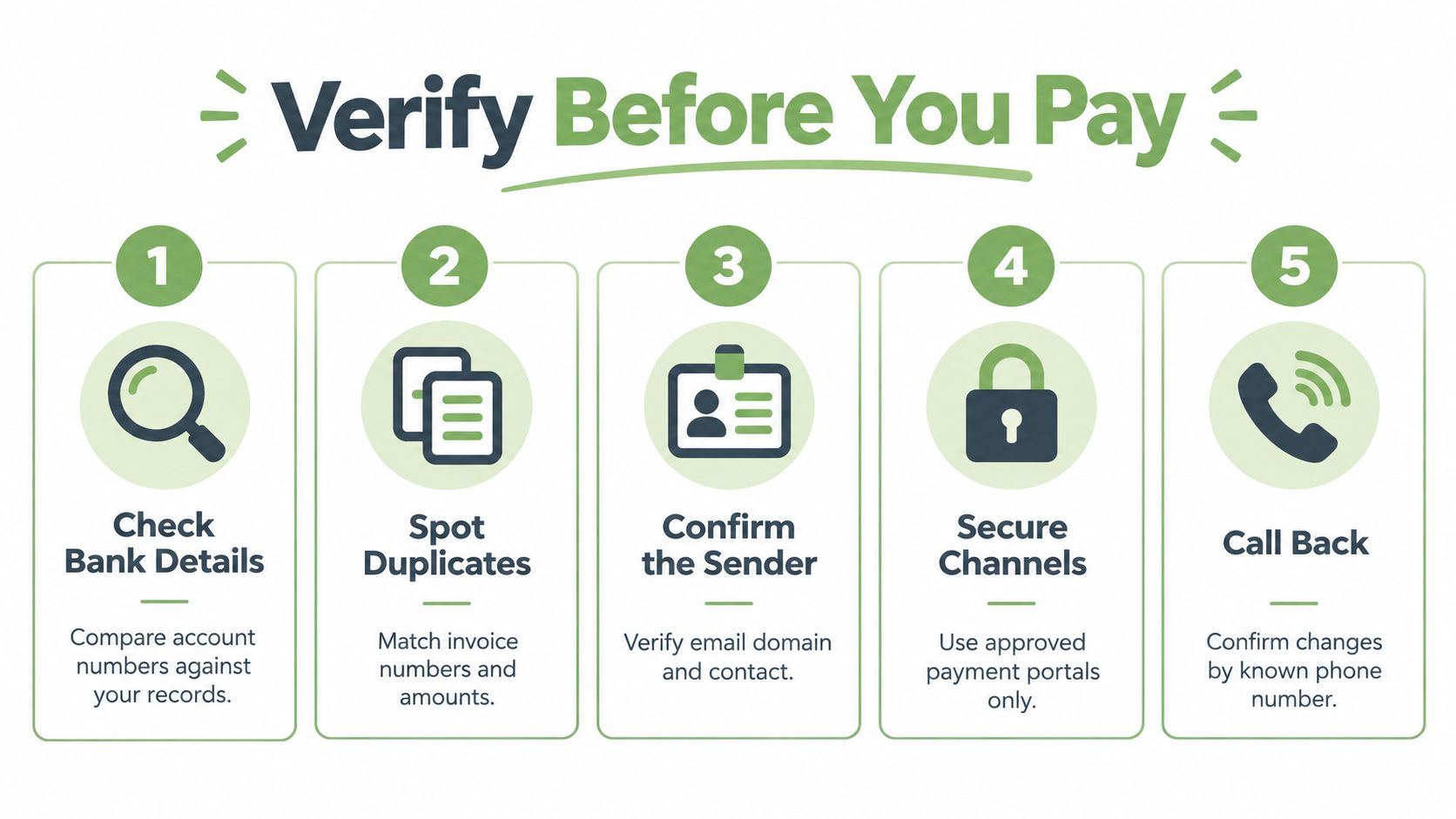
A solo operator doesn't need an accounts payable department to catch bad invoices. A short check is usually enough.
- Compare bank details: Match account numbers and beneficiary names against prior records or the signed agreement.
- Spot duplicates: Check the invoice number, amount, and date against earlier invoices and the contract or estimate.
- Confirm the sender: Verify the email domain and contact name, especially when the invoice arrives from a new address.
- Use approved channels: Pay through the agreed portal, link, or transfer path, not through a sudden last-minute instruction.
- Call back on a known number: Confirm any change to banking instructions with a phone number already on file.
Treat changes as separate events
A legitimate invoice can still contain a mistake. A familiar-looking invoice can still be fraudulent. That's why any change to bank details deserves separate confirmation through a trusted channel, not a reply to the same email thread that carried the altered instruction.
The risk gets sharper because there's pressure to move quickly, and late payments remain common across suppliers globally. That environment creates a perfect opening for altered details, duplicate billing, or phishing that looks urgent. For a small business, the practical answer is a simple rule, no money moves until the invoice matches the agreement and the payment route is confirmed.
Recording Payments and Managing Cash Flow
Once the money leaves the account, the job isn't finished. Payment records need to sit beside the estimate, invoice, deposit record, and client messages so the business can answer questions later without digging through a bank feed.
The IRS generally suggests keeping small-business records for three years, though the right retention period depends on the action, expense, or event documented IRS recordkeeping guidance. For a service business, that means saving the full billing trail, not just the payment confirmation.
A cleaner file usually includes:
- Approved estimate
- Issued invoice
- Deposit or partial-payment record
- Payment confirmation
- Client communication tied to the balance
A digital billing system makes that easier because the unpaid balance stays visible until the invoice is closed. That helps with reconciliation, tax prep, and dispute handling, and it keeps the owner from relying on memory when a client asks what was paid and what still remains. For service businesses that bill directly, that kind of visibility is often more valuable than any single payment method.
GetBill helps small service businesses create itemized estimates and invoices, share them by email or public link, accept supported online card payments through Stripe, and record deposits or partial payments with remaining balances. If the current billing process makes it hard to track what's been paid and what still needs attention, GetBill is worth a look for a simpler invoice workflow.