

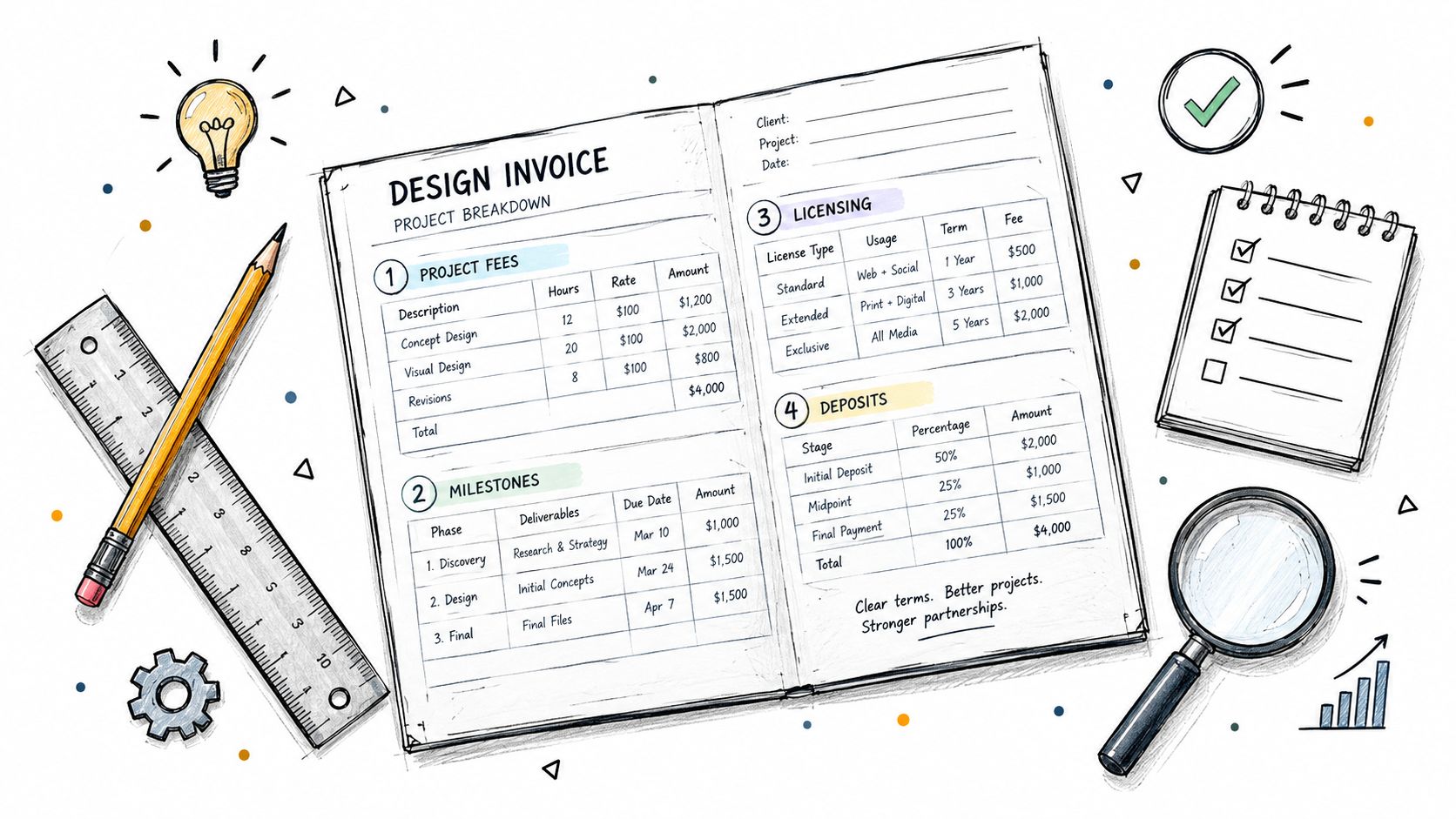
A client has just received a logo package and is questioning why the total is higher than expected. In another project, the studio finished the work weeks ago but can't collect the final payment because nobody agreed on a deposit or milestone schedule. In both cases, the invoice exposes a problem that should have been clear earlier.
An invoice for design isn't just a request for money. It shows the client what was priced, what was delivered, which payment has already been received, and what remains due. The right format depends on how the designer gets paid, whether by time, milestone, recurring allowance, package, approved estimate, or deposit and balance.
The six examples below connect each structure to a practical decision: what to bill, what the client should see, and how partial payments should be recorded. Tax and sales-tax requirements vary by jurisdiction, so each example should be checked against local rules and the actual contract.
Table of Contents
- 1. Hourly Rate Invoice Template with Time Tracking Breakdown
- 2. Project-Based Milestone Invoice Template
- 3. Retainer-Based Invoice Template with Monthly Drawdown
- 4. Package or Bundle Invoice Template
- 5. Proposal-to-Invoice Template with Scope Confirmation
- 6. Deposit and Final Invoice Template with Payment Schedule
- Comparison of 6 Design Invoice Templates
- Choose the Invoice Structure Your Contract Supports
1. Hourly Rate Invoice Template with Time Tracking Breakdown
An hourly invoice works best when the scope may change or the client needs access to specialist time rather than a fixed deliverable. Freelance designers, UX consultants, and small studios often use it for discovery, research, revisions, and production support where the final workload can't be predicted precisely.
The invoice should show the project summary first, followed by the detailed time record. For example, a logo redesign might be billed as follows:
- Discovery: 3 hours at $75 per hour
- Concept sketches: 5 hours at $75 per hour
- Revisions: 3 hours at $75 per hour
- File delivery: 1 hour at $75 per hour
The summary line can state “Logo redesign, 12 hours total”, while the detail explains how those hours were used. That gives the client quick context without hiding the work behind a single total.
Make the time record defensible
A UX consultant working with a startup might bill 40 hours of user research and wireframing across two weeks. The invoice should identify the agreed rate, the covered period, and the principal tasks. A timer or time-tracking system helps prevent reconstruction errors at the end of the project, especially when several clients are active at once.
Non-billable time should stay separate. Internal administration, sales calls, and unpaid revisions shouldn't appear as billable hours. If a discount applies, show the original service value and the discount as distinct lines so the client can understand the adjustment.
Practical rule: An hourly invoice should answer three questions quickly: what work was performed, how much time did it take, and which rate did the client approve?
Hourly billing is transparent, but it can also make the client feel responsible for every minute. The estimate or contract should therefore define the rate, approval limits, included revision expectations, and treatment of work outside the original request.
2. Project-Based Milestone Invoice Template
A milestone invoice connects payment to an agreed result instead of a timesheet. It suits branding, website design, and UX projects where the client approves defined stages such as strategy, wireframes, high-fidelity designs, and final handoff.
A web designer working with a retail client might issue three invoices:
- Site strategy and wireframes: $2,500
- High-fidelity design comps: $3,000
- Final assets and handoff: $1,500
The project total is $7,000, but each invoice requests payment for a clearly named stage. The same milestone names should appear in the proposal, contract, approval emails, and invoices. Consistent labels reduce questions from both the client and the accounts-payable team.
Bill the approved outcome
Descriptions should focus on the deliverable, not a vague activity. “Approved wireframe set for desktop and mobile” gives the client more useful information than “Phase two design work.” A sign-off date or approval note can also show when the milestone became billable.
A branding consultant could use the same structure for discovery completion, approved mood board and concepts, and final brand guide delivery. If a stage spans several weeks, a halfway invoice can support cash flow, but only when the contract allows that billing point. An invoice can't unilaterally create a new milestone or change the payment agreement.
The trade-off is straightforward. Milestone billing is easier for the client to budget and easier for the designer to connect to delivery, but it requires precise acceptance language. If “final design” isn't defined, the parties may disagree about whether a milestone is complete.
3. Retainer-Based Invoice Template with Monthly Drawdown
A retainer invoice supports an ongoing relationship. The client pays a recurring fee for a defined capacity or service allowance, such as up to 50 hours of design work, a set number of advertising assets, or continuing product-design support.
A graphic designer might invoice a boutique marketing agency $2,000 for up to 50 hours during the month. The supporting summary could show 38 hours used and 12 hours available for the following month, if the agreement permits rollover. A UX consultant could instead invoice a SaaS startup $4,500 for product-design consultation and component refinement, with a short log of meetings and screens designed.
Show activity without turning the invoice into a timesheet
The recurring fee should remain easy to identify. A short monthly report can document completed work without overwhelming the client:
- Work completed: Campaign assets, landing-page updates, and design reviews
- Capacity used: Hours or agreed service units consumed
- Remaining allowance: Unused capacity and whether it carries forward
- Out-of-scope work: Requests requiring a separate estimate
Retainers create predictable billing, but they also create ambiguity when the scope is loose. The written agreement should define included project types, hours or deliverables, revision limits, response expectations, and the treatment of unused capacity. Some designers allow rollover, while others limit use to the current month. Either approach can work if the client sees it before the first invoice.
A retainer is not a blank check for every design request. It is a billing arrangement for a defined capacity.
A monthly tracker can sit outside the invoicing system and support the invoice summary. If usage repeatedly exceeds the allowance, the designer should discuss a revised scope or fee rather than absorb the extra work. A review every few months gives both parties a scheduled opportunity to adjust the arrangement.
4. Package or Bundle Invoice Template
A package invoice sells a defined group of services at one fixed price. It works for designers who offer recognizable service levels, such as a logo package, website refresh, or brand identity system. Clients who prefer a clear decision often find a package easier to compare than a long menu of individual tasks.
A logo designer might offer:
- Essential: $400 for three concepts and two revision rounds
- Standard: $800 for five concepts and unlimited revisions for 30 days
- Premium: $1,500 for unlimited concepts, revisions, and a brand-guidelines document
The invoice should name the selected package and list its included deliverables. “Standard logo package” alone isn't enough, because the client may not remember what that label includes. A short bullet list makes the scope visible at the point of payment.
Keep the bundle honest
A web designer might distinguish a Website Refresh at $2,500, covering new design mockups and content updates for an existing site, from a Complete Redesign at $7,500, covering strategy, new design, and development handoff. The package names should describe a meaningful difference in scope, not merely create an artificial pricing ladder.
Showing individual service values can help explain a bundle, but only when the breakdown reflects the actual pricing model. A fake discount or inflated “regular price” weakens trust and can create problems when the client compares the invoice with the proposal.
Package pricing simplifies the sale, but it can conceal scope risk. Revision limits, file formats, licensing, copy responsibilities, development exclusions, and rush requests should appear in the proposal or contract. The invoice can summarize them, but it shouldn't carry the entire agreement.
Designers who work across service businesses can also compare how deliverables are presented in a photography sample invoice. The service differs, but the same principle applies, the client should see what the named package includes.
5. Proposal-to-Invoice Template with Scope Confirmation
A proposal-to-invoice structure keeps the sales agreement and the payment request aligned. It suits designers who prepare formal estimates before work begins and want the final invoice to confirm that the promised scope was delivered.
The invoice can include a note such as “Per Estimate #2024-001 issued 15 January 2024. Scope completed as agreed. No change orders issued.” Its line items should match the estimate, including the same service names and quantities. That consistency reassures the client and gives the designer a cleaner record if a question arises later.
Treat changes as separate decisions
Suppose a web designer's proposal included three revision rounds. The client later requests two additional rounds. The invoice should reference the approved change order rather than adding work to an existing line without approval:
- Original estimate: Estimate #PRO-456
- Approved change: Change Order #1 for two additional revision rounds
- Invoice treatment: Original estimate plus the approved additional charge
A written change order should describe the request, price, and schedule effect before the extra work begins. This protects the relationship because the client gets a choice instead of an unexpected total.
GetBill's quote-to-invoice workflow can carry estimate details into an invoice, where the designer can then confirm whether the scope stayed unchanged. The document should still be reviewed by a person before sending. Software can transfer line items, but it can't decide whether a client request changed the agreement.
Attach the original estimate to the invoice email or provide a document link. For a long project, a short mid-project confirmation can record approved changes while the details are still fresh. This approach works better than waiting until the final invoice to reconstruct months of feedback.
6. Deposit and Final Invoice Template with Payment Schedule
A deposit and final invoice structure places part of the project payment at the start and requests the balance after completion. It fits branding, website, and other projects where the designer commits substantial time before delivering the final files.
For a $5,000 branding project, the designer might issue a $2,500 deposit invoice before work begins. The final invoice would show the original project total of $5,000, the deposit received of $2,500, and the remaining balance of $2,500. A web project priced at $10,000 could use a $3,000 deposit and a final balance of $7,000, provided the contract states that schedule.
Record the credit clearly
The deposit terms belong in the proposal or contract, not only on the invoice. The client should know what begins after payment, whether the deposit is applied to the final project total, and what happens if the project pauses or ends early.
A final invoice note can state: “Deposit of $2,500 received 15 January 2024, applied to this invoice.” The document should show the original total, deposit credit, any approved additional work, and the final amount due. A client shouldn't need to subtract several earlier documents to discover the balance.
GetBill can record partial payments and invoice balances, which supports this workflow when a deposit or installment has already been collected. The designer still needs to verify the payment record and ensure the final invoice reflects the actual amount received.
Cash-flow rule: Request the deposit immediately after approval or signature, not after the designer has already spent weeks on the project.
A deposit protects the designer from carrying the full cost of delivery, but it can also make a new client more cautious. Clear scope, a defined start condition, and a professional payment record help explain why the upfront amount exists. Any early-payment discount should be agreed in advance and shown transparently, rather than introduced after the client receives the final invoice.
Comparison of 6 Design Invoice Templates
| Invoice Type | Implementation Complexity | Resource Requirements | Expected Outcomes | Ideal Use Cases | Key Advantages |
|---|---|---|---|---|---|
| Hourly Rate Invoice Template with Time Tracking Breakdown | Low–Medium, requires accurate time tracking procedures | Time-tracking tool, detailed logs, invoicing software | Transparent billing; clear cost-by-task visibility | Freelancers and consultants with variable scope or ongoing work | High transparency; easier dispute resolution; justifies rush fees |
| Project-Based Milestone Invoice Template | Medium, needs defined milestones and contract alignment | Clear milestone definitions in contract, estimate-to-invoice workflow | Predictable payment tied to deliverables; reduced scope disputes | Fixed‑scope web/branding projects and multi‑phase engagements | Aligns payments with deliverables; predictable cash flow |
| Retainer-Based Invoice Template with Monthly Drawdown | Medium, recurring billing and usage tracking required | Recurring invoice setup, monthly reporting, hours/credit tracker | Stable recurring revenue; stronger client relationships | Ongoing support, maintenance, or monthly design retainers | Predictable income; simplifies budgeting for clients |
| Package or Bundle Invoice Template | Low, requires upfront package design and pricing strategy | Predefined package descriptions, invoicing template for tiers | Simplified purchasing decisions; perceived higher value | Agencies selling tiered services or defined service bundles | Easy to sell and scale; streamlined invoicing |
| Proposal-to-Invoice Template with Scope Confirmation | Medium–High, requires formal estimate and change-order process | Proposal/estimate system, version control, change-order tracking | Reduced disputes; strong audit trail linking proposal to invoice | Projects with formal proposals or long sales cycles | Professionalism and clarity; minimizes scope/payment conflicts |
| Deposit and Final Invoice Template with Payment Schedule | Low–Medium, needs partial payment tracking and contract terms | Partial payment recording, contract deposit terms, invoicing system | Improved cash flow and lower nonpayment risk | Medium-to-large projects where upfront commitment is needed | Protects cash flow; demonstrates deposit application on final bill |
Choose the Invoice Structure Your Contract Supports
The invoice should match the pricing model agreed in writing. Use hours for time-and-materials work, named milestones for fixed phases, a defined monthly allowance for retainers, a documented package for bundled services, an estimate reference when scope confirmation matters, and a deposit line when the project requires upfront cash.
Before sending the document, compare it with the proposal or contract. Check the client name, project identifier, deliverable descriptions, quantities, rate or fixed price, approved expenses, taxes, discounts, deposit credit, due date, and payment method. If the client requested extra concepts, revision rounds, rush delivery, or new deliverables, confirm that the change was approved before placing it on the invoice.
The payment term should be explicit. In the Design Business Association's 2022 survey of UK member agencies, 75% of respondents reported standard 28-day payment terms, while the reported average payment time was 46 days. The report also said 30% of respondents more often than not had to accept their clients' payment terms rather than their own. Those historical results are useful context, not a universal payment standard: agree the due date, milestone status, deposit record, and outstanding balance for the actual project. See the 2022 DBA Annual Survey Report.
For U.S. businesses, estimated-tax obligations are separate from client invoicing. IRS Publication 583 says individuals generally must make estimated tax payments when they expect to owe at least $1,000 when filing, while corporations generally face the estimated-payment rule at $500, and individuals use Form 1040-ES to calculate and pay IRS Publication 583. State and local requirements can differ, so a qualified tax adviser should review the designer's entity, location, sales-tax position, and records.
The FTC Rule on Unfair or Deceptive Fees took effect on May 12, 2025, but its covered industries are live-event tickets and short-term lodging. It isn't a general invoice-pricing rule for designers, photographers, handymen, or other ordinary service businesses FTC fee rule frequently asked questions. Service businesses should instead check the tax, disclosure, and consumer-protection rules that apply in the jurisdiction where the service is sold.
If estimates and invoices are prepared from a phone or laptop, GetBill supports itemized documents, estimate-to-invoice conversion, branded PDFs, shareable document links, and recorded partial payments. Supported online card payments depend on a connected Stripe account and the user's region. These product capabilities help organize the billing record, but they don't replace a contract, tax advice, or a deliberate follow-up process.
GetBill helps independent designers create itemized estimates and invoices, convert approved estimates into invoices, share branded documents, and record deposits or partial payments against the remaining balance. Visit GetBill to set up a clearer workflow for design projects and client payment collection.