

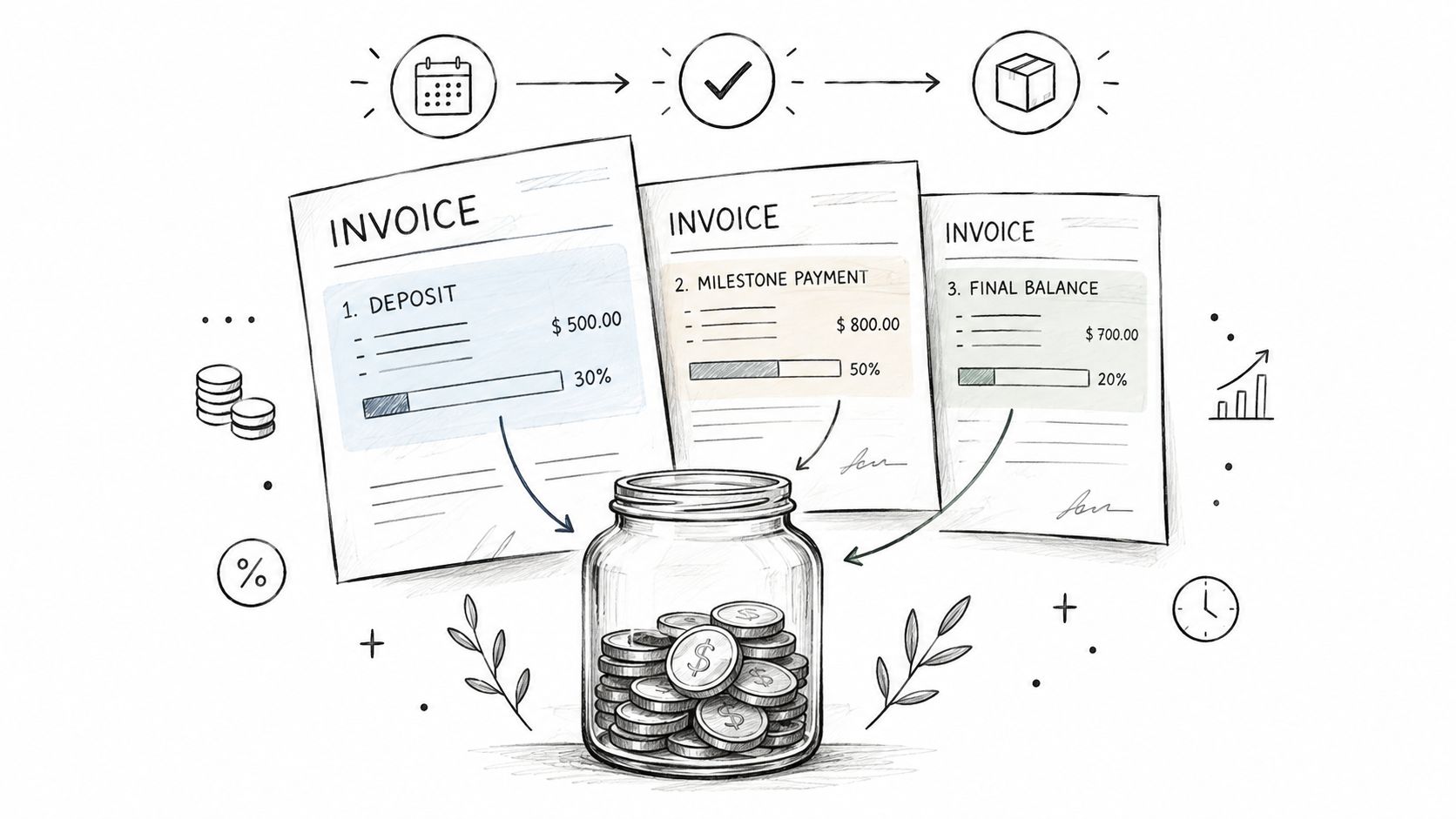
The client's deposit lands late, the crew is already on site, and the invoice still looks open in accounting. That's the moment a partial payment example stops being a math exercise and becomes a cash-flow decision. For a small service business, the difference between a planned deposit, a milestone installment, and a surprise short payment can determine whether the job funds itself or steadily drains the bank account.
Table of Contents
- Understanding Partial Payments and Deposits
- Structuring Milestone Payments for Service Projects
- Recording Partial Payments on Client Invoices
- Handling Unexpected or Short Client Payments
- Managing Processing Fees and Net Balances
- Enforcing Payment Terms and Tracking Open Balances
Understanding Partial Payments and Deposits
A service business usually feels the pressure first on the first job payment, not the last. Materials get ordered, labor starts, and overhead keeps running while the client's check is still pending. That's why a partial payment is more than “some money off the invoice,” it's a way to divide one commercial obligation into stages that match actual work and reduce the amount left exposed at any one time.
Deposit first, balance later
A planned deposit is different from an accidental underpayment. In contractor work, a deposit is tied to commitment and project start, while a short payment is usually a mismatch between what was billed and what was received. The practical benefit is simple, the invoice stays anchored to the original total and the open balance is always visible.
Practical rule: keep the original invoice open until the full balance is settled, then record each payment against that same document.
That structure works whether the job is a cleaning contract, a design engagement, or a repair call. QuickBooks' guidance describes partial payments as a way to split a service or construction invoice into meaningful stages, with a deposit, progress payments, and a final balance tied to defined events such as contract signing, material delivery, or completion of a work phase (QuickBooks payment schedule guidance). In practice, that means the estimate should name the deposit amount, the next trigger, and the final balance before work begins.
Structuring Milestone Payments for Service Projects
The cleanest milestone schedule is tied to something the client can verify, not just the passage of time. Contract signing, material delivery, phase completion, and final inspection all work better than “every Friday,” because the payment trigger is visible and defensible. Construction has used that logic for a long time, and small service businesses can borrow it without adopting construction-grade complexity.
A staged invoice example
A $10,000 project can be structured as a 10% deposit, four milestone payments of 20%, and a final 10% balance. That means $1,000 at signing, $2,000 after each of four agreed stages, and $1,000 at the end. The value of the schedule isn't just the arithmetic, it's the link between the payment and a specific deliverable, which makes client conversations far easier when the next invoice goes out.
| Project Stage | Trigger Event | Percentage | Amount Due |
|---|---|---|---|
| Deposit | Contract signed | 10% | $1,000 |
| Milestone 1 | First agreed phase completed | 20% | $2,000 |
| Milestone 2 | Second agreed phase completed | 20% | $2,000 |
| Milestone 3 | Third agreed phase completed | 20% | $2,000 |
| Milestone 4 | Fourth agreed phase completed | 20% | $2,000 |
| Final balance | Final inspection or completion | 10% | $1,000 |
A similar six-stage construction example uses a deposit, foundation, framing, rough-ins, finishing, and substantial completion. In that structure, a $50,000 contract would break into $5,000, $10,000, $12,500, $10,000, $7,500, and $5,000, with the final 10% held until punch-list items are resolved (TaskTag construction schedule template). That same logic works for a studio, consultant, or freelancer if the project is big enough to justify more than one payment.
If design work is the use case, a practical starting point is a deposit for onboarding, a payment at approved concept delivery, another at final production files, and the last balance at handoff. A useful reference for breaking out billing items on design work is this design invoice example from GetBill.
Recording Partial Payments on Client Invoices
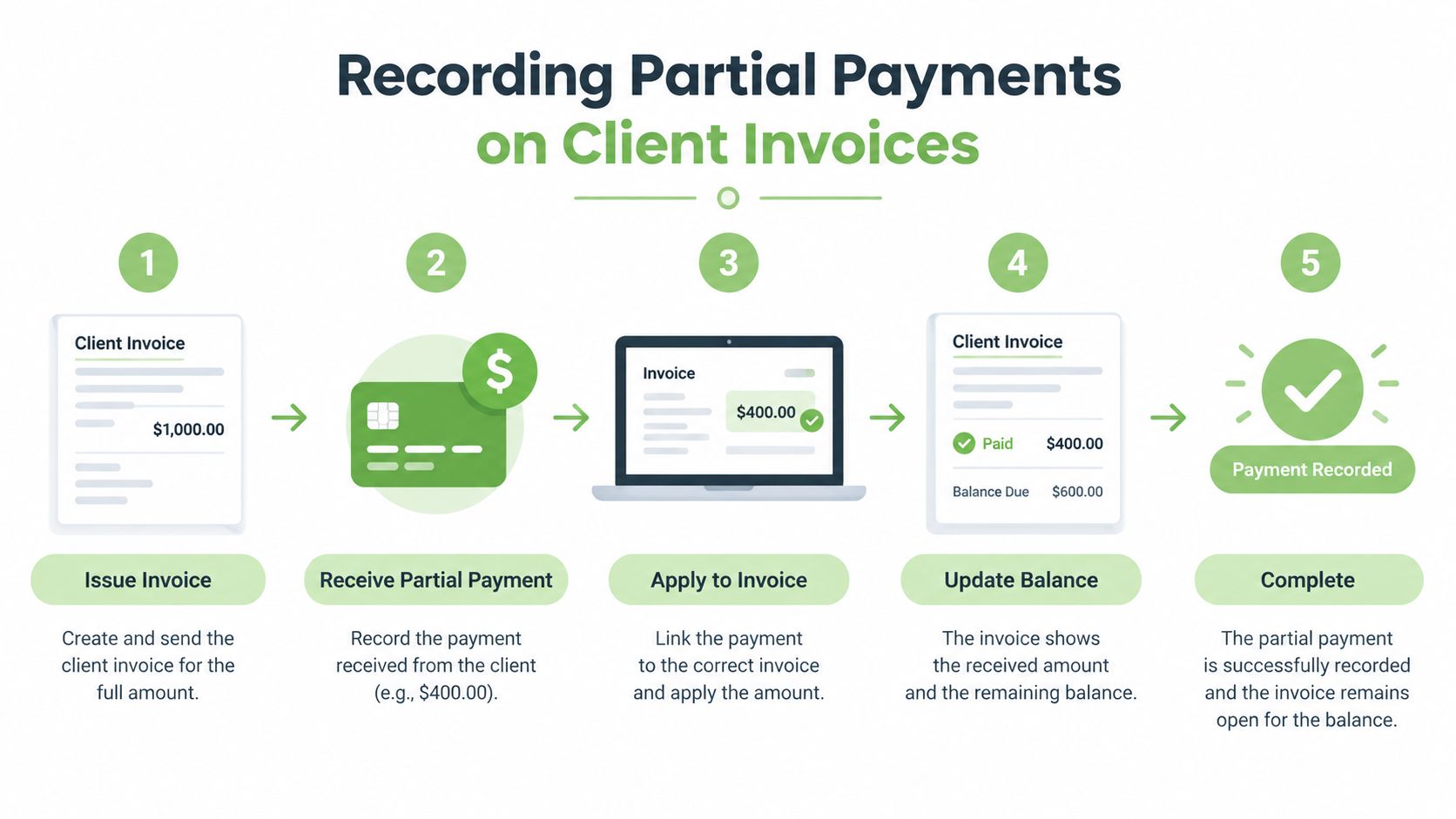
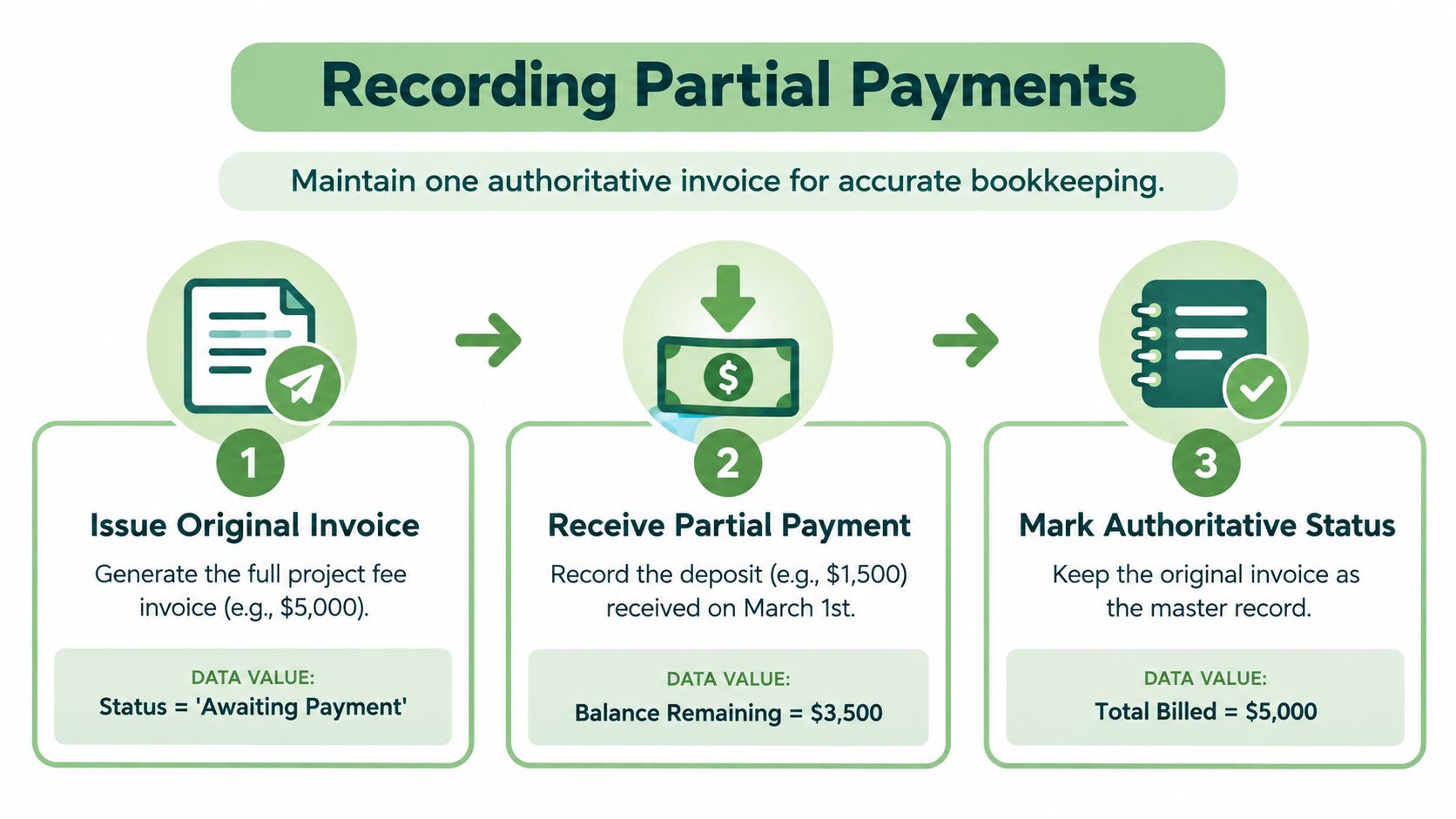
The bookkeeping mistake that causes the most trouble is creating a new invoice for the unpaid remainder. That makes the accounting look busy, but it muddies the receivable trail and can lead to duplicate billing. The better approach is to preserve one authoritative invoice and allocate each payment against it.
What to record every time money comes in
A clean payment record should preserve the payment date, amount, method, invoice identifier, and remaining balance. That creates an auditable trail from the commercial promise to the settlement activity. If a consultant issues a $2,400 invoice, receives a $960 deposit, and still has $1,440 open, the invoice should stay open until that $1,440 is collected.
The accounting treatment depends on the business's accounting basis. Under cash accounting, income is generally recognized when payment is received, while accrual accounting recognizes revenue when it is earned, subject to the applicable tax and revenue rules. For UK VAT-registered businesses using the VAT Cash Accounting Scheme, HMRC says that when a partial invoice payment is received and VAT isn't separately identified, the payment is treated as VAT-inclusive, so the VAT share must be calculated proportionally (HMRC VAT cash accounting guidance).
Keep the invoice open, not duplicated. The moment a second invoice is created for the same work, reconciliation gets harder and collection history gets less defensible.
Tools matter here because many owners don't need a full accounting suite to stay organized. GetBill supports recording partial payments against the original invoice, keeping the original total, amount received, and remaining balance visible while the invoice stays open until it's fully paid. For a simple invoice layout that makes partial allocations easier to track, this hourly-rate invoice template is a practical starting point.
Handling Unexpected or Short Client Payments
Not every partial payment is agreed in advance. Sometimes the client pays less because of a budget problem, a dispute, a bank transfer error, or a simple administrative miss. The wrong move is to treat that underpayment like a fresh installment plan and secretly reset the billing trail.
A short payment should be recorded against the original invoice, then acknowledged clearly. Unless the parties renegotiate in writing, the original due date still governs the unpaid amount. That matters because an underpayment doesn't create a new deal on its own, it just leaves a balance open.
Why a second invoice causes problems
A second invoice for the unpaid portion can make the books look as if two separate obligations exist when there's really only one. That creates duplicate receivables, complicates follow-up, and makes it harder to explain what was paid, what's still owed, and why. A service business should preserve the original invoice number, log the payment method and date, and leave the balance open until the client settles it.
This issue shows up often in small businesses. A 2025 survey of 2,487 U.S. small businesses found that 56% had outstanding invoices (QuickBooks late payments report). That doesn't mean every open invoice is a problem, but it does show why partial-payment workflows need to be built around collections, not just accounting labels.
A short payment is best handled with a direct acknowledgment, a remaining balance statement, and a clear next step. That keeps the original due date intact unless the client and business owner agree to new terms in writing.
Managing Processing Fees and Net Balances
Card payments and cross-border transfers can make the bank deposit look smaller than the invoice amount. That's not the same thing as the client underpaying. The invoice balance and the net settlement are related, but they're not interchangeable.
Gross invoice, net deposit
A service business has to decide who bears the fee. If the agreement says the business absorbs processor fees, the client's contractual payment can be marked satisfied even if the bank receives less. If the agreement clearly assigns fees to the client where legally permitted, then the invoice should reflect that term. What should never happen is converting a processing fee into a client arrears balance without disclosure.
Payment providers and regions don't treat every transaction the same way. McKinsey notes that payment experiences increasingly run through platforms, and card-based pricing faces ongoing pressure and regulatory scrutiny, which makes fee handling more visible than it used to be (McKinsey Global Payments Report 2025). A practical example is a $1,000 invoice with a $400 deposit and a $600 balance. If a card processor settles only $388 because of a $12 fee, the client still owes $600 if the contract says the business absorbs the fee.
The invoice balance tracks what the client owes under the agreement. The bank deposit tracks what the processor actually remits.
Stripe Invoicing has its own partial-payment workflow through the Stripe Dashboard or API. Its partial-payment documentation describes recording an amount up to the remaining balance and updating the invoice payment fields until it is fully paid. This is a separate Stripe Invoicing workflow; it does not establish that GetBill's connected card checkout lets clients choose a partial amount. GetBill lets the business record payments already received against the original invoice and shows the remaining balance.
Enforcing Payment Terms and Tracking Open Balances
A job that starts with a deposit can still turn into a cash-flow squeeze if the rest of the balance is vague. Materials get ordered, labor gets booked, and the invoice sits open longer than it should. Tight payment terms reduce that gap, and they make it easier to see which amount is a planned deposit, which amount is a milestone installment, and which amount is a short payment that needs follow-up.
Put the terms in writing before work starts
The estimate or service agreement should spell out the deposit amount, milestone triggers, final due date, accepted payment methods, and the balance left after each payment. That gives the client a clear path and gives the business a usable forecast. In its September 2013 bulletin, based on a 2012 survey of Australian businesses, the Reserve Bank of Australia reported that payment within 30 days was most common, with smaller businesses tending toward about 20 days and larger businesses toward about 40 days (RBA bulletin on payment terms).
The schedule should still match the job's funding needs. If a project needs materials up front, the due dates should reflect that reality instead of pushing collection so far out that the contractor is financing the work.
The invoice date and due date should also be consistent with the contract language, so the client knows exactly when payment is expected. Invoice date and due date basics help keep that timing clear on the paperwork and in the accounting record.
Payment-term language should also comply with applicable local rules and contract requirements. A business should not add late charges, fee pass-throughs, or other balance adjustments unless the agreement allows them and the governing rules permit them.
For a cleaner workflow, GetBill can record deposits and partial payments against the original invoice while showing the remaining balance in one place. That matters when the invoice balance tracks what the client owes under the agreement, while the bank deposit tracks what the processor remits.