

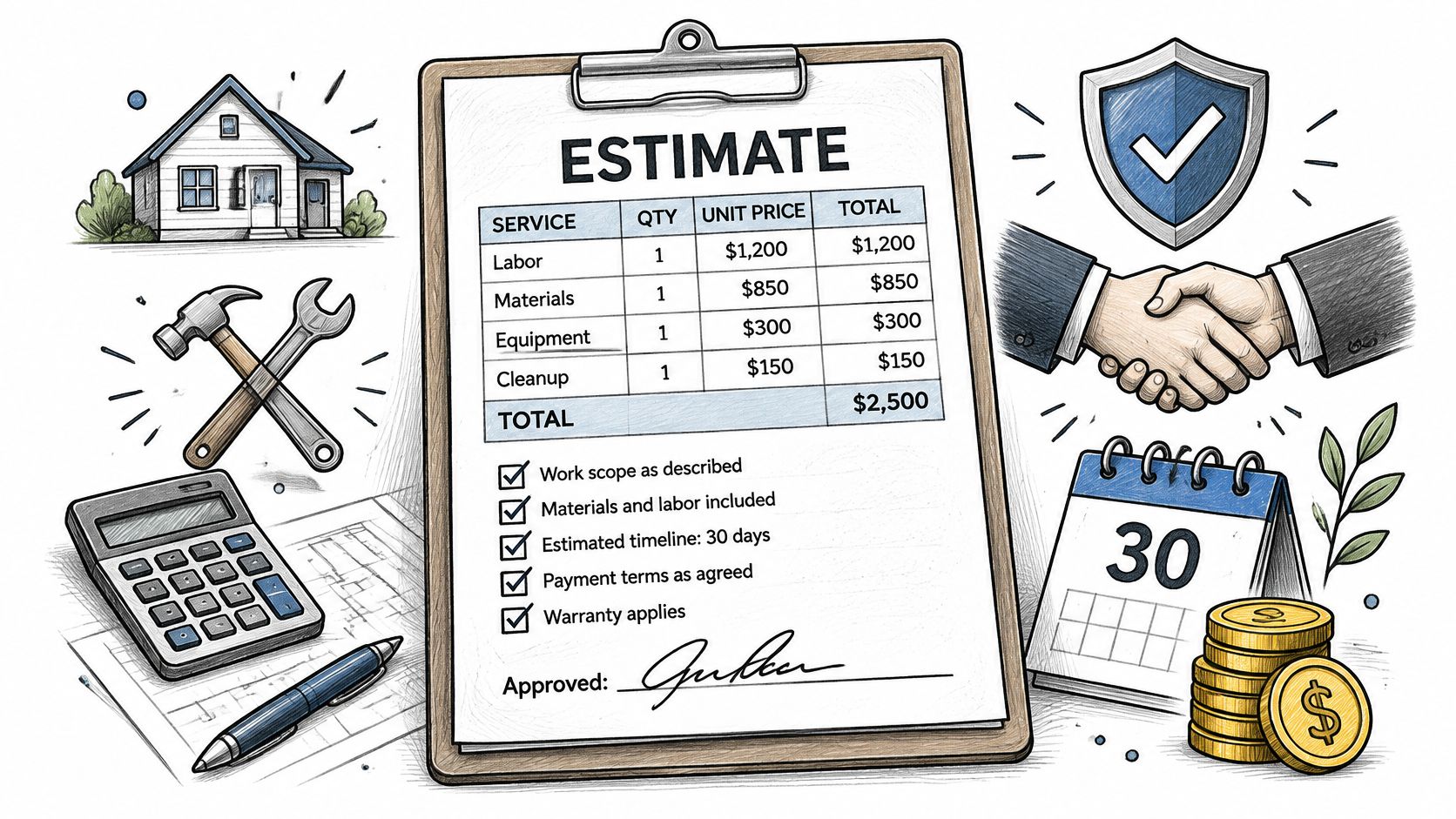
A client approves a price by text, asks for two extra tasks on site, then questions the final invoice because the total moved. The work was done, but the estimate never said what counted as extra, when the balance was due, or how a change had to be approved. Strong estimate terms and conditions prevent that gap. They turn a headline number into a cash-flow and change-control document that states the scope, the price basis, and the exact event that triggers payment or repricing.
Table of Contents
- Essential Estimate Terms and Sample Wording
- Choosing the Right Label
- Scope Changes and Written Change Orders
- Deposits, Milestones and Payment Timing
- Cancellations, Late Payments and Disputed Invoices
- Taxes, Mandatory Charges and Liability Limits
- Verify Jurisdiction Rules and Sources
- Confirm Your Terms Before Sending the Next Estimate
Essential Estimate Terms and Sample Wording
The fastest usable template starts with nine clauses placed on the estimate itself, not buried in a separate document the client never opens. Each clause answers one commercial question before work begins, so acceptance means the client has approved the scope and the mechanics, not just a total.
| Clause | What to State | Sample Wording |
|---|---|---|
| Validity | Date the estimate expires | This estimate is valid for 30 days from the issue date. |
| Scope and inclusions | Each service line, quantity and unit price | Includes only the items listed in this estimate. |
| Exclusions and assumptions | What is not priced and what the price assumes | Excludes permits, disposal and client-supplied materials unless listed. |
| Taxes and mandatory fees | Whether prices include sales tax and other required charges | Prices exclude sales tax, which is added where required by law. |
| Deposit and payments | Amount, trigger, due date and accepted methods | A 30% deposit is due on acceptance; the balance is due 14 days after invoice. |
| Change orders | How added work is approved and priced | Work outside the listed scope begins only after written approval of a revised estimate. |
| Acceptance | How the client approves the estimate | This estimate is accepted when signed or approved in writing, including by e-signature. |
| Cancellation | What is kept or refunded if the client stops | Any refund follows the cancellation rights and deadlines required by applicable law. Any amount retained must be permitted and documented. |
| Liability limit | Cap on claims and exclusion of indirect loss | To the extent permitted by law, liability under this estimate is limited to the fees paid and excludes indirect loss. |
How to Adapt the Wording to a Real Job
Sample sentences only work after the blanks are filled with job facts. Validity should be counted from a named issue date, not from a vague phrase such as "for a limited time," because material prices and schedules move. Scope lines should list each service with its quantity and unit price, for example three rooms cleaned, two site visits, or ten hours of design work, so the client can see what drives the total.
Deposit wording needs arithmetic the client can check. On a hypothetical $4,000 project, a 30% deposit equals $1,200 due on acceptance, leaving the balance tied to a later trigger stated in the payment clause. A cleaner adapting the same structure can compare service-specific phrasing in this guide to terms and conditions for cleaning quotes, then replace generic lines with access, supplies, and property-condition assumptions that match the actual visit.
Exclusions deserve the same specificity as inclusions. “Excludes disposal” is clearer than “extras may apply,” and an assumption such as “price assumes clear access and client-supplied paint” tells the client exactly what could change the price. Consumer-facing terms should stay clear, unambiguous, and balanced, because wording that hides a charge or shifts every risk to the client creates disputes even before a lawyer gets involved.
Template test: A client who reads only the estimate should know what's being bought, what it costs, when payment is due, and what would change the price. A missing answer means the clause set isn't finished.
The table is a starting point, not a finished contract. Liability caps, cancellation rights, and tax treatment need local review before the template goes to consumers. The practical standard is simple. If a clause can't be explained in plain language at the kitchen table, it isn't ready to send.
Choosing the Right Label
A wrong label is a cash-flow problem, not a wording problem. A client who believes they hold a fixed quote will dispute every revised invoice, so the label sets the expectation about whether the number can move before any work starts.
Under UK Trading Standards guidance on estimates and quotations, a quotation is normally a fixed price, while an estimate is generally a rough approximation of what work will cost. That guidance explains the principle clearly for UK traders and consumers. US estimate rules vary by state, so a US business should confirm local requirements before relying on the same wording. The underlying principle travels well, though: the label must match how firm the price is.
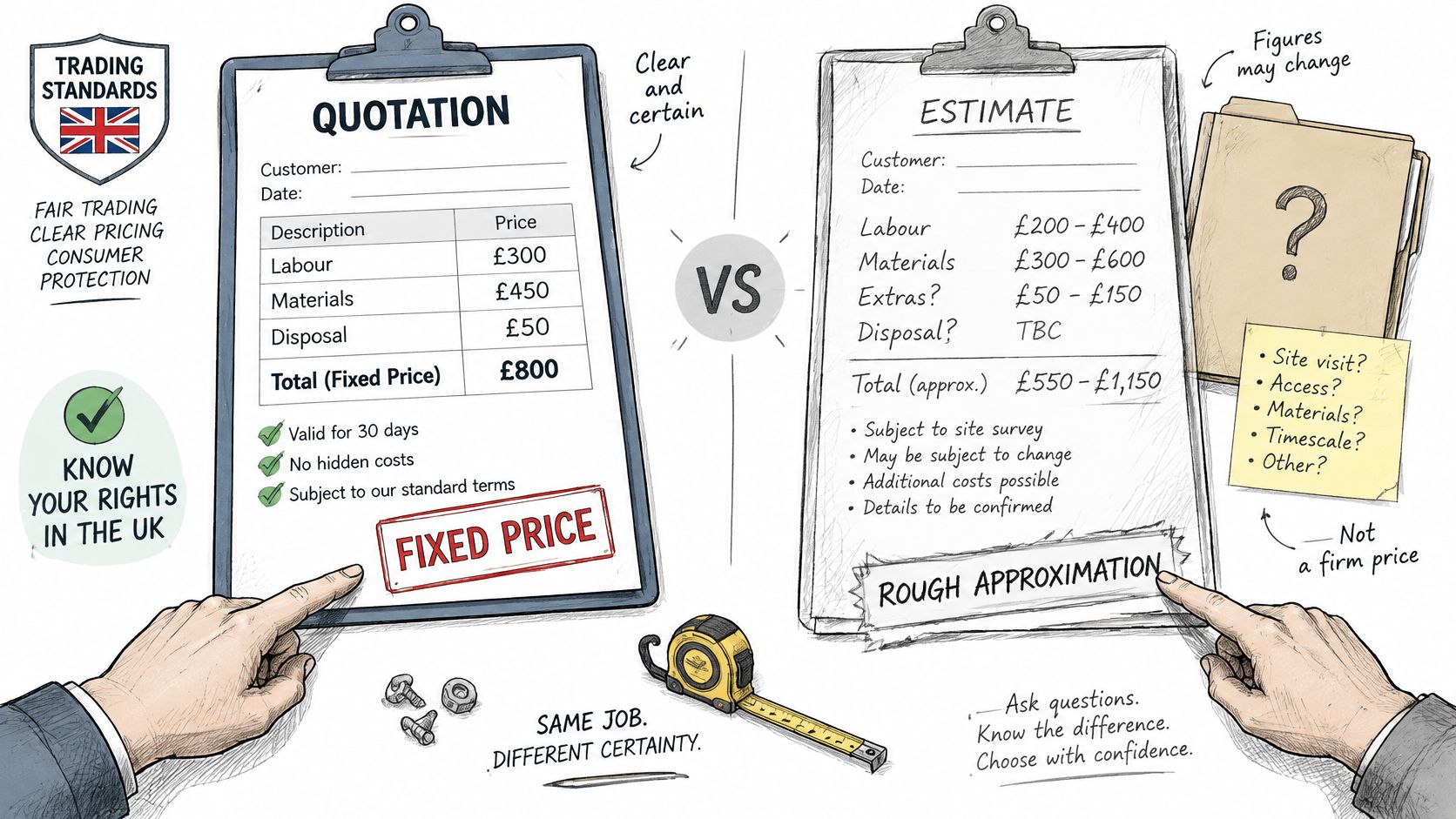
An estimate earns its label through wording, not the title in the header. It should name its assumptions and state that the final amount may change once measurements, specifications, or a full survey are available. A line such as “estimate, not fixed quotation; subject to confirmed scope” separates an indicative price from a contractual commitment. Realism requirement sits underneath the label. An estimate must still be a good-faith figure, and statements a client relies on, including price or timescale, can become binding even on a document labeled as an estimate.
| Factor | Estimate | Fixed Quote |
|---|---|---|
| Price basis | Approximate, based on stated assumptions | Fixed total for a defined scope |
| Information needed | Partial, pending survey or client details | Complete scope and specifications |
| Expected accuracy | Range or rough figure | Set amount, changed only through agreed change orders |
| Best used when | Scope is still unclear | Scope is confirmed and documented |
| Repricing trigger | New information or a scope change | Written change order only |
The Decision Test
The test turns on information, not preference. If the job can't be surveyed or fully specified yet, the document should be labeled an estimate with its assumptions listed. Once scope, quantities, and materials are confirmed in writing, a fixed quote gives both sides a firmer commitment.
Separate what the estimate itself must say from what only a local rule demands. The assumptions and repricing trigger belong in the document's own text, because they control whether the price holds. Consumer disclosure or cooling-off requirements come from state or national law, and those need checking in the jurisdiction where the client sits rather than copying phrasing from another country's guidance.
Businesses weighing document format alongside label can review the distinction in this comparison of a proposal and a quote, then match the document type to how much scope detail exists. A detailed proposal doesn't convert an approximate price into a fixed one. Confirmed scope plus explicit fixed-price wording does that work.
Scope Changes and Written Change Orders
A client texts, “while you're here, can you add the back room?” The work is real, the price is not, and the finish date starts moving before anyone names it. For contractors, cleaners, photographers, designers, and consultants, that is how scope creep turns a clear estimate into an argument over cash.
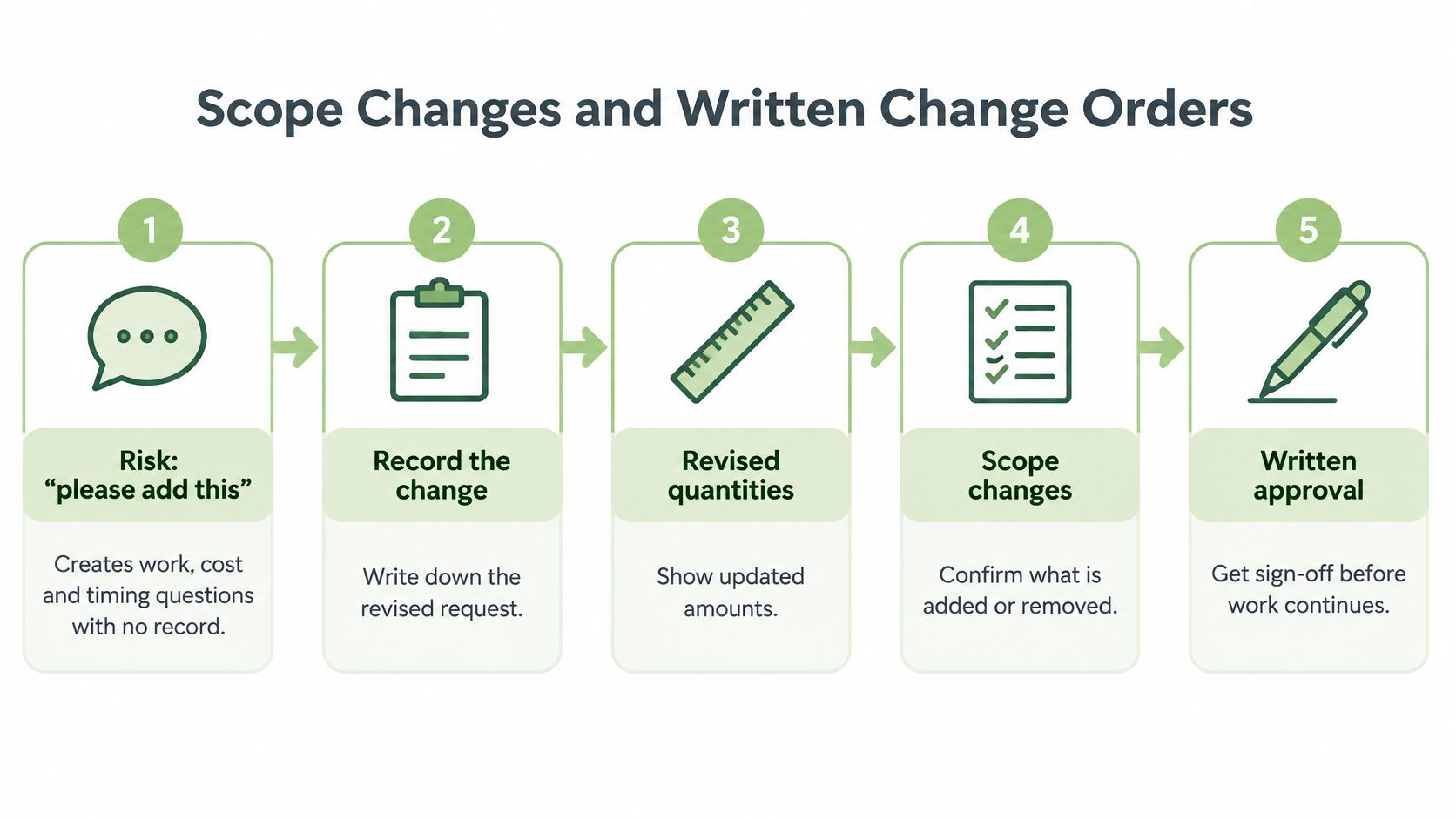
A change order exists to control cash and scope. A good one restates revised labor and material quantities, describes the scope change, and gives any time adjustment in days. It itemizes labor, materials, and markups plainly enough that the client can compare the change with the original estimate. Keep legal form separate from business discipline. Some states or countries may require signed written change orders for residential work, while every job benefits from the same record even where no rule forces it.
Five Steps Before Extra Work Starts
- Record the request in writing. Save the client's exact ask in an email or revised estimate. A written request prevents later disagreement about what was requested in the first place.
- Check the original scope. Compare the task against the itemized lines, exclusions, and assumptions. Work already included stays at the agreed price, while work outside those lines moves to pricing.
- Price the change on a stated basis. Use a fixed lump sum, an agreed unit price, or a documented time-and-materials rate. The basis tells the client how the new number was built.
- State the schedule impact in days. Added work often shifts the finish date even when the price is small. Recording the time effect protects the original deadline from silent erosion.
- Get written approval before starting. Add the approved amount as a separate line on the later invoice. Separate lines preserve the original estimate and make the incremental cost auditable. Keep the client’s written approval with the job, whether it arrives by email or a signed document. GetBill supports converting an estimate into an invoice without re-entering its line items.
Approval quality matters more than speed. An email reply that names the change and its price is stronger evidence than a text saying “sure,” because the email ties consent to a specific amount. The safer habit is sending a short revised estimate for written approval, then starting the added work. For residential jobs, review scope-of-work disputes in Kendall home projects to see how unclear scope escalates once work is underway. Flexibility stays intact, and the estimate keeps acting like a boundary instead of an open-ended bill.
Deposits, Milestones and Payment Timing
A deposit that covers scheduling and materials can protect cash flow, while a deposit that exceeds the work or costs committed can deter a client. Set payment amounts against clear events: acceptance, a defined milestone, or completion. State the amount due at each point and the date or trigger for payment.
Federal construction contracts illustrate why the payment stage matters. Under FAR 52.232-27, qualifying progress payments generally have a 14-day due-date rule, while final payments and accepted partial deliveries follow separate conditions and generally a 30-day rule. Those federal contract provisions are not standard deadlines for ordinary private service invoices. For each estimate, agree the deposit trigger, milestone amounts, final-balance due date and payment methods under the applicable rules.
A Worked Example That Reconciles
For a hypothetical $4,000 project with a 30% deposit, the deposit is $1,200 on acceptance, leaving $2,800 due at the stated trigger. Add a $500 approved change order, and the approved total becomes $4,500, with $3,300 still due. Each payment should reconcile to the agreed price and recorded changes.
Reconciliation formula: Approved total, plus authorized changes, minus credits and payments received, equals the amount due. If you cannot rebuild the balance from those parts, check the figures before invoicing.
Define completion in terms the client can verify, such as delivery of listed work or completion of a stated milestone. If client review affects payment timing, specify the review period and how the client should report corrections. The structure in this invoice deposit template guide can help organize the deposit wording; adapt the milestones to the actual deliverables.
| Structure | Best Fit | Main Risk |
|---|---|---|
| Full payment on acceptance | Short jobs and rush bookings | Clients may see upfront payment as a barrier |
| Deposit then balance on completion | Projects with materials or scheduling costs | Balance disputes if completion is undefined |
| Milestone schedule | Multi-week projects with clear deliverables | Each milestone needs a defined approval point |
| Monthly retainer | Ongoing consulting, cleaning or maintenance | Unused hours and cancellation rules must be set |
| Net 30 after invoice | Clients with formal approval cycles | Cash gap until the due date; collection depends on follow-up |
Tie each payment to work completed or a specific cost commitment, and avoid asking the client to fund the entire job without a clear basis. For projects where inspection matters, state what remains payable after inspection and what evidence closes that milestone.
Payment terms should say whether final files, goods or additional work are released before the balance clears, where the agreed terms and applicable law permit that condition. Record partial payments against the invoice so the client can verify the amount received and remaining balance. Keep payment triggers, due dates and approved changes clear.
Cancellations, Late Payments and Disputed Invoices
A bold “no refunds” line feels protective. In practice, it's often the clause most likely to fail, because cancellation rights, work already performed, and materials already ordered don't disappear just because a template says so. Safer terms price each failure path in advance.
Cancellation Terms That Price Work Already Done
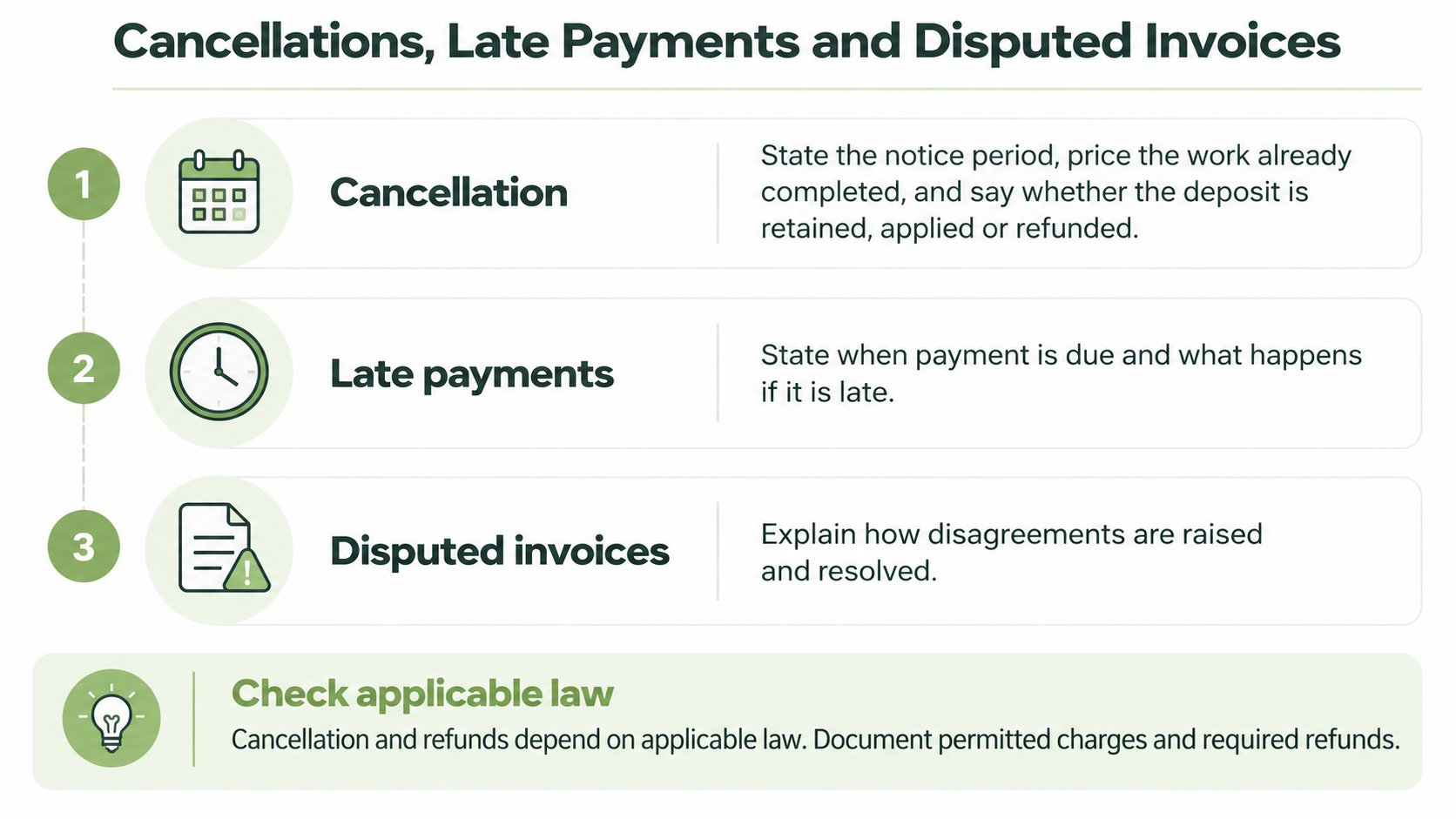
Cancellation wording should identify the notice process, any permitted charge for completed work or committed costs, and the refund deadline that applies. These terms must preserve statutory cancellation and refund rights. Do not treat a sample retention clause or a fixed refund period as universally valid.
Some transactions qualify for protections such as the FTC Cooling-Off Rule. Check its coverage and exclusions and any additional state rules before choosing cancellation terms. Mandatory rights and refund deadlines override sample contract wording.
Late Payment Consequences Without Invented Penalties
Late-payment terms should state what happens when a balance is overdue, such as a pause in work or withholding final files until payment arrives. Those operational consequences are usually easier to explain and enforce than surprise penalties. Any late fee or interest charge must be permitted by the relevant state and stated clearly in advance, since many states restrict such charges. A fee copied from another state's template shouldn't appear on an estimate until its legality is verified.
Disputed invoices need a channel, not a standoff. Effective terms require written notice of the disputed amount within a stated period, require payment of the undisputed portion on schedule, and commit both sides to resolving the disputed line against the approved estimate and change orders. Keeping the accepted estimate, approvals, and messages together turns the dispute into a document check instead of a memory contest.
A client who must identify the disputed line in writing usually raises a smaller, clearer disagreement than a client invited to reject the whole invoice.
Taxes, Mandatory Charges and Liability Limits
A common assumption needs correcting first. The FTC Rule on Unfair or Deceptive Fees guidance took effect May 12, 2025, and its scope is limited to live-event tickets and short-term lodging. It isn't a general federal pricing rule for handyman, cleaning, photography, or consulting estimates, and service businesses shouldn't describe it that way to clients.
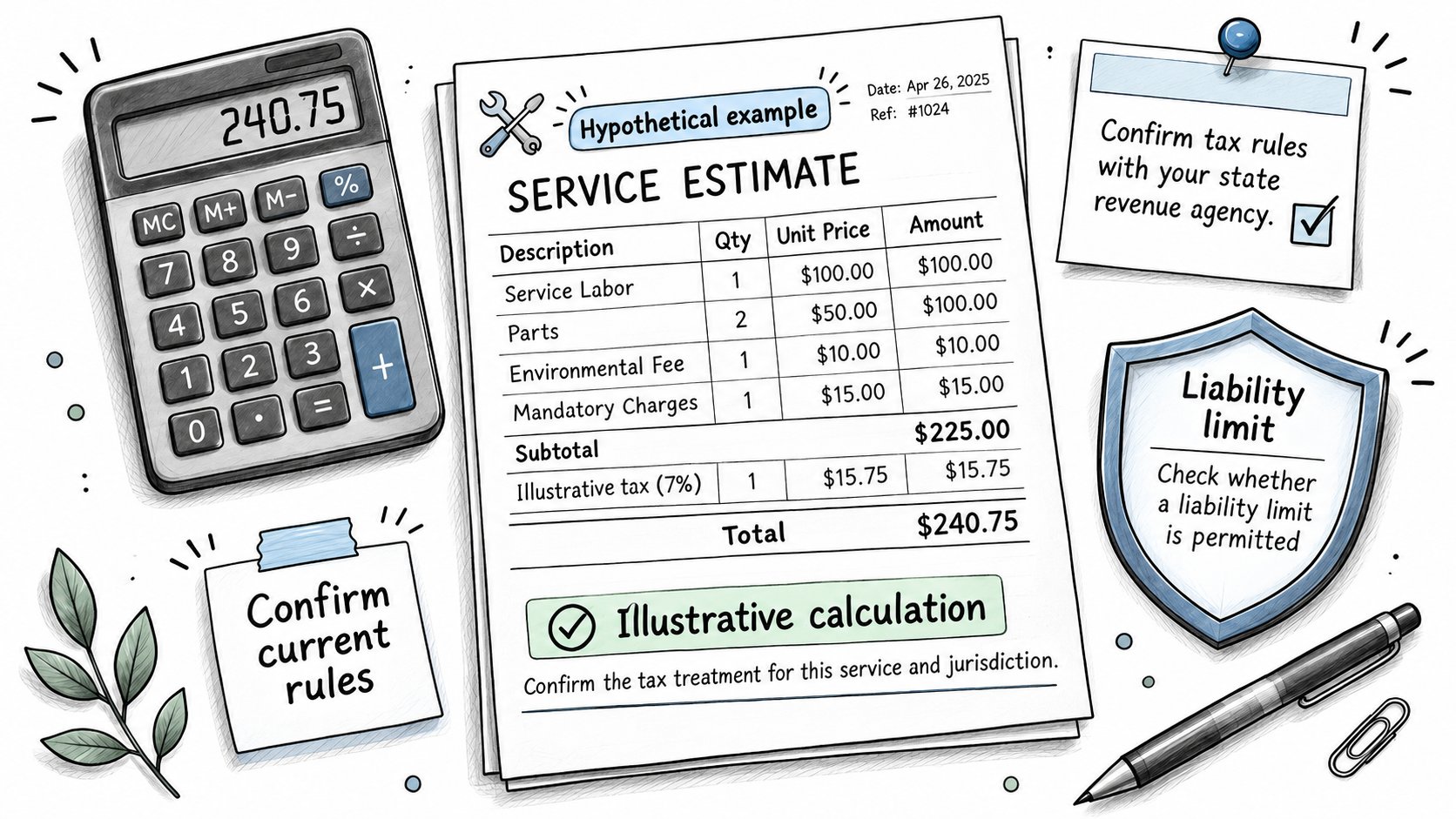
That correction doesn't remove the underlying duty. Covered ticket and lodging businesses must disclose total price upfront including mandatory fees known and calculable at the time, while ordinary service businesses still must state their own prices, mandatory charges, taxes, deposits, and deadlines accurately under applicable state and local consumer-protection laws. The FTC rule isn't the authority that imposes those service-estimate duties.
Sales Tax and the Owner Tax Reserve
Sales tax on services is set by state and locality, so the estimate should say whether prices include tax or add it where required. The taxable status of the specific service should be confirmed with the state revenue agency, because the same service can be treated differently across state lines. Businesses that work with value-added tax formats can compare document layout in this invoice template with VAT guide, while keeping US sales-tax decisions tied to the relevant state rule.
Income tax sits outside the client estimate but affects cash planning. US sole proprietors, partners, and S corporation shareholders who expect to owe at least $1,000 at filing generally must make federal estimated tax payments through Form 1040-ES and the IRS estimated-tax guidance, so part of each client payment should be reserved rather than treated as spendable cash. State estimated-tax rules are separate and need their own check.
Liability limits need local review before use with consumers. A clause capping recovery at fees paid and excluding indirect loss may be restricted in consumer contracts or where negligence is involved, depending on jurisdiction. Software doesn't solve that judgment call. GetBill does not warrant that invoices, estimates, templates, tax settings, or records generated through the Service will meet legal, tax, accounting, or regulatory obligations, and GetBill does not provide legal, tax, accounting, financial, or professional advice. The business owner remains responsible for confirming each rule.
Verify Jurisdiction Rules and Sources
A cancellation clause lifted from a UK template can read cleanly and still be wrong for a Florida contractor. Sort every legal or tax clause by jurisdiction, covered business, and primary source before it reaches a client estimate, because a rule that is accurate for one industry or country can mislead when copied into a service template unchecked.
| Rule or Source | Who It Covers | Where to Verify |
|---|---|---|
| FTC Rule on Unfair or Deceptive Fees | Live-event tickets and short-term lodging only | FTC guidance |
| State sales tax on services | Businesses selling taxable services in that state or locality | State revenue agency |
| Federal estimated income tax | US sole proprietors, partners and S corporation shareholders expecting to owe $1,000 or more | IRS estimated-tax guidance and Form 1040-ES |
| UK estimate and quotation guidance | UK traders and consumers | UK Trading Standards guidance |
The coverage column makes the first cut. The FTC fee rule applies to a ticket broker, not a plumber, so it belongs in the template only for covered businesses. For each row that does apply, record the jurisdiction, effective date, and primary source next to the clause. Before relying on a rule, confirm the source is current and covers your business type and state, and drop any rule you cannot confirm from the agency or regulator that issues it. The estimate itself states your prices, deposit trigger, and change-order process; verified rules supply only what the law adds on top.
Confirm Your Terms Before Sending the Next Estimate
A reviewed template comes from a short sequence, done once and revisited when services or laws change.
- Choose the label for each document. Estimate or fixed quote follows the information test, with approximate pricing labeled transparently and confirmed scope priced firmly.
- Adapt the clause table to each service. Scope, exclusions, deposit trigger, and the change-order rule belong in one standard template per service line, not rewritten from memory each time.
- Run the jurisdiction check. Sales tax, cancellation rights, late fees, and liability limits get verified for each state or country served before the clause is used.
- Get one local professional review. A local attorney or accountant reviews the template once, then reviews it again when the law or the service menu changes.
- Log every change and payment against the accepted estimate. Deposits, partial payments, and approved changes recorded against the original document keep the remaining balance reconcilable at invoice time.
Workflow tools can support that record without replacing professional review. GetBill can prepare itemized estimates with taxes and notes, share documents by email or public links, and convert an estimate into an invoice without re-entering its line items. Retain the client’s written approval separately where needed. This article is general guidance, and each clause should be checked for the transaction and jurisdiction.
Small service businesses that want estimate terms and conditions to stay attached to the billing record can create an itemized estimate in GetBill, record the client's approval, and convert the accepted estimate into an invoice without retyping the scope. Deposits and partial payments can then be tracked against the remaining balance, so the approved price, changes, and amount due stay in one document trail.