

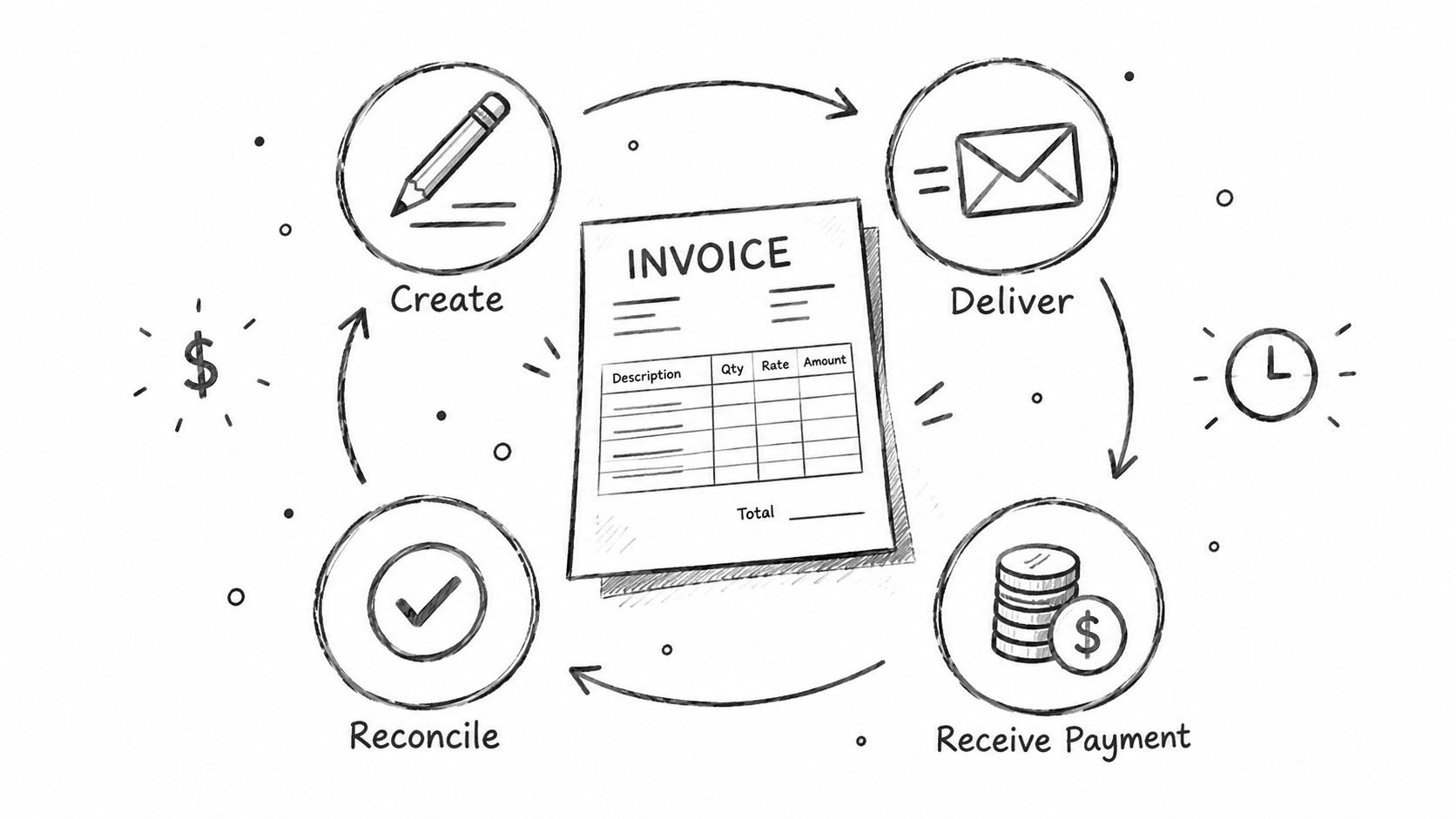
A service business can do everything right on the front end, send a clean invoice, and still wait too long for cash. The document leaves the inbox, the work is already done, and the key question becomes whether the client pays on time, pays in part, or lets the balance drift into overdue territory.
That gap is where many billing problems begin. A good invoice is not just a polished PDF, it is a controlled workflow, a record of what was sold, and a tool for collecting payment without losing track of the balance.
Table of Contents
- What Actually Happens After You Send an Invoice
- The Invoice Lifecycle From Estimate to Payment
- Invoice Terms, Payment Options, and Cash-Flow Tradeoffs
- Why Invoices Get Stuck or Disputed
- How Invoicing Supports Bookkeeping and Tax Readiness
- Practical Next Steps for Smarter Invoicing
What Actually Happens After You Send an Invoice
A cleaner finishes a recurring visit, a consultant closes a project milestone, or a contractor wraps a repair. The invoice goes out, and the work feels complete, but the money still hasn't arrived. At that point, the invoice has become a claim, not proof of payment.
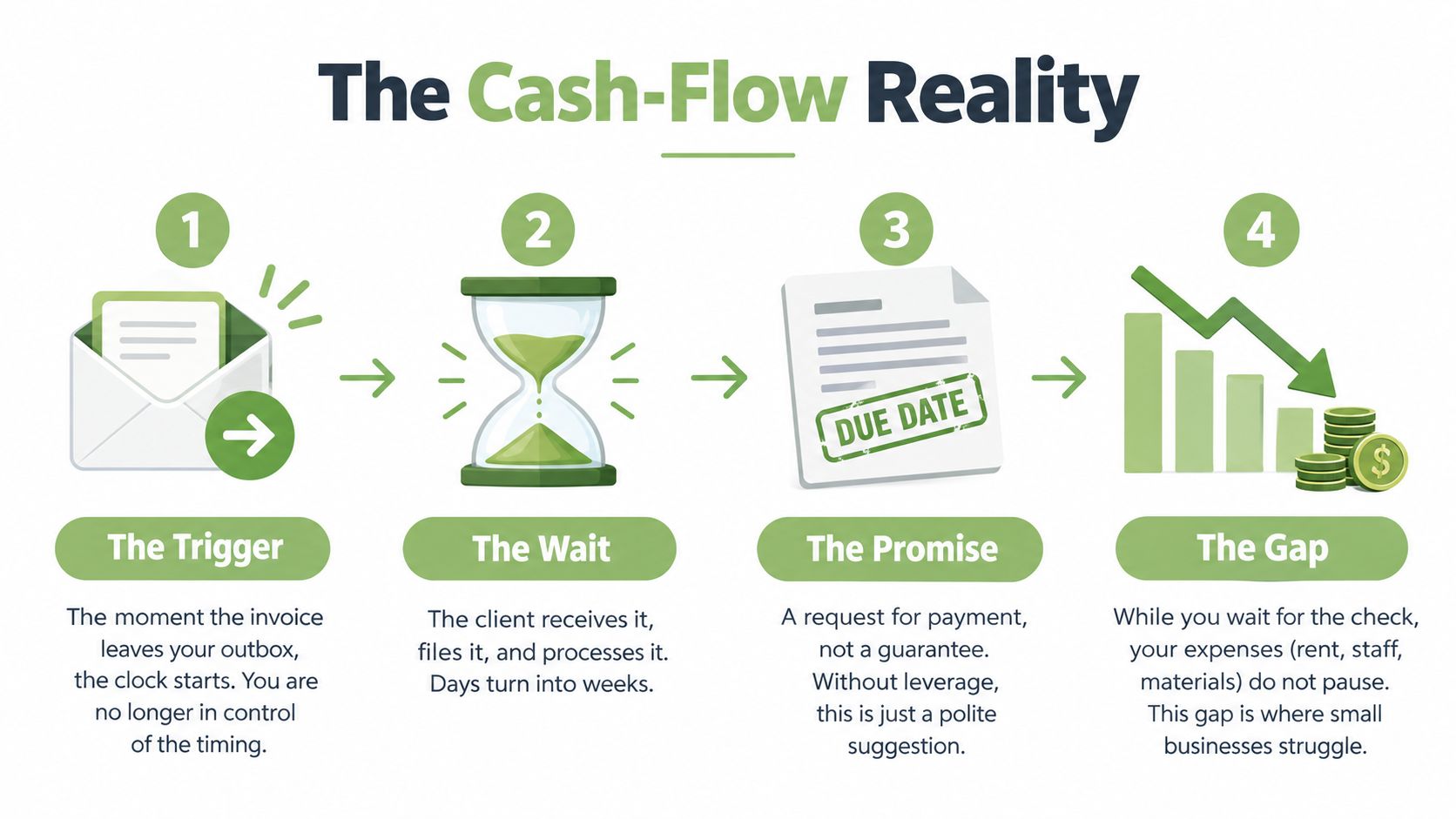
The practical status flow is simple, and it matters: draft, sent, partially paid, overdue, and paid. That sequence keeps the business owner focused on the next action, not just the document itself. An invoice can move through those states while the client is reviewing it, routing it for approval, or waiting for their own internal payment cycle.
Practical rule: if the balance is still open, the invoice is still active.
The moment control drops away
The trigger is the moment the invoice leaves the outbox. From there, the client may accept it quickly, set it aside, or question a line item before paying. That is why deposit collection, milestone billing, and partial payment tracking matter, because they give the business some control before the final balance is due.
The invoice also needs a traceable number, because a sequential invoice number reduces ambiguity when discussing corrections, reconciling payments, or answering client questions. The European Commission's invoicing guidance makes that traceability part of a full VAT invoice structure, along with the issue date, customer and supplier identity, the services supplied, the VAT treatment, and the amount due European Commission invoicing rules.
The gap between billing and cash
The gap shows up when rent, staff time, fuel, software, or materials still need to be paid while the invoice sits in someone else's queue. That's why a billing process has to cover what happens after sending, not just how the template looks. A business that only thinks in terms of “sent” and “paid” misses the operational middle where most cash-flow stress appears.
For a service owner, that middle is where collection discipline lives. The invoice doesn't end the job, it starts the collection cycle.
How to invoice someone can be a useful reference if the current workflow still starts with a blank page every time.
The Invoice Lifecycle From Estimate to Payment
A workable invoice starts before the invoice exists. The estimate or agreed scope sets the boundaries, then the work performed gets translated into billable line items, and only then does the invoice formalize the amount owed. That sequence keeps the document tied to actual work instead of vague memory.
For service businesses, a useful invoice makes the services, quantities, prices, applicable taxes and amount due easy to understand. Any agreed discounts, deposits or partial payments should be recorded so the remaining balance is clear. The European Commission's explanation of EN 16931 describes a semantic model for the core business terms of a structured electronic invoice. That is a specific eInvoicing standard, rather than a universal requirement for every invoice (European eInvoicing standard explained).
From scope to line item
A consultant might bill discovery time, drafting, revisions, and final delivery as separate entries. A photographer might separate shoot time, editing, travel, and licensing. A contractor might itemize labor and materials so the customer can verify what was delivered.
Itemization works because it ties the amount due to measurable work, not to a vague total pulled from memory.
That also makes the invoice easier to approve internally on the client side. If the customer can reconcile the line items with the agreed scope, the approval step gets simpler and fewer disputes start at the collection stage.
What consistent fields do for the business
A strong invoice trail uses the same core fields every time, including the unique invoice number, issue date, customer identity, description of services, currency, tax treatment, payment terms, payment instructions, and payment status. Those fields keep the record usable later, not just presentable at send time.
Quote to invoice becomes especially useful when the estimate and the final bill need to stay connected without retyping the work description. The value there is operational, not cosmetic, because the invoice inherits the approved scope instead of starting over.
The best workflow is usually plain: confirm the scope, log the work, issue the invoice, record any deposit or partial payment, and keep the remaining balance visible. That leaves the owner with a clean paper trail and a client who can see where the number came from.
Invoice Terms, Payment Options, and Cash-Flow Tradeoffs
The payment structure matters as much as the invoice itself. A deposit lowers the customer's unpaid commitment before work begins, milestone billing aligns cash with progress, net terms give the client more time, and immediate online payment shifts collection closer to the send date. None of those is universally best.
| Payment option | Cash-flow impact | Best suited for | Risk to watch |
|---|---|---|---|
| Upfront deposit | Reduces exposure before work starts | Custom projects, bookings, larger jobs | Can create friction if the client wasn't briefed clearly |
| Milestone billing | Brings in cash during the project | Longer service engagements | A milestone can be delayed if delivery slips |
| Net payment terms | Gives the client processing time | B2B work with standard AP cycles | Cash can lag even when the work is finished |
| Immediate online payment | Shortens the path to cash | Smaller jobs and direct client billing | Payment friction if the client prefers invoice routing |
A partial payment should be treated carefully. It reduces the remaining balance, but it doesn't automatically change the original due date unless the business explicitly agrees to that change. That distinction prevents confusion when a client assumes the clock reset just because they paid something.
Choosing terms that fit the work
A small service business that completes one-off jobs usually benefits from simpler collection points, especially when the work is low friction and the client already expects to pay quickly. Larger projects often need staged billing, because the cash required to finish the work shouldn't sit entirely on the service provider.
Cash-flow rule: the more the business fronts labor or materials, the less forgiving the payment terms should be.
The right structure also depends on how the client pays internally. If the customer's payment approval process is slow, an invoice with clear terms and a visible balance is easier to process than a vague request with no milestones or dates.
Why Invoices Get Stuck or Disputed
Most billing failures are not mysterious. The invoice gets stuck because a line item is unclear, a payment term is missing, a client can't match the charge to the work, or nobody has the supporting records handy when questions come up.
That's where disputes become expensive. Stripe describes a dispute, or chargeback, as a cardholder questioning a payment with the card issuer, and the business has to respond with transaction-specific evidence rather than just saying an invoice was sent Stripe dispute guidance. In practice, that means the business should keep the estimate or scope, invoice, payment confirmation, dates of service, delivery records, and any messages about changes or refunds.
The documentation gap
An invoice on its own proves what was billed, not necessarily what was paid. If the client claims the charge was incorrect, the business needs the surrounding evidence to show what was agreed, what was delivered, and what changed along the way.
The cleanest defense starts long before a dispute. Clear descriptions, visible payment terms, and matched records reduce the odds of confusion, especially when the customer's accounting team or card issuer asks for detail.
What usually slows collection
Ambiguous wording is a common problem. So is billing the wrong contact, leaving the payment instructions buried at the bottom, or sending a final invoice without making the remaining balance obvious. Those issues don't just delay cash, they make follow-up harder because the owner has to re-explain the same bill.
A service business does better when each invoice reads like a record a stranger could verify quickly. That makes approval easier and gives the owner better footing if collection turns into a dispute.
How Invoicing Supports Bookkeeping and Tax Readiness
Invoices are part of the business record set, not separate from it. In the United States, the IRS lists invoices, receipts, sales slips, paid bills, deposit slips, and canceled checks as supporting business documents. Its recordkeeping guidance calls for enough detail to determine gross receipts, business expenses, and asset cost (IRS recordkeeping guidance).
For a service business, that means keeping the invoice together with proof of payment when payment arrives. A paid invoice plus a bank record or card settlement is a stronger record than an invoice alone, because the invoice by itself doesn't prove cash changed hands.
A useful file structure
A practical file for each job should connect the estimate or agreed scope, the issued invoice, any deposit or partial-payment record, and the final payment evidence. That makes it easier to answer client questions, track cash flow, and prepare records later.
Invoice template with VAT can help when tax treatment needs to stay consistent across documents, especially if the business works across different billing setups. The main point, though, is discipline. The invoice has to fit into the record trail, not sit outside it.
Keep the invoice, keep the proof of payment, and keep them together.
Practical Next Steps for Smarter Invoicing
A better invoice process starts with three habits. First, define payment terms before work begins. Second, keep deposits, partial payments, and remaining balances visible. Third, save the invoice with the proof that it was paid.
The rest is consistency. Use the same core fields every time, itemize the work clearly, and treat the invoice as a live collection record until the balance is closed. That approach gives the owner a cleaner cash trail and fewer surprises at tax time or in a dispute.
If the current billing process still feels scattered, GetBill gives small service businesses a way to create itemized invoices and estimates, convert approved estimates into invoices, share them by email or link, and record deposits and partial payments with remaining balances. Visit GetBill to see how a more structured invoice workflow can fit a freelancer or service business without turning billing into a second job.