


You finished the job on Friday. The client liked the work, the materials were bought two weeks ago, and the invoice went out Monday. By Wednesday you're checking the account again, because rent and a helper are both due before that money lands. The line that decides whether the gap is a week or two months is the payment term, and most owners pick it by habit.
Invoice payments terms are a financing decision. Every extra day is a day you carry labor, materials, and overhead while the client holds the cash. A friendly long term can turn a profitable job into an unsecured loan. A due-on-receipt term can protect you and still cost a buyer who needs a normal approval cycle. The workable path is a clear window that doesn't make you the client's lender.
Table of Contents
- Common Invoice Payment Terms at a Glance
- How the Due Date Clock Starts and Why It Matters
- Choosing Terms by Client Risk and Cash Needs
- Deposits, Milestones and Partial Payments
- Writing Terms Clients Cannot Misread
- Government Clients Require Complete Invoices
- Put One Standard Term in Writing Before Your Next Estimate
Common Invoice Payment Terms at a Glance
An invoice payment term is the deadline a client must pay by, written as due on receipt, a number of days after a trigger date, or a fixed calendar date.
Take one invoice dated March 1, 2026. The dates below are what each label means on a calendar, before anyone argues about it.
| Term | What It Means | Due Date for a March 1, 2026 Invoice | Best Fit |
|---|---|---|---|
| Due on receipt | Payment is due when the client receives the invoice | March 1, 2026 | Small one-time jobs and new clients |
| Net 15 | Payment is due 15 days after the invoice date | March 16, 2026 | Trusted clients with short approval cycles |
| Net 30 | Payment is due 30 days after the invoice date | March 31, 2026 | Standard commercial default |
| Net 45 | Payment is due 45 days after the invoice date | April 15, 2026 | Clients with formal approval steps |
| Net 60 | Payment is due 60 days after the invoice date | April 30, 2026 | Large organizations; highest cash exposure |
| Net 30 EOM | Payment is due 30 days after the end of the invoice month | April 30, 2026 | Monthly retainers and recurring billing |
| 2/10 Net 30 | Client takes 2% off if paid within 10 days; full balance due by day 30 | 2% discount through March 11, 2026; full amount by March 31, 2026 | Clients who value early-payment discounts |
| Deposit | Part of the fee is due before work begins | Due on signing, not tied to the invoice date | Projects with materials, scheduling or long lead times |
Due on receipt suits a small one-off or a first-time client. Cash is due when the invoice arrives, so you aren't extending credit you haven't earned. Net 15, due March 16, fits a known client with a short approval path. Net 30, due March 31, is the commercial default most payables teams already run.
Net 45 (April 15) and Net 60 (April 30) match buyers with formal sign-off, and they tie up the most cash. Net 30 EOM doesn't start on March 1. The count starts at month-end, so that same invoice is due April 30, which fits a retainer better than a one-day job. 2/10 Net 30 trades 2% off for payment by March 11, with the full balance due March 31. Offer it only when the margin can absorb the cut. A deposit is due on signing, not on the invoice date.
A term is only as clear as its trigger. Net 30 with no start date leaves room to argue about which day the clock began.
How the Due Date Clock Starts and Why It Matters
A photographer delivers final images on April 2, 2026 and sends the invoice on April 5. Net 30 from the invoice date is due May 5, 2026. Net 30 from delivery is due May 2, 2026. Net 30 from client approval has no date until someone approves the gallery. Same job, three clocks. The slowest one is a loan you never priced.
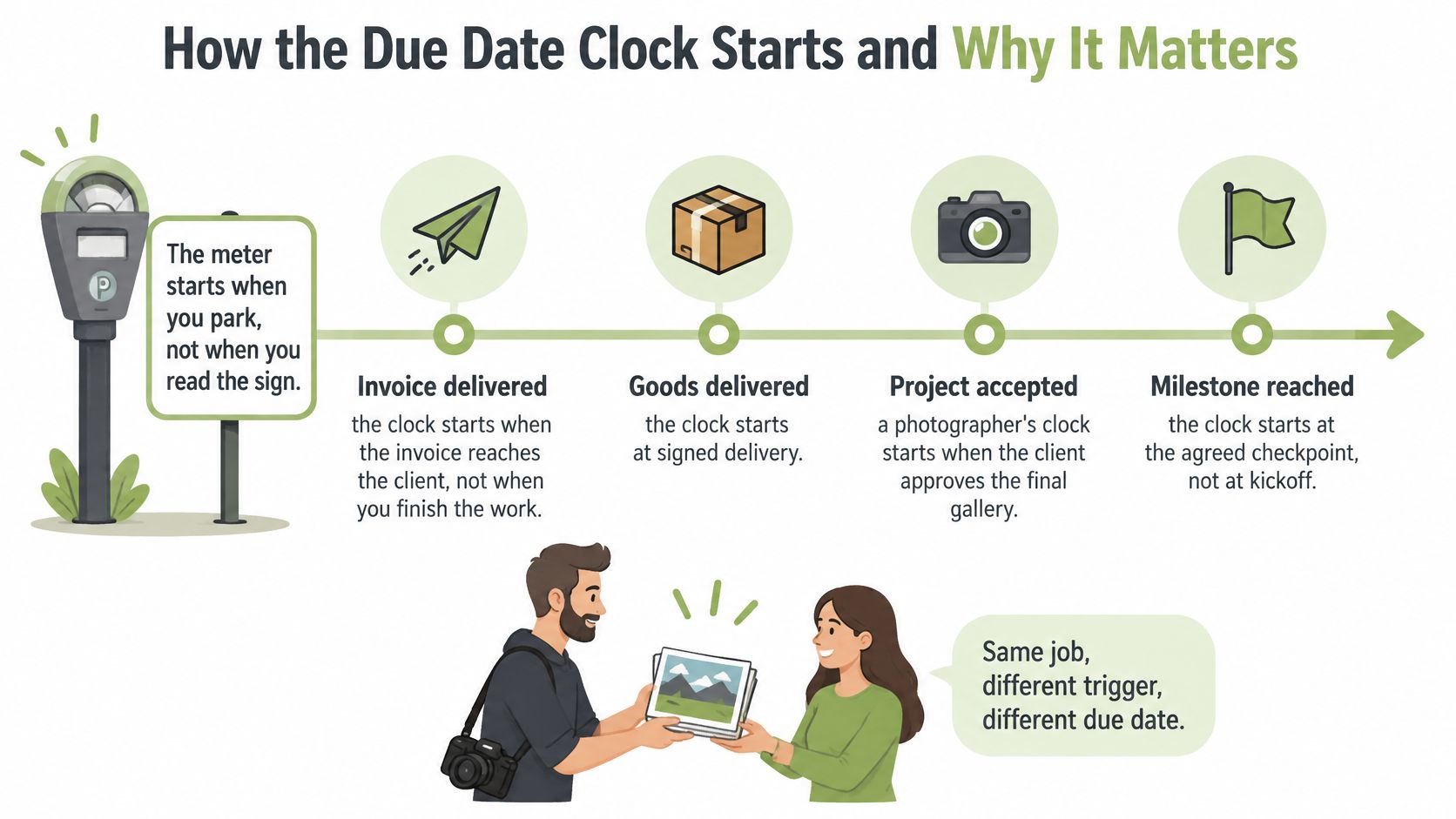
If the invoice never names the start, the client can treat delivery, approval, or the day finance opened the file as day one. You keep carrying labor and expenses until that argument ends. A later trigger is a cash-flow choice when you set it on purpose. An unnamed trigger makes you the client's lender by default.
Same job, three different due dates
The approval version works only if the agreement says what counts as approval and who confirms it in writing. Until that confirmation exists, there is no due date to be late against, so a late fee has nothing to attach to. The invoice date and due date on the bill should repeat the trigger you already signed, so the calendar date is not a surprise.
When the invoice is silent
For a private US client, the signed agreement and applicable state law control. A missing date turns into a fight over when payment was due and whether a late charge can run at all. Put any fee or interest rate in the signed agreement, with the amount and the day it starts, and check that state's caps before you add it. Verify the rule where the client sits. This is not a substitute for local advice.
Outside the US, do not assume the same clock. The UK Small Business Commissioner interest guidance states that an unpaid invoice with no agreed date is generally due within 30 days, that businesses can set upfront payment or early-payment discounts, and that statutory interest on UK business-to-business debts is commonly 8 percentage points above the Bank of England base rate, plus potentially fixed recovery compensation. Other countries set their own payment periods and recovery rules, so a US-style reminder is not a collection plan.
If the buyer is in Israel, read the steps before an invoice turns bad from RNC Group before you treat a domestic follow-up as enough.
Every invoice needs three parts. Name the trigger, state the number of days, and print the calendar due date. Keep proof of when you sent the invoice and when the client accepted the work.
Choosing Terms by Client Risk and Cash Needs
Every day on the term is a day you finance the job. The label on the invoice is a credit decision.

A 2025 US survey found that 56% of small businesses had unpaid invoices, with affected businesses owed an average of $17,500, and that cash-flow problems hit 60% of businesses using longer payment terms, compared with 40% using immediate terms, according to the Intuit QuickBooks small business late payments report. Longer credit shows up as a thinner bank balance, not as goodwill you can spend.
Match the term to the buyer
| Situation | Suggested Term | Why |
|---|---|---|
| New client, small one-off job | Due on receipt or a deposit first | Limits exposure before the work starts |
| Repeat client with a clean payment history | Net 15 or Net 30 | Predictable timing without extra credit risk |
| Large project running several weeks | Deposit plus milestone invoices | Keeps unrecovered labor and materials small |
| Client with an approval committee or procurement queue | Net 30 or Net 45 with the approval step stated | Reflects the real timeline without open-ended waiting |
| Client with repeated late payments | Shorter term, deposit and a written stop-work clause | Reduces the credit you extend |
| Retainer client billed monthly | Net 30 EOM | Matches the billing cycle to month-end cash |
Read the row against your own numbers, not against what the client calls standard.
History comes first. A repeat buyer who pays cleanly can sit on Net 15 or Net 30. Two late payments in a row means a shorter term on the next job, not a longer one.
Cash you spend before you bill is next. Materials, a rental, or a subcontractor paid weekly raise the amount at risk even when the client is pleasant.
Runway is weeks of rent, insurance, payroll, and software you can cover from cash on hand. Three weeks of runway and a Net 60 term don't belong on the same job.
The approval path is real for some buyers. Name the step in the term so the wait has an end. Job length matters too. A Saturday call-out and a six-week build shouldn't share a due date.
A stricter term can cost a client who wants flexibility. A longer term can turn a profitable job into an unsecured loan.
Keep one standard term for most clients. Offer one extension only after a clean history, and attach a deposit to that extension. A $3,000 monthly cleaning contract on Net 60 leaves roughly $6,000 outstanding at a time, because the second invoice goes out before the first is paid. Owners comparing borrowed cash with shorter terms can look at funding options for London small businesses from Action Accountants. Borrowed money has a price. So does the credit you give away.
Deposits, Milestones and Partial Payments
An $8,000 home-office build shouldn't be one invoice on the last day. Split it so materials and labor aren't all sitting unpaid at the end.
| Payment | Trigger | Share of Total | Amount |
|---|---|---|---|
| Deposit | Signed agreement | 50% | $4,000 |
| Milestone | Framing approved by client | 25% | $2,000 |
| Final balance | Completion, due 15 days later | 25% | $2,000 |
| Total | Full project | 100% | $8,000 |
The deposit is due when the agreement is signed, before materials are ordered or the calendar is blocked. Say what it covers, such as fixtures and the first week of labor, and say whether it is refundable if the client cancels. The milestone is due when the client approves the framing, not when the work looks finished to you. The final balance is due 15 days after completion.
Each later document credits what has already been paid and shows what remains. After the $4,000 deposit, the open amount is $4,000. The $2,000 milestone drops it to $2,000. A payment that lives only in a text thread gets requested twice or missed.
Write three facts beside each amount on the estimate. What the payment covers, whether it is refundable, and which event makes it due. A deposit invoice template is a layout for those lines. It doesn't decide refund rights under state contract law.
Federal income tax on an advance payment
A deposit isn't automatically tax-free because the work isn't finished. For a taxpayer using an applicable financial statement, Treasury Regulation 1.451-8 provides that an advance payment for services is included in gross income for the year of receipt to the extent it is recognized as revenue on that financial statement by year-end. Keep the estimate that shows what the deposit covers, record the receipt accurately, and ask a tax professional how your accounting method and state rules affect recognition. That federal rule doesn't set a universal payment term, and it doesn't decide refundability.
The business that issues the invoice stays responsible for the services, the payer relationship, payouts, chargebacks, refunds, disputes, taxes, and compliance. Collecting a deposit doesn't move those duties onto the client or onto billing software.
Writing Terms Clients Cannot Misread
Plenty of late invoices aren't ignored. They stall on a missing purchase order, a scope question, or an approval nobody named.
The 2025 Atradius Payment Practices Barometer for North America reported that 43% of B2B invoices were overdue, with administrative delays and invoice disputes identified as leading causes. Average payment terms were about 45 days, while late payments often took twice as long to resolve.
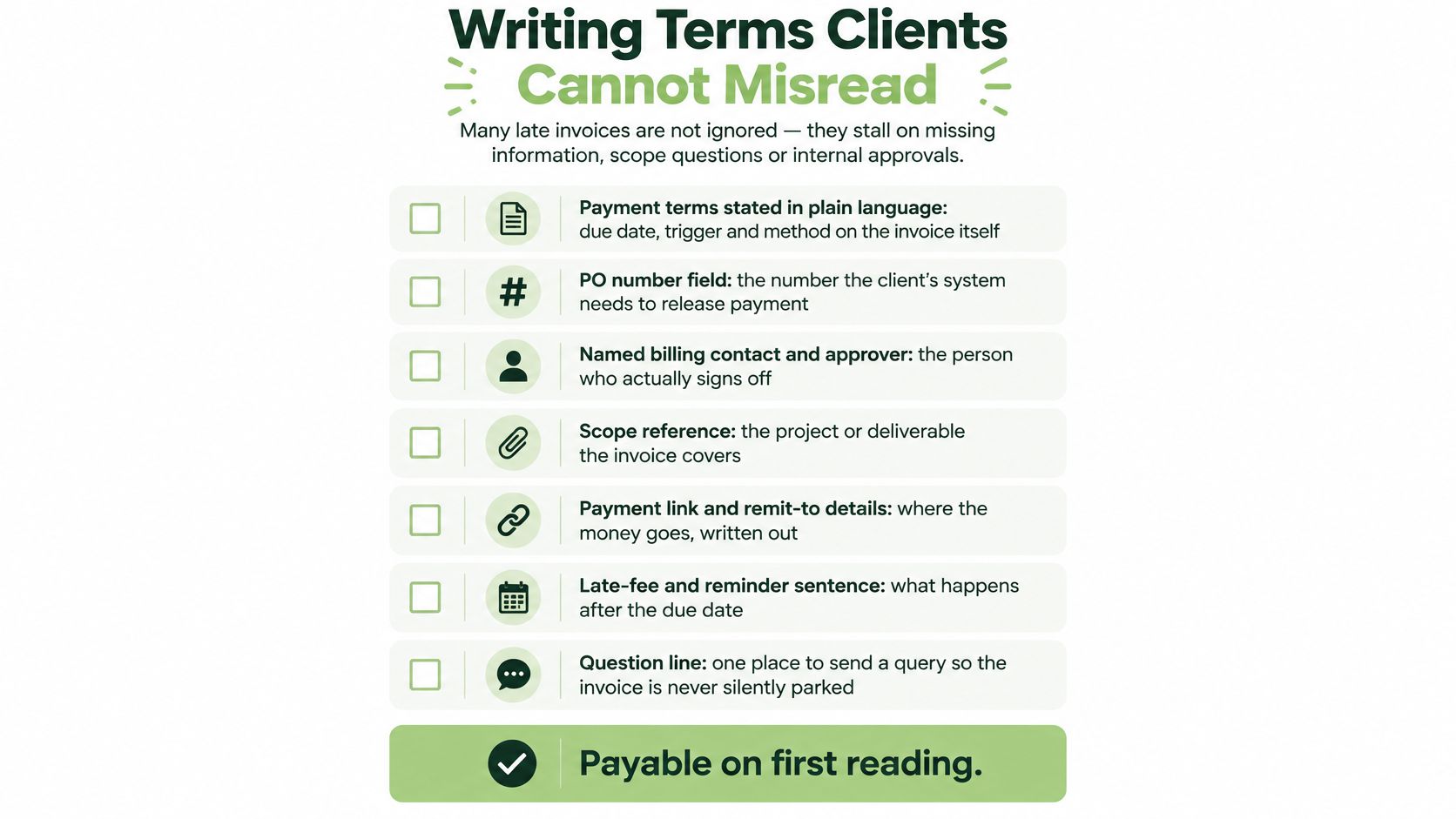
Fields that make an invoice payable
- Legal name and billing entity: The company that will pay, not a nickname from the job site.
- Purchase order or approval number: The reference their system needs before it will release funds.
- Itemized scope: Hours or quantities, rates, and what was delivered.
- Tax treatment: What is taxable in that client's jurisdiction, stated on the face of the bill.
- Accepted methods: Bank transfer, card, or both, with where the money goes.
- Credits: Any deposit or earlier payment, applied in plain figures.
- Milestone: The checkpoint this invoice covers, if the job is split.
- Due-date trigger: The event, the number of days, and the calendar date.
Three stalls, three responses
A disputed invoice is one where the client objects to scope or amount. Fix the scope in writing before you press for collection. An unpaid but valid invoice has no objection. The next step is a reminder that quotes the contract date, not a new negotiation. A payment blocked by internal process, such as a missing purchase order or an unfinished vendor setup, needs a call to the accounts-payable contact. Ask for the reference and the submission route, then resend once, complete.
Wording a clerk can apply without calling you looks like this. 'Payment is due 30 days after the invoice date by bank transfer or card. The $4,000 deposit received on March 3, 2026 is credited on this invoice.'
Every term on the invoice has to match the signed agreement. The bill should never introduce a fee, a discount, or a due date the client hasn't already accepted.
Government Clients Require Complete Invoices
Federal work and private work don't share a rulebook.
The federal Prompt Payment Act, 31 U.S.C. 3901 and related provisions, covers qualifying payments by US federal agencies for property or services. It requires an interest penalty when an agency misses the required payment date. On federal contracts, the government generally pays that penalty automatically when the conditions are met, without a separate request from the contractor. That protection doesn't carry over to a private client. For ordinary commercial work, any late fee or interest rate belongs in the signed agreement, and state law should be checked before you charge it.
What a proper invoice adds
Under 31 U.S.C. 3903, federal agencies must review invoices promptly, and an invoice that isn't a proper invoice must generally be returned within seven days with the reasons identified. Beyond a complete commercial bill, a federal invoice needs the contract or purchase-order number, the service period or milestones, quantities or hours and rates, the total, payment instructions, and delivery to the billing office named in the contract.
The seven-day return rule belongs to the federal acquisition system. It isn't a deadline for private clients. For a commercial customer, the contract still sets the date.
Before the first invoice, ask the accounts-payable contact for the reference numbers and the submission route. A returned bill costs a week you have already used. Rules in other countries are their own checklists. The EndureGo Tax invoice compliance guide from EndureGo Tax covers Australian tax-invoice requirements. Those aren't a US federal rule, and they shouldn't be copied onto a domestic service invoice.
Put One Standard Term in Writing Before Your Next Estimate
Pick one default this week and put it on every estimate. Rewriting terms for each caller is how a short term becomes a long one.
- Choose a default for each client type you serve. A cleaner with repeat households doesn't need the same default as a contractor bidding institutional work. Match the typical buyer, then stop inventing a new term on the phone.
- Write the trigger and the number of days into the estimate. The invoice is too late to negotiate. If you want payment 15 days after completion, the estimate should say so before anyone signs. Estimate terms and conditions belong next to the price, not in a footer nobody reads.
- List each deposit and milestone with its trigger. "50% on signing, 25% when framing is approved, 25% fifteen days after completion" is a schedule. "Progress billing" isn't.
- Repeat the same terms, due date, and payment method on the invoice. If the estimate says bank transfer and the invoice adds a card fee, you've opened a dispute.
- Record every payment and show the remaining balance on the next document. A deposit that exists only in a message thread will be questioned.
- Review open invoices weekly. A reminder that quotes the contract date is a record. A reminder with no date is only a nudge.
If you bill from GetBill, an accepted estimate can be converted into an invoice with one click, without re-entering the line items. Deposits and partial payments can be recorded from cash, cards, or bank transfers, and the balance stays updated. GetBill doesn't warrant that invoices, estimates, calculations, templates, or tax settings will meet legal, tax, or accounting obligations. The wording still needs your review and, where a late fee or a deposit's tax treatment is in question, a professional's.
Set one standard term this week. Don't rewrite it for every client who asks for more time unless the deposit moves with the extension.
GetBill is built for freelancers and small service businesses that send estimates and invoices, show a due date the client can read, and record deposits and partial payments while the remaining balance stays visible. Card payments go through a connected Stripe account, and GetBill doesn't hold the funds. Put the term on the next estimate and send it from GetBill.