


The client has approved the design, the consultant has delivered the recommendations, or the handyman has finished the repairs. The work is complete, but the business account hasn't changed. Somewhere between the approval email and the next bill payment, the owner still needs to turn completed work into money received.
Invoicing as a freelancer means managing that gap deliberately. A reliable billing workflow starts before work begins, carries the agreed scope into an understandable invoice, and continues until the payment has been recorded. Professional presentation helps, but cash-flow protection comes from clear agreements, timely billing, and consistent follow-through.
Table of Contents
- Why Freelancer Invoicing Deserves the Same Attention as Delivery
- Setting the Price Before You Send Anything
- What Every Freelancer Invoice Has to Include
- Choosing Payment Terms That Fit Your Cash Flow
- Sending the Invoice and Getting Paid
- Tax Records the Invoice Should Support
- The Weekly Freelance Billing Routine
Why Freelancer Invoicing Deserves the Same Attention as Delivery
A photographer sends an edited gallery, and the client replies with approval. The project contact assumes accounting will arrange payment, while accounting waits for an invoice with the right business name and project reference. The work is accepted, but the money remains stuck between delivery and payment.
That gap is where cash-flow risk builds. An invoice documents the payment obligation, recording the work completed, the agreed charges, and the amount still due. It gives the client's accounts team what they need to process payment and gives the freelancer a record to follow up against. It does not confirm that money has arrived.
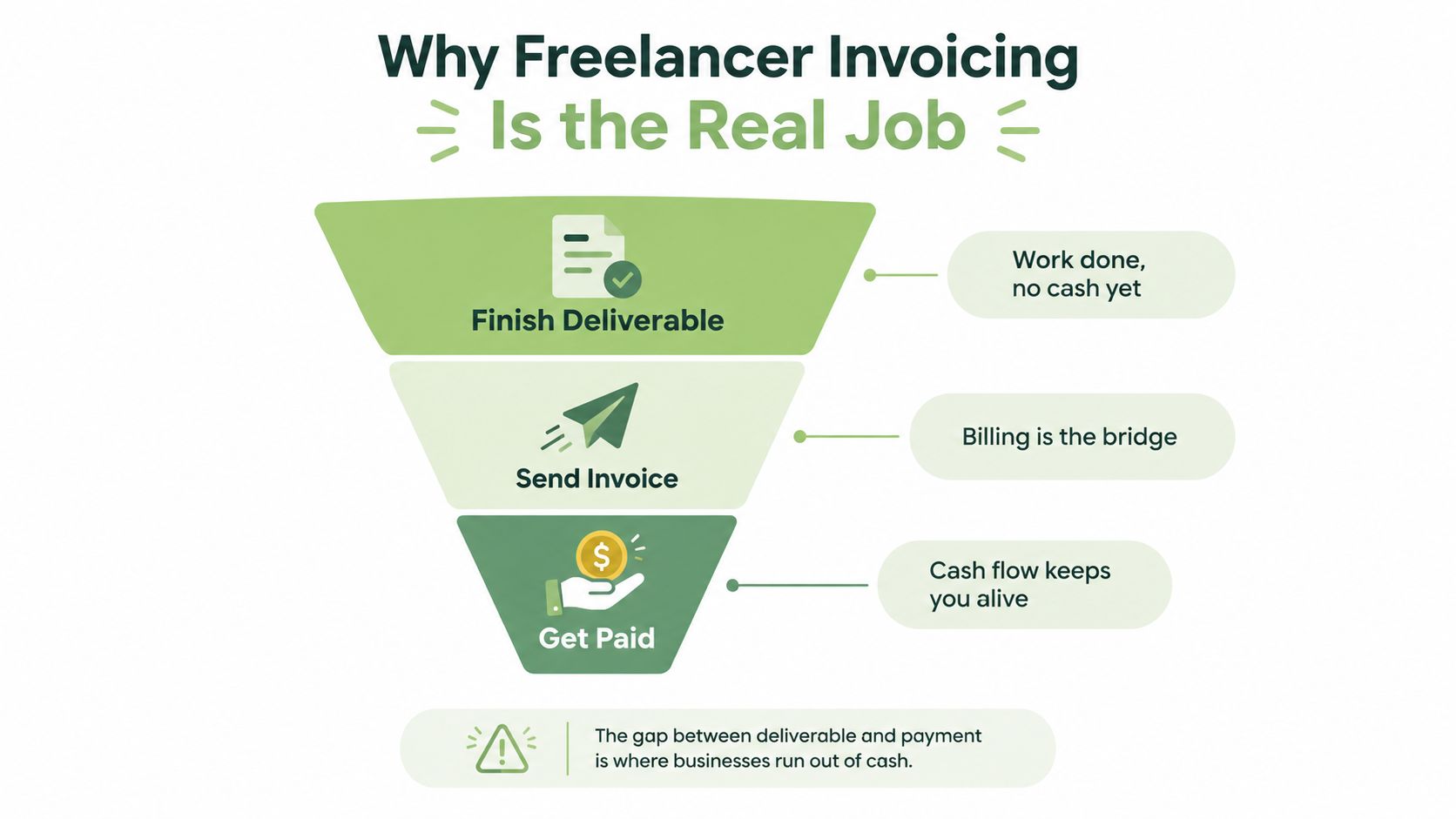
Completion Isn't Collection
A completed project can still leave a small service business carrying unpaid labor, materials, or subcontractor costs. Put approved work into the billing queue as soon as it is ready. Leaving it in a project archive can mean starting another job while still financing the last one.
Keep earned revenue, an outstanding invoice, and money received separate in your records. They mark different stages of the cash-flow process. An invoice waiting for approval is not cash available for rent, supplies, or other operating expenses.
A client's satisfaction is valuable, but it isn't a payment record.
Build a Handoff That Accounting Can Use
During onboarding, confirm the billing contact as well as the person who approves the work. For a larger organization, ask whether accounts payable requires a purchase-order reference, a vendor portal submission, or proof that the work is complete. A cleaner working for a household may only need to send the invoice directly to the client.
- Identify the recipient. Confirm who processes payment instead of assuming the project contact does.
- Preserve approval evidence. Store the accepted estimate and completion confirmation with the billing record.
- Separate delivery from settlement. Mark the work complete, then track the invoice as unpaid until payment arrives.
A well-designed PDF makes an invoice easier to read, but presentation alone cannot clear an unapproved price, missing billing instructions, or a dispute over whether the work is finished. The invoice is a working financial record, so make sure it reflects what was agreed and lets you see what remains unpaid.
Setting the Price Before You Send Anything
The estimate is where a service business decides how much unpaid exposure it can accept. Pricing only the visible work leaves the owner vulnerable to revisions, materials purchased upfront, and client decisions that extend the project. Scope and payment structure belong in the same conversation.
Payment risk is not hypothetical. IPSE reports that 54% of surveyed freelancers had experienced a client payment delay during their self-employed career. Respondents who had experienced late payment were owed an average of £5,230 for completed work. These UK survey findings describe the respondents and do not predict an individual client’s payment behavior.

Match the Pricing Model to the Uncertainty
Hourly pricing suits work whose requirements are still developing, such as troubleshooting or open-ended consulting. The trade-off is that the client needs visibility into time spent and permission to review spending before the assignment expands.
Project pricing suits a defined outcome. A designer can price an agreed deliverable, but the estimate should identify included revisions, required client inputs, and exclusions. Without those boundaries, a fixed price can become an unlimited commitment.
A retainer can suit ongoing advisory or maintenance work. Its scope still needs limits: reserved availability, included services, and treatment of unused capacity shouldn't be left to assumption.
Make the Estimate Usable for Billing
A practical estimate connects the service description to the later invoice rather than presenting an unexplained total.
- Define the deliverable. A handyman should distinguish the agreed repair from additional damage discovered after opening the work area.
- Name dependencies. A photographer should specify which client approvals or materials are needed before delivery.
- Separate optional work. Additional services should remain outside the approved total until accepted.
- State billing triggers. The agreement should explain when the deposit, milestone charge, or final balance becomes payable.
A reduced scope also needs written confirmation. Removing a deliverable doesn't automatically establish a revised price, especially when preparation or purchasing has already occurred. Both parties should approve the changed work and amount before the final invoice is prepared.
What Every Freelancer Invoice Has to Include
An accounts-payable reviewer should be able to match the invoice to approved work without reconstructing the project from email. Specific descriptions and visible arithmetic make that review easier. They also give the owner a dependable record when a client disputes a charge.
Historical US evidence illustrates why collection deserves attention: a 2015 Freelancers Union survey of 5,358 freelancers found that 71% had struggled to collect payment at some point; among respondents with payment trouble in 2014, 81% reported late payment, with average late payments of $5,735, as documented in the Freelancers Union’s The Costs of Nonpayment report.
Fields a Freelancer Invoice Needs
These are practical billing fields, not a claim that every jurisdiction imposes identical invoice requirements.
| Field | Purpose |
|---|---|
| Business name and contact details | Identify the provider and where billing questions should go. |
| Client name and billing details | Identify the customer responsible for payment. |
| Unique invoice number | Connect correspondence and payments to the correct document. |
| Issue date and due date | Show when billing occurred and when payment is expected. |
| Estimate, contract, or purchase-order reference | Match the charge to approved work. |
| Itemized services, quantities, and rates | Explain the work and calculation. |
| Subtotal, adjustments, and applicable tax | Show how the total was calculated. |
| Currency and invoice total | Remove ambiguity about the amount billed. |
| Payments received and remaining balance | Prevent a deposit from being overlooked or billed again. |
| Payment instructions and agreed terms | Give the client a usable route to settlement. |
Write for Someone Who Wasn't at the Meeting
A line labeled “consulting” leaves too much interpretation. “Operations review and written recommendations under the approved estimate” identifies the deliverable; hourly work should also show the recorded quantity and agreed rate. Approved extra work should have its own description and reference.
For UK sole traders, Stewart Accounting Services' UK invoice template for sole traders provides a jurisdiction-specific starting point. A US business shouldn't copy UK tax treatment or required fields without checking its own requirements.
Document discipline: The invoice should reflect the agreement, not introduce a new one.
Late-fee notes should match previously agreed terms, with local legal requirements checked before applying charges. A scope change buried in correspondence should be linked to its approval rather than presented as a surprise addition.
Choosing Payment Terms That Fit Your Cash Flow
A signed-off project can still leave you short of cash if the client's payment deadline falls after your own bills are due. Payment terms set how long you agree to wait, not how reliably a client will pay. Net-15 means payment is due within fifteen days of the agreed starting point; net 30 payment terms allow a longer wait. These are contractual choices, not guarantees of collection.
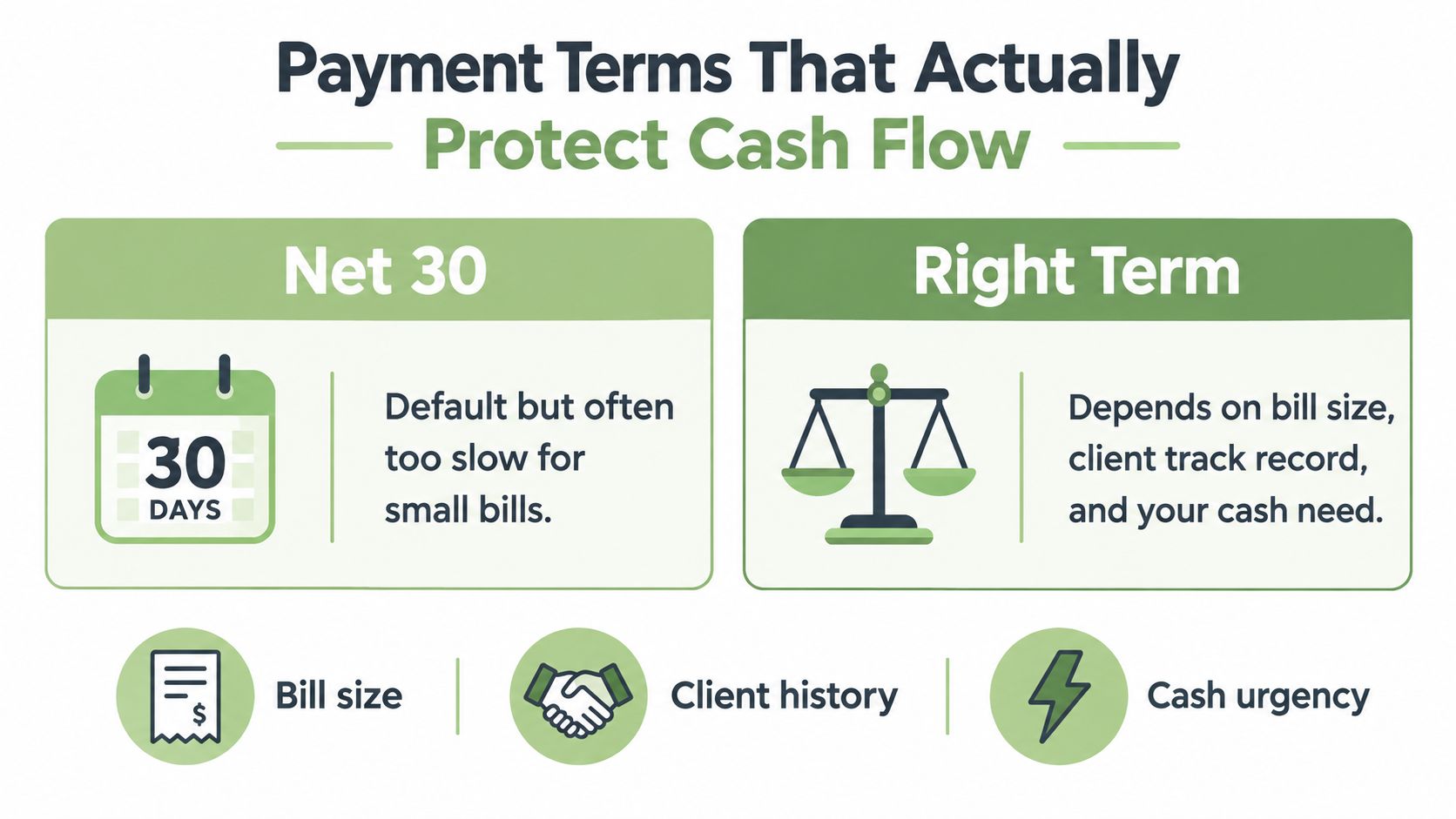
Compare the Waiting Period With the Work Funded
A short deadline can suit a small, completed assignment, as long as the customer accepts it before work begins. Longer terms may fit an established procurement process. The trade-off is that you must have enough cash to carry the work until payment arrives.
That gap matters most when you pay for materials or subcontractors before invoicing. A larger client's professional reputation doesn't tell you how long invoice approval takes, so ask about its process before accepting its terms.
| Arrangement | Cash-flow benefit | Trade-off |
|---|---|---|
| Shorter payment terms | Limits the agreed waiting period | May conflict with the client's payment process |
| Upfront deposit | Reduces initial unpaid exposure | Requires the client to commit before delivery |
| Milestone billing | Connects payment to completed stages | Needs clear acceptance criteria |
| Longer terms | May fit client procurement | Leaves the provider funding work for longer |
Negotiate Exposure, Not Just the Deadline
If a client can't shorten its standard terms, propose a deposit or separately billable stages. Define milestones using observable completion, such as delivery of approved design files, rather than a vague sense of progress. This makes the payment trigger easier to confirm and reduces the amount of work left unpaid at once.
Agree on a pause-work threshold and the notice process for overdue invoices before work starts. A written response plan helps you avoid choosing between an abrupt confrontation and continuing work without payment.
The invoice date and due date determine when the agreed waiting period begins. State the calendar deadline, and clarify whether the clock starts when the invoice is issued, received, or another agreed event occurs.
For partial payments, show the original charge, the amount received, and the outstanding balance. If you revise the payment schedule, state whether the remaining amount keeps its original deadline or follows newly agreed dates. That record gives both parties a clear basis for tracking what is still owed.
Sending the Invoice and Getting Paid
A prepared invoice still needs a usable delivery channel. A PDF attachment can be convenient for a client who files documents locally; a public document link may suit someone reviewing bills from a phone. If the customer requires a billing portal, an email alone may not complete the submission.
The delivery message should be short and operational. Include the invoice reference, outstanding amount, due date, and payment instructions, then send it to the agreed billing recipient. The project contact can be copied when that helps connect approval with payment.
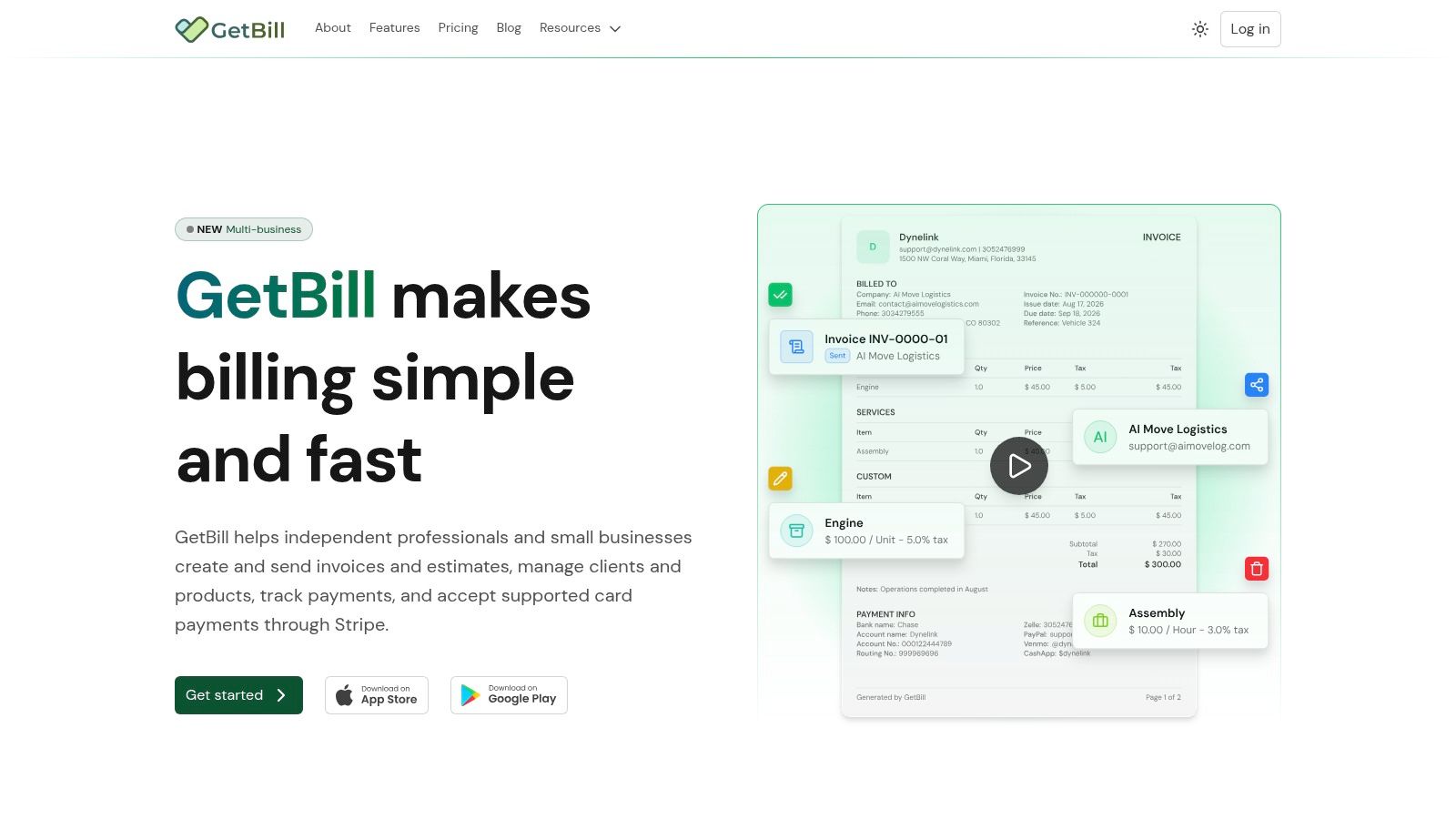
Test the Payment Path Before Relying on It
A business offering online payment should check the actual workflow rather than assume every payment button supports the same arrangement. Stripe’s documentation distinguishes customer-specific Invoicing from reusable Payment Links: its comparison lists partial payments and payment plans for Invoicing, not Payment Links. These are Stripe product capabilities; GetBill’s supported payment workflow must be checked separately for the connected account and region.
The owner should confirm that the selected route charges the intended amount and identifies the payment against the correct invoice. An estimate mentioning a deposit isn't evidence that the deposit was collected.
- Check document access. Open the attachment or shared document as a recipient would.
- Check payment instructions. Confirm that the amount and destination match the invoice.
- Check submission evidence. Retain the sent message or portal confirmation.
- Reconcile actual receipt. Don't mark an invoice paid merely because the client says payment is coming.
Follow Up Without Restarting the Conversation
For a new client, confirm that the invoice reached the correct recipient. If the deadline passes, the reminder should reference the same invoice, restate the balance, and ask for a specific payment date.
A useful reminder to pay stays factual rather than apologetic. If the client reports an administrative problem, ask which document or approval is missing and who can resolve it.
Keep the payment discussion about an identifiable invoice and a concrete next action.
When a client disputes only part of the work, distinguish the disputed charge from the undisputed balance. Any concession or revised schedule should be recorded in writing so the next reminder reflects the current agreement.
Tax Records the Invoice Should Support
Billing and tax preparation use related records, but they aren't the same task. An invoice records a customer's obligation; payment records show what arrived. Neither document alone establishes that the business has met its tax-payment requirements.
For US federal taxes, IRS guidance for independent contractors says business income is generally reported on Schedule C and net self-employment earnings of $400 or more generally require Schedule SE. The IRS also explains that clients typically don't withhold federal income tax, estimated payments may be necessary, and failing to make required payments on time can result in an underpayment penalty.
Keep a Connected Record of Each Engagement
The practical objective is traceability. An owner should be able to move from an accepted estimate to the invoice, from the invoice to the payment record, and from an expense entry to its supporting document. That makes later review more dependable than searching scattered attachments.
- Preserve the agreement. Keep accepted estimates, scope revisions, and pricing approvals.
- Retain issued documents. File invoices and any later adjustments without overwriting the history.
- Match receipts to invoices. Record payment dates, amounts, and references.
- Keep expense support. Retain documentation for business costs separately from customer billing.
Gross customer charges and money deposited may differ when processing fees or other adjustments apply. Recording only the bank deposit can make it harder to explain the difference during bookkeeping review.
Verify the Rules That Actually Apply
Form 1040-ES or a tax professional can help evaluate federal estimated-payment requirements under the IRS guidance above. State and local obligations require separate review; the federal self-employment framework doesn't settle whether a particular service is subject to sales tax.
Cross-border work needs its own check. A guide to an invoice template with VAT can help organize relevant fields, but a template doesn't determine registration status, the correct tax treatment, or the required document format.
Before billing an unfamiliar jurisdiction, the owner should verify the applicable tax fields, customer classification, submission requirements, and record-retention duties with the relevant authority or adviser. Software should support that determination, not substitute for it.
The Weekly Freelance Billing Routine
Set a weekly time to review the billing queue before unpaid work or late payments disrupt cash flow. Decide which completed work is ready to invoice, which payments have arrived, and which overdue accounts need a follow-up. Regular review makes it easier to act while there are still clear next steps.
The 2025 Leapers freelancer research report found that 67.5% of surveyed freelancers experienced late payments; among that group, 81.2% reported additional stress. Separately, 43.4% of respondents encountered payment terms of 60 days or more. A regular billing review can help identify overdue invoices and decide the next follow-up action.
Run the Billing Queue
- Review approved work. Check active estimates against completed work and milestone records, then invoice when the agreement says payment is due.
- Complete delivery. Send each invoice through the required channel and make its payment instructions easy to find.
- Record money received. Match deposits and partial payments to the correct invoices, then confirm each remaining balance.
- Resolve exceptions. Follow up on overdue accounts, missing approvals, and disputed charges before taking on more unpaid work for that client.
Keep invoicing promptly when work reaches an agreed billing trigger. The weekly review catches missed invoices and keeps payment status current; it should not delay a bill that is already due.
Automate Reentry Before Adding Complexity
A spreadsheet can work for occasional billing if you keep it up to date. Invoicing software may save time when you repeatedly enter client details, service descriptions, or transfer estimates into invoices. The trade-off is simple: faster preparation still requires a final review.
Check saved records before reusing them. An old rate or billing address can carry forward just as easily as accurate details, so templates reduce typing, not responsibility.
For field-service operators, mobile billing can complete the handoff before leaving the job. Branded PDFs create a consistent presentation, and white-label documents on eligible plans remove application branding. Neither feature collects an overdue balance on its own.
Give every outstanding amount an owner, a status, and a next action. More elaborate software cannot replace that weekly discipline.
GetBill offers itemized estimates and invoices, estimate-to-invoice conversion, branded PDFs, document sharing, and records for deposits and partial payments. If your weekly billing still involves repeated manual entry, try GetBill's estimate-to-invoice workflow and see whether it removes that work. Supported online card payments depend on a connected Stripe account and region.