

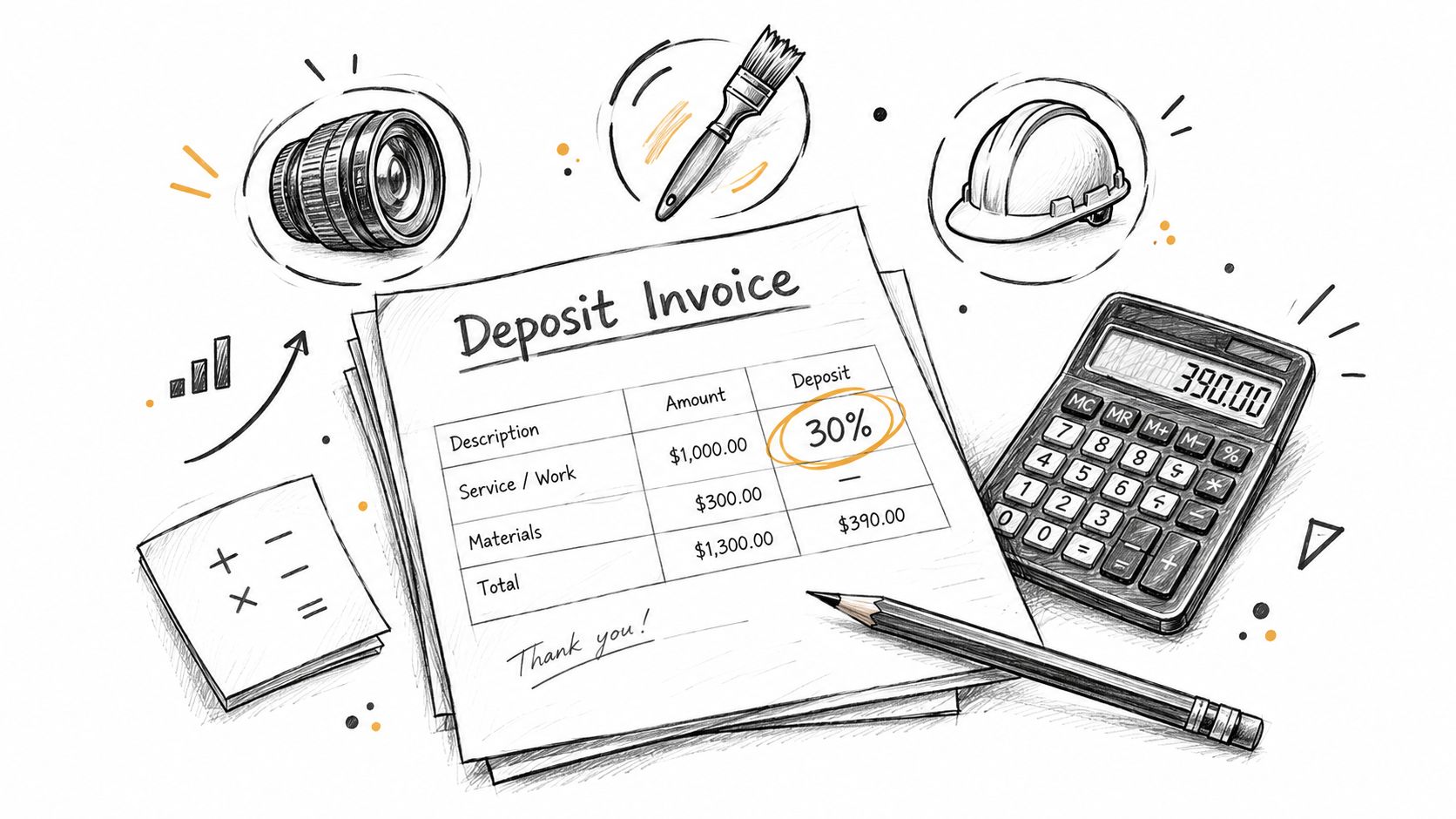
A client says yes, the calendar slot is blocked, and materials need ordering before a single hour of billable work happens. That's the moment a deposit invoice example stops being a template search and becomes a cash flow decision. The document has to ask for money clearly, protect the booking, and still reconcile cleanly when the final bill goes out.
Table of Contents
- A Contractor Books a Job and Needs Cash Up Front
- What a Deposit Invoice Is and What It Is Not
- Calculating a Deposit That Actually Covers Your Risk
- Anatomy of a Deposit Invoice With Sample Numbers
- From Deposit Received to Final Invoice Without Double Charging
- Tax Treatment and Jurisdictional Questions to Verify
- Putting It Together With a Short Pre-Send Checklist
A Contractor Books a Job and Needs Cash Up Front
A contractor has just confirmed a $4,000 service job. Lumber, fixtures, and a helper's time must be committed this week, but delivery is weeks away. Billing everything at the end means the business funds the client's project and hopes the final invoice gets paid on time.
That hope is expensive for small firms. In UK government research published in 2024, 49% of small businesses reported that business customers took longer than typical agreed terms, and 32% of microbusinesses paid their own suppliers late because customers had paid late, according to UK late payments research on payment performance across business sizes. The figures come from the UK, but any owner who invoices clients directly recognizes the chain reaction.
The Two Stage Payment Schedule
For this job, the owner asks for 30%, or $1,200, before work begins and $2,800 on delivery. The deposit isn't a penalty or a test of trust. It covers costs the business must pay whether or not the client stays enthusiastic, and it reserves crew time that can't be resold easily if the job collapses.
Historical U.S. evidence points the same way. A GAO analysis of Department of Defense payments found 14.5% of small business invoices were paid late compared with 10% overall, as documented in the GAO review of small business invoice payment timeliness. Smaller suppliers carried the heavier delay burden even in a formal public sector system.
A deposit works best when the client can see exactly what it funds, not when it sounds like a round number pulled from habit.
The estimate should state the schedule before the invoice appears, so the request never surprises anyone. Owners who are still shaping that first document can use guidance on writing an estimate that sets price and payment terms clearly to align scope, total, and deposit language. Once the client accepts those terms, the deposit invoice executes what was already agreed.
What a Deposit Invoice Is and What It Is Not
A deposit invoice is a documented request for an advance or partial payment. It records the total contract price, the amount due now, and the balance still payable later. It creates a payment obligation before work starts, which separates it from a quote or a casual email asking for money.
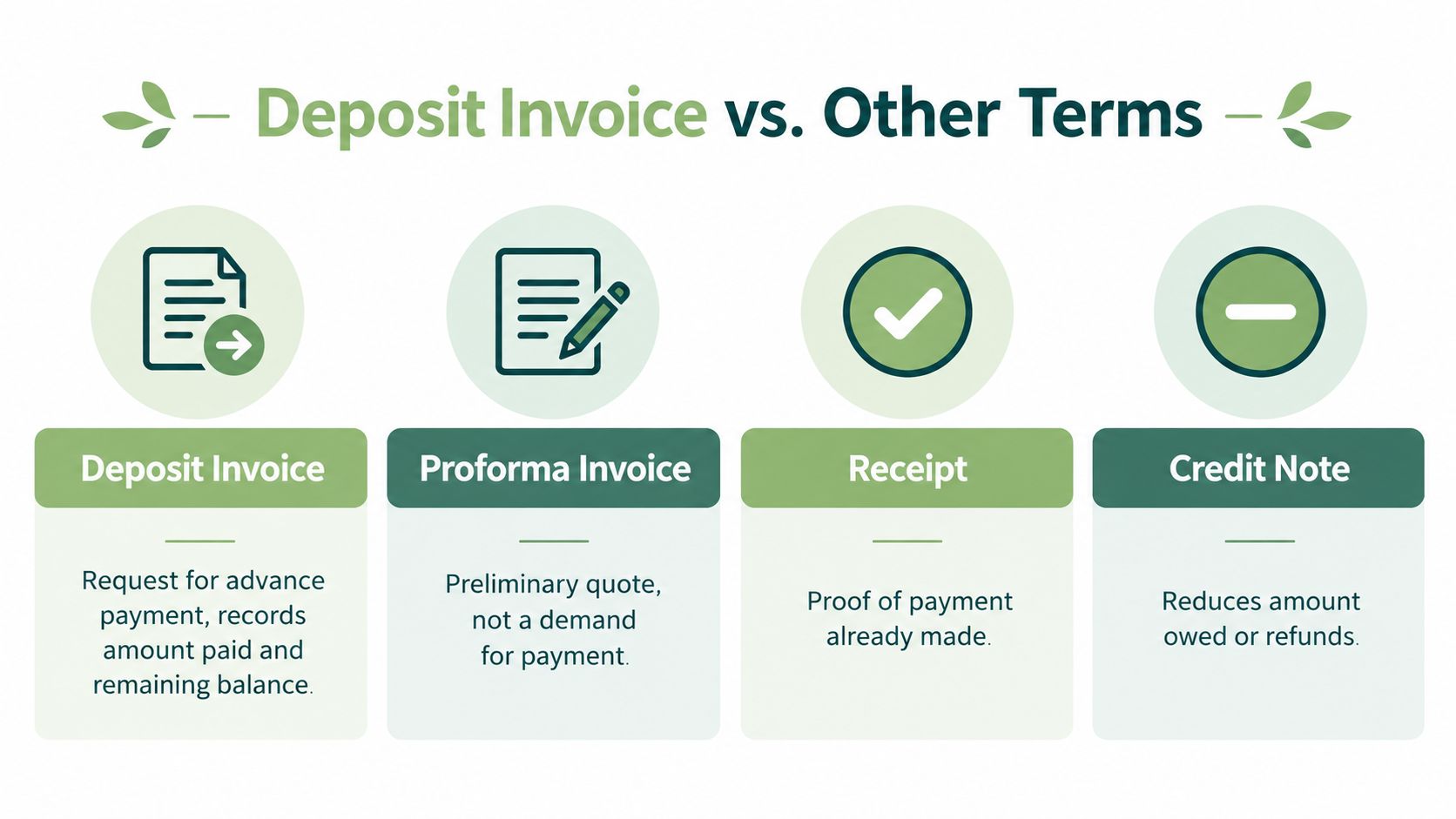
Confusion starts when owners use four different documents as if they're interchangeable. The wording matters because each one triggers different expectations about payment, refunds, and records.
Four Terms Owners Mix Up
- Deposit invoice: Requests cash before work begins and shows the remaining balance against the full contract.
- Receipt: Acknowledges money already received. It doesn't ask for payment, and it should show the date, method, and amount paid.
- Retainer: Typically reserves ongoing availability over a period, such as a consultant's monthly access, rather than funding one defined project.
- Progress payment: Bills after a milestone is reached, so payment follows completed stages instead of preceding the work.
A refundable security deposit is different again. It's held against damage or nonperformance and is expected back if conditions are met. A booking deposit for a photographer or contractor, by contrast, is usually applied to the project price and may be forfeited under written cancellation terms.
Labeling isn't pedantry. Calling a request a receipt can imply the client already paid, and calling an advance a retainer can create arguments about unused time. Australian readers, for example, face specific local rules on what counts as a tax invoice, which shows why document names should match local requirements rather than a downloaded template. The safest practice is plain language the client can repeat back without help.
Calculating a Deposit That Actually Covers Your Risk
"Charge half up front" is easy advice and often wrong. A deposit that's too small leaves the owner financing materials, while one that's too large can stall an otherwise solid booking. The number should come from the job's actual exposure, not from a universal rule.
Three drivers cover most service work. First, add upfront costs paid before delivery, such as materials, subcontractors, studio rental, permits, or travel. Second, price the calendar risk, because a cancelled Saturday wedding or a blocked crew week can't always be refilled. Third, consider how much cash the business needs to keep suppliers and payroll current until the balance arrives.
Working the $4,000 Example
Suppose the contractor must spend $600 on materials and commit $400 to a subcontractor before starting. Add $200 for scheduling risk if the client cancels after the slot is held. The total exposure is $1,200, which happens to equal 30% of the contract.
That math gives the owner a calm explanation if the client asks why. "The deposit covers materials ordered for this job and crew time reserved on those dates" lands better than "that's our policy." It also makes partial refunds easier to reason through, because spent and unspent portions are already identified.
| Service type | Typical deposit | Main cost driver |
|---|---|---|
| Contractor work | Cost based share of total | Materials, permits, subcontractors |
| Photography | Booking based share | Reserved date, travel, rentals |
| Consulting | Project or period based amount | Reserved availability, preparation |
| Design | Milestone linked share | Discovery work, blocked studio time |
Practical rule: If the deposit can't be explained in one sentence tied to real costs or reserved time, the percentage probably needs revisiting.
Flat fees suit small, tightly scoped jobs where baseline costs are known. Percentages suit larger projects where scope may shift, because the deposit scales with the contract. Either way, write the basis into the agreement before invoicing, and don't negotiate the amount down without also reducing what's committed before payment clears.
Anatomy of a Deposit Invoice With Sample Numbers
A usable deposit invoice example reads like a transaction schedule, not a single undifferentiated bill. Every line answers a question the client, bookkeeper, or tax preparer will ask later. Vague documents create the disputes owners blame on difficult clients.
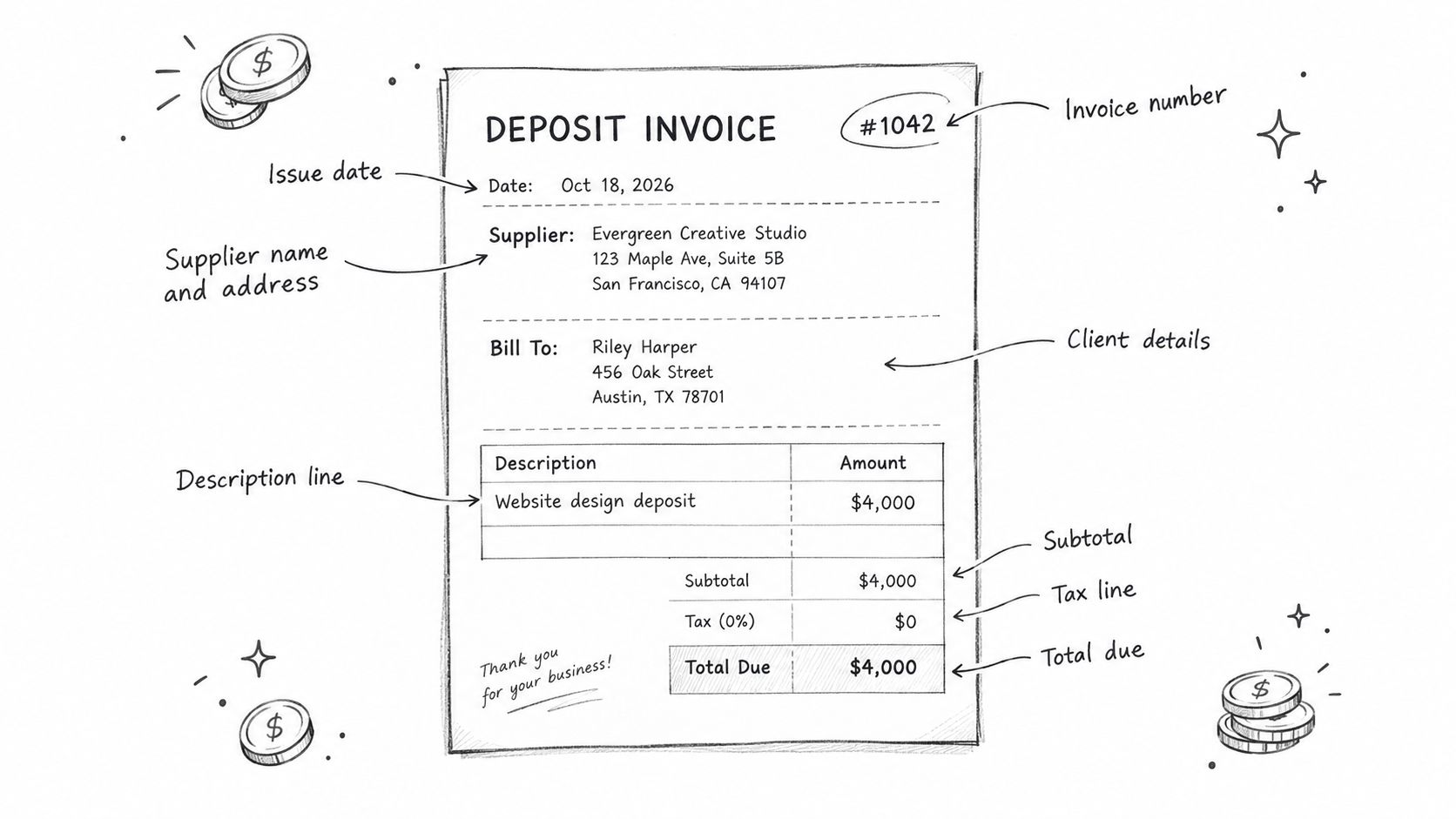
Start with identification. Show a unique sequential invoice number, the issue date, and the legal names and addresses of both supplier and customer. EU VAT guidance lists sequential numbering, supplier and customer identification, service description, dates, unit price, VAT rate, and VAT amount as core invoice fields in its European Commission guidance on VAT invoicing rules. U.S. businesses won't follow EU rules, but the discipline of complete fields travels well.
Line by Line Structure
- Header: "Deposit Invoice" printed clearly, with invoice number and issue date.
- Parties: Business legal name, address, and contact details, plus the client's billing name and address.
- Scope: A specific description, such as "Bathroom remodel labor and materials per signed estimate," not just "services."
- Contract total: $4,000 shown in full so the deposit has context.
- Deposit line: "Deposit due before commencement, 30% ($1,200)."
- Remaining balance: $2,800 due on delivery, calculated for the client rather than left as homework.
- Terms: Due date, accepted payment methods, and wire or card instructions where relevant.
Tax belongs on the document where it applies, shown by rate and amount rather than buried in a lump sum. The invoice should also state whether it is only an invoice or also serves as a receipt after payment. Those are different functions, and combining them without saying so muddies the record.
Wording Worth Copying
Scope language can stay short. "This deposit applies to the project described above and will be credited against the final invoice for that project" ties the money to one job. It prevents the deposit from drifting toward unrelated future work without a written change.
Cancellation language needs the same clarity. A workable clause states whether the deposit is refundable, transferable, or forfeited if the client cancels, and whether amounts already spent on materials are deducted from any refund. Owners shouldn't copy refund terms from another trade without checking local consumer rules, because enforceability varies.
One last field saves arguments later. Add a short note such as "Work is scheduled after deposit payment clears" if that's the policy. Clients accept firm sequencing far better when it's written before money changes hands.
From Deposit Received to Final Invoice Without Double Charging
Most templates stop at the deposit request, which is exactly where bookkeeping trouble begins. The client pays $1,200, work proceeds, and weeks later someone issues a final invoice for the full $4,000 because the deposit lives in a separate email thread. The client now suspects double billing, even when the mistake is innocent.
Payment timing makes this more than an embarrassment. In a 2025 U.S. survey, 60% of small businesses with longer payment terms reported cash flow problems compared with 40% using immediate terms, according to the QuickBooks small business late payments report for 2025. Clean records shorten the path to the remaining balance.
Recording the Payment
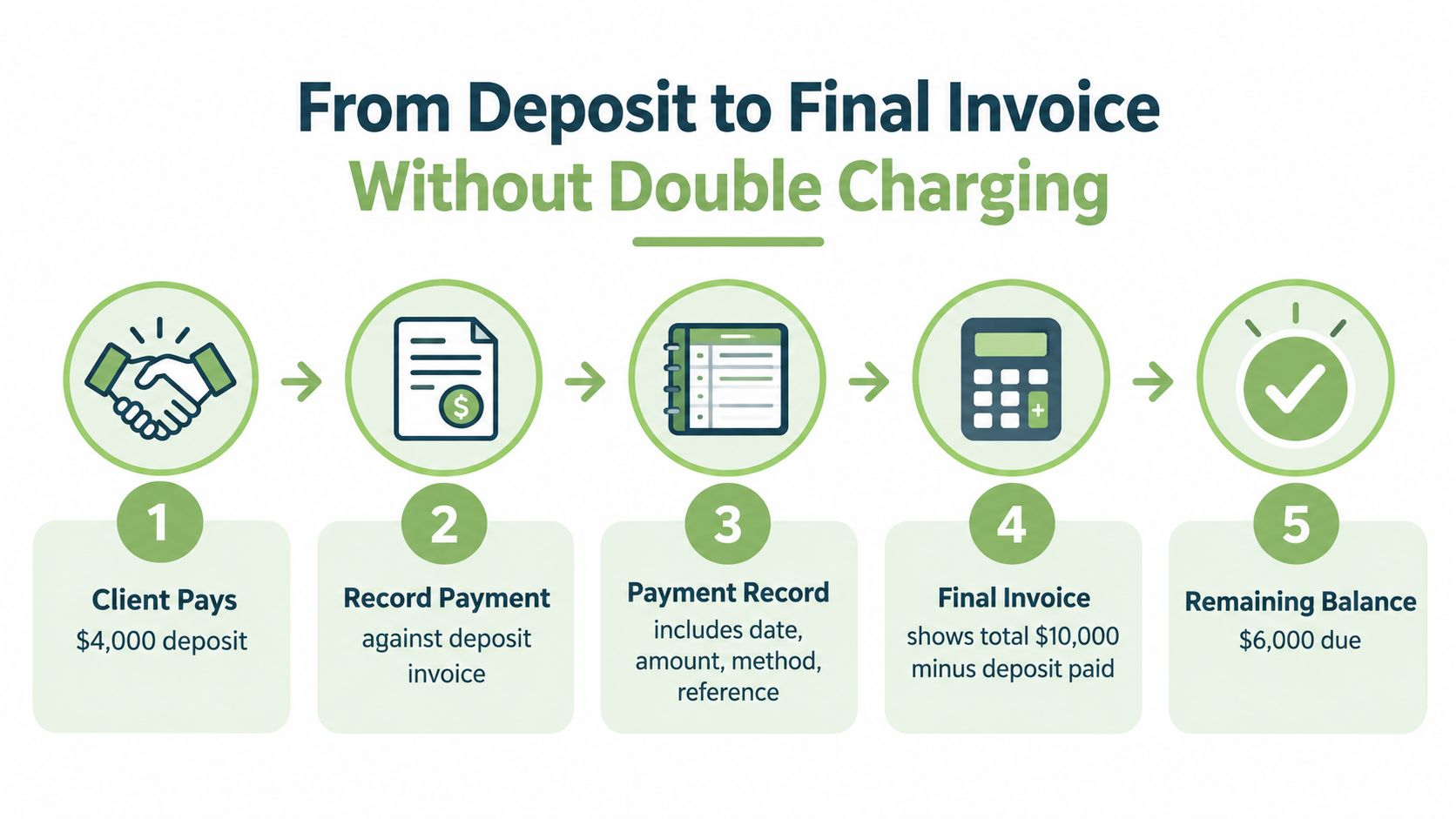
When funds arrive, record them against the deposit invoice the same day. The payment record should preserve the amount received, date, method, and reference, plus the outstanding balance afterward. Keep that record linked to the original invoice instead of creating a loose note in a spreadsheet.
GetBill supports recording deposits and partial payments against the original invoice while keeping the original total, amount received, and remaining balance visible. Owners using other systems should look for the same linked structure, because the feature that matters is the audit trail, not the brand. A worked partial payment example showing balances carried forward illustrates how partial amounts should reduce what's owed without rewriting the original total.
Issuing the Final Invoice
The final invoice restates the contract total, then credits the deposit. It should show $4,000 as the project total, a credit line reading "Less deposit received, Invoice [number], $1,200," and a balance due of $2,800. Referencing the original deposit invoice number lets the client reconcile both documents in seconds.
Partial payments need the same treatment. If a client sends less than the deposit amount, record what arrived, show what's still missing, and don't mark the deposit satisfied until the full agreed sum clears. If a client overpays or pays the balance early, apply the excess as a clearly labeled credit or refund it promptly, and note which choice was made.
Scope changes follow the same logic. Added work increases the contract total through a written change, and the deposit credit stays fixed at what was received. The final balance then reflects the revised total minus real payments, never minus amounts that were merely invoiced.
Tax Treatment and Jurisdictional Questions to Verify
A template can't answer tax timing. Whether tax is triggered when a deposit is invoiced or when it's received depends on jurisdiction, accounting method, and whether the amount is earned immediately or held against future work. Owners who skip that question can distort income records and the final balance at the same time.
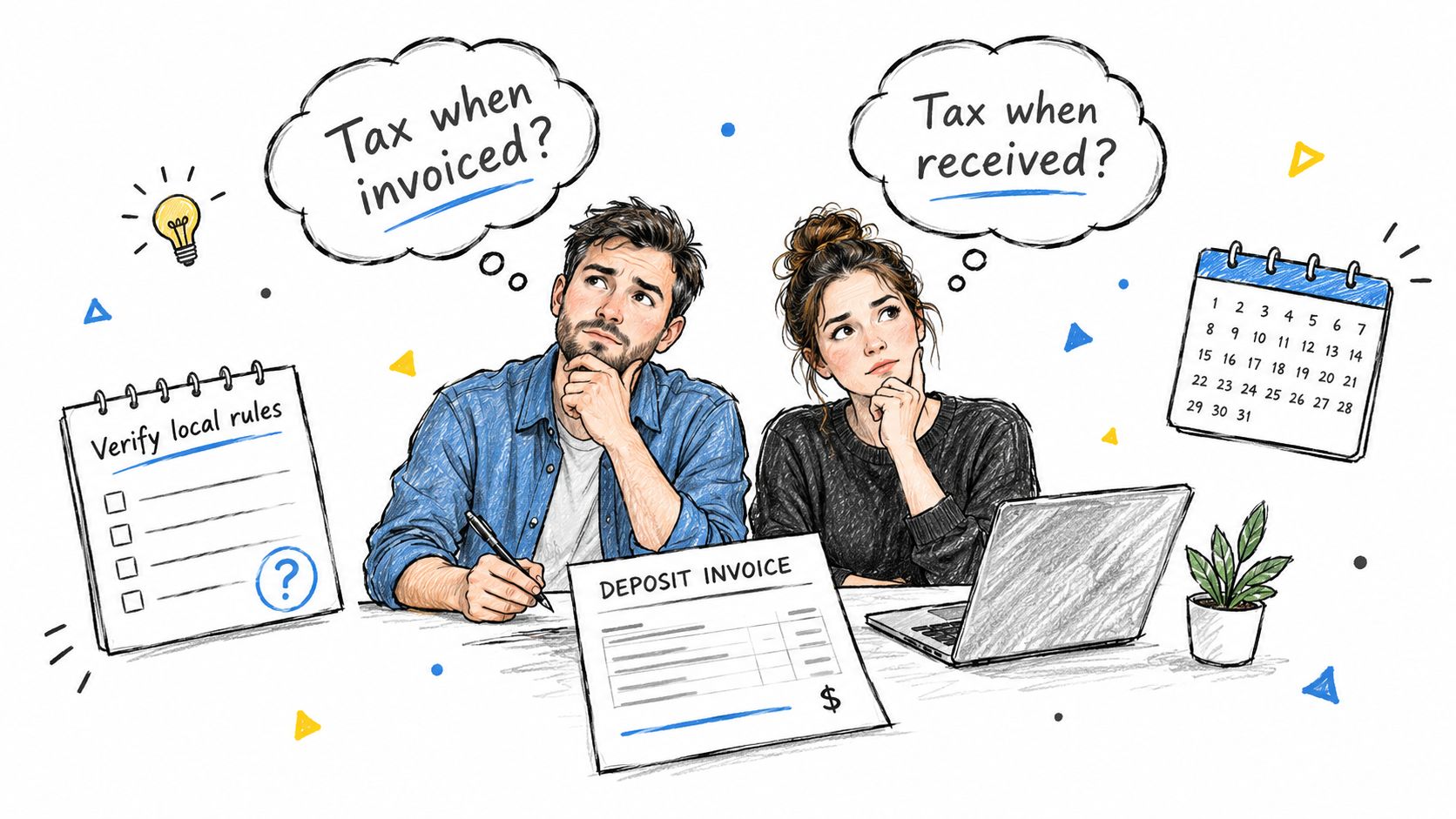
For a U.S. service business using the cash method, an advance payment for services is generally included in income in the year it is received. The limited deferral election described in IRS Publication 538 concerns eligible accrual-method taxpayers and should not be presented as a cash-method option. Confirm the treatment of the particular payment, including whether it is a genuinely refundable security deposit, with a qualified tax professional.
Rules That Don't Travel Across Borders
Other systems handle advances differently. For UK VAT-registered businesses, HMRC guidance on advance payments generally requires VAT to be accounted for when payment is received or a VAT invoice is issued, whichever happens first. Under the cash accounting scheme, VAT is generally accounted for when payment is received, unless the payment is a returnable deposit. In Ireland, Irish Revenue guidance requires a VAT invoice for each advance payment, generally by the 15th day of the following month; its stated exceptions and special deposit rules still need to be checked. UK businesses dealing with cross border services may also need reverse charge VAT explained in plain terms before deciding who accounts for the tax. Owners who charge VAT should review how an invoice template with VAT fields for rate and amount structures those entries, then confirm local requirements.
One U.S. rule deserves a caution flag. The FTC Rule on Unfair or Deceptive Fees, effective May 12, 2025, covers live event tickets and short term lodging, not ordinary service invoices, as the FTC guidance on the unfair or deceptive fees rule makes clear. Contractors and photographers should still disclose totals and fees clearly, but they shouldn't cite that rule as the legal basis for deposit terms.
- Tax trigger: Is tax due when the deposit is invoiced, received, or earned?
- Document name: Must it be called an advance invoice, tax invoice, or receipt locally?
- Refund status: Is the deposit refundable, transferable, or forfeited on cancellation?
- Income timing: Does the accounting method change when the deposit counts as income?
Putting It Together With a Short Pre-Send Checklist
Before sending, confirm the agreement is signed and the deposit percentage matches real upfront costs. Check the invoice number, both parties, scope, contract total, deposit line, remaining balance, due date, and payment method. Confirm cancellation and refund terms are written, tax fields fit the jurisdiction, and the deposit is labeled as an invoice rather than a receipt. Finally, decide how the payment will be recorded and credited on the final invoice, so the job can close with one linked record instead of a reconstruction.
If deposit tracking currently lives across emails, spreadsheets, and memory, GetBill offers itemized estimates and invoices with deposits and partial payments recorded against the original total, so the remaining balance stays visible through the final bill. Visit the site to see whether that workflow fits the way the business already bills clients.