

You've finished the work, sent the invoice, and now the client's accounts-payable team is processing it. The job is done, but materials, subcontractors, and payroll still need covering while the payment clock runs. The terms agreed for that job determine how much of the client's costs your business is financing in the meantime.
A useful set of terms for invoices does more than name a deadline. It makes clear when payment is due, what triggers the countdown, and whether the job should be funded through a deposit or progress payments. Those choices belong in the estimate or contract before work begins, not as a surprise at the bottom of an invoice.
Table of Contents
- Why Invoice Terms Matter for Your Cash Flow
- Common Invoice Terms and What They Actually Mean
- How Late Payment Data Shapes Your Terms
- Writing Payment Terms That Are Clear and Enforceable
- Choosing the Right Terms for Each Job
- Applying Your Terms in Estimates and Invoices
- Cross-Border Invoicing and Currency Considerations
- Setting Terms in the Contract Before Work Begins
- Checking Your Invoice Before You Send It
- Putting Your Invoice Terms into Practice
Why Invoice Terms Matter for Your Cash Flow
An invoice can be correct and still leave a business waiting for cash. A cleaning company might finish a commercial job on Friday, send a Net 30 invoice, then wait for the customer's internal approval and payment run. Meanwhile, the cleaner still has to pay staff and restock supplies. The due date sets the contractual expectation, but it doesn't guarantee the payment will arrive then.
European Commission impact-assessment data shows why that gap matters. Approximately five out of every ten invoices were paid late in the dataset, and the share of companies reporting that they paid invoices on time declined as company size increased. The figures were 51.3% for micro-enterprises, 47.9% for small enterprises, 41.5% for medium-sized enterprises, and 34.5% for large enterprises (European Commission impact assessment).
That doesn't mean every client will pay late. It does mean an owner shouldn't treat an invoice as a cash-flow plan. A deposit can cover materials before a contractor starts; milestone billing can fund a consultant's work in stages. These structures shift some financing responsibility from the service provider to the client.
Practical rule: Agree on the payment schedule while preparing the estimate. Terms written into a contract or accepted estimate are stronger than terms first introduced after the work is complete.
Common Invoice Terms and What They Actually Mean
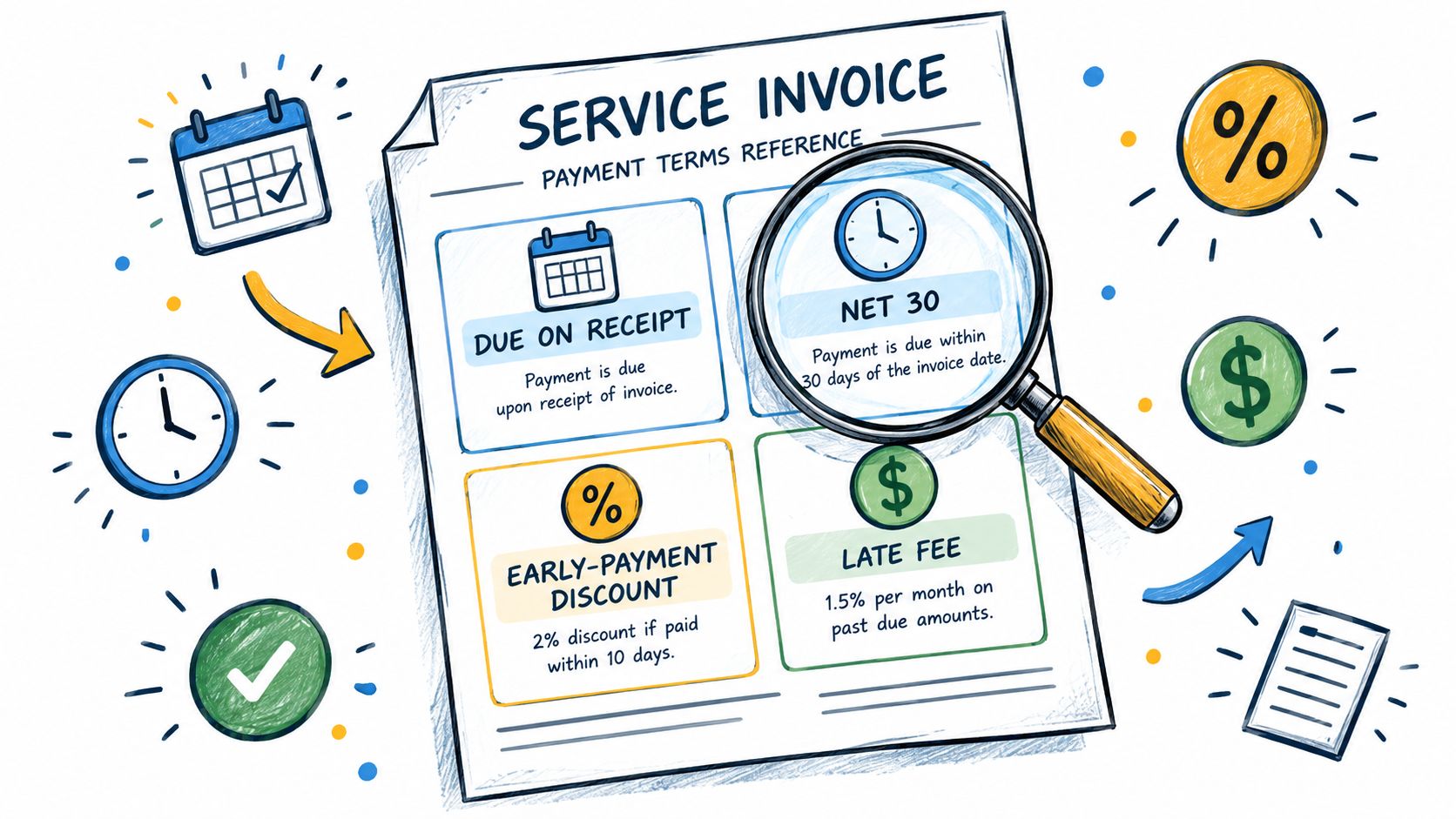
Net terms describe the time allowed for payment, but the starting point needs to be explicit. “Net 30” could mean thirty days from the invoice date, receipt, or service acceptance. Those triggers can produce different due dates, especially when a client routes invoices through an approval process.
| Term | Meaning | When the clock starts |
|---|---|---|
| Due upon receipt | Payment is expected when the client receives the invoice. | Receipt of the invoice, unless the agreement defines another trigger. |
| Net 7 | Payment is due within seven days. | The event named in the agreement, such as invoice issue or receipt. |
| Net 14 | Payment is due within fourteen days. | The stated trigger date. |
| Net 30 | Payment is due within thirty days. | The stated trigger date. |
| Net 60 | Payment is due within sixty days. | The stated trigger date. |
| Net 90 | Payment is due within ninety days. | The stated trigger date. |
Use an exact due date alongside shorthand. A photographer's invoice might say, “Net 14 from invoice date. Payment due April 15.” For guidance on distinguishing the invoice date from the due date, see this invoice date and due date guide.
Other terms shape the amount or timing. An early-payment discount reduces the amount due if the client pays by a stated date; show both the discounted deadline and the regular due date. A late fee describes a charge for overdue payment, but its legality and enforceability depend on the governing law and contract.
A deposit is paid before work starts. Milestone billing divides payment across agreed project stages, while retainage holds back an agreed portion until specified work or approval is complete. These options can protect cash flow, but the client needs to see the schedule in the estimate and understand what triggers each payment.
How Late Payment Data Shapes Your Terms
Late payment isn't just an occasional inconvenience. European Commission analysis found that average payment periods exceeded 60 days in both business-to-business and government-to-business transactions in recent reporting, and longer agreed payment terms were associated with longer actual payment periods in 87% of cases (EU Payment Observatory analysis). A generous deadline can therefore extend the time a small provider waits in practice.
For covered EU business-to-business transactions, Article 3 of Directive 2011/7/EU distinguishes agreed payment dates from cases where the contract sets no date or period. In the latter case, late-payment interest generally starts after 30 calendar days from the applicable invoice-receipt, goods-or-services-receipt, or acceptance trigger, subject to the Directive's conditions. Contractual payment periods generally must not exceed 60 calendar days unless expressly agreed otherwise and not grossly unfair to the creditor. Check the applicable national implementing law; this is not a universal rule for every service provider or client.
In the United States, federal procurement has its own rules. Under the general federal invoice-payment rule, the due date is the later of 30 calendar days after receipt of a proper invoice or 30 calendar days after Government acceptance of the supplies or services, subject to applicable exceptions. That framework should not be confused with a universal requirement that private-sector clients pay on Net 30.
Shorter deadlines, deposits, and progress payments aren't automatically confrontational. They're ways to avoid carrying the entire project cost while a client processes payment. When a customer needs a reminder, approval gate reminder samples can help shape a clear, professional follow-up.
Writing Payment Terms That Are Clear and Enforceable
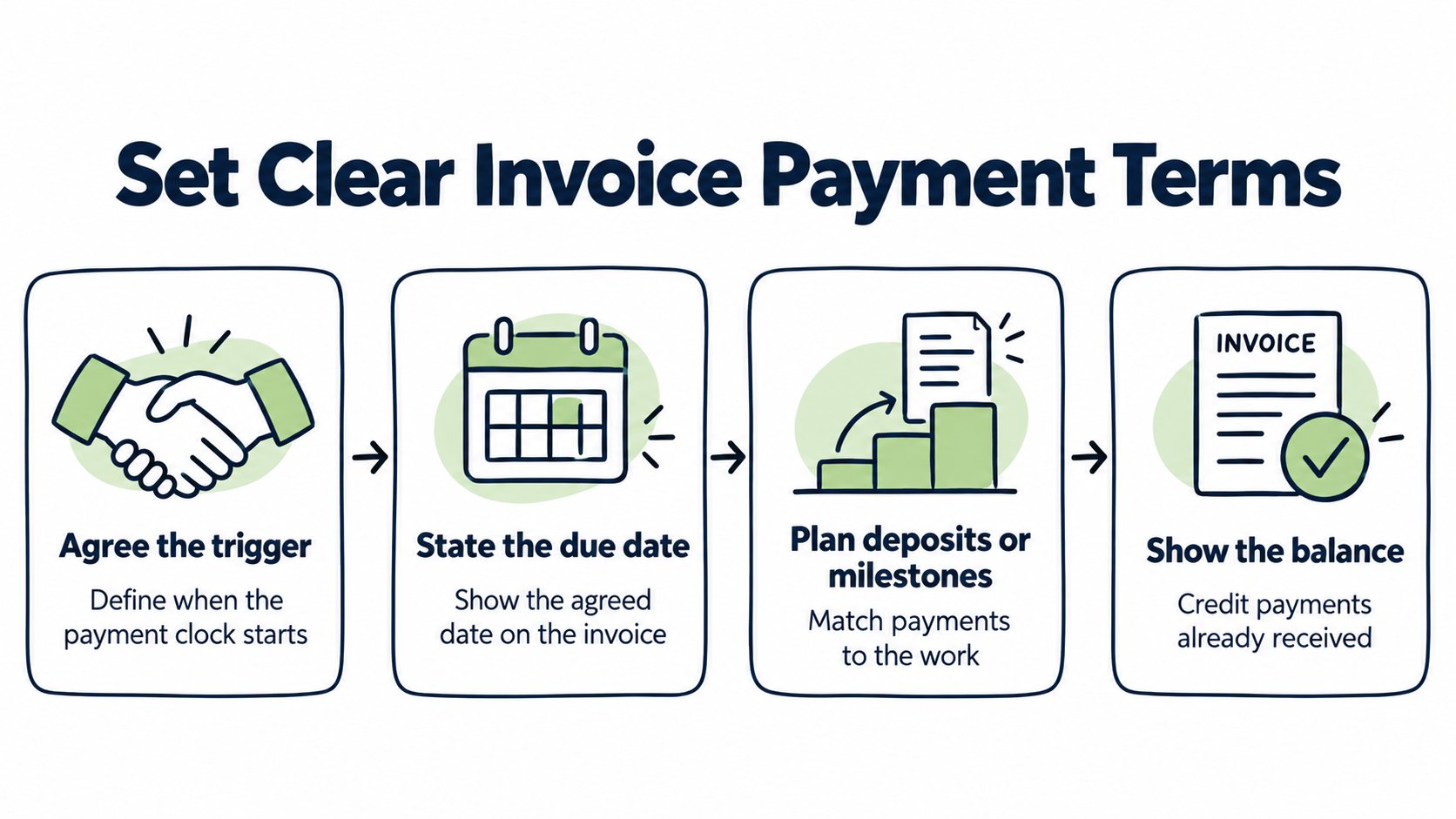
A payment clause should answer three practical questions: how much is due, by what date, and what event starts the clock? “Payment due in 30 days” leaves room for argument if the client assumes the period starts upon acceptance but the provider counts from invoice issue.
For federal invoice payments covered by the general rule in FAR 32.904(b)(1), payment is due on the later of 30 calendar days after the designated billing office receives a proper invoice or 30 calendar days after Government acceptance of the supplies or services. Contract-specific and other regulatory exceptions can apply. This is a federal procurement rule, not a default for private service contracts.
A well-structured terms block identifies the invoice trigger, exact due date, accepted payment method, and any required client references. It should also state how a deposit or prior partial payment is credited against the remaining balance. If an invoice must include a purchase-order number or contract reference to enter the buyer's payment system, that requirement should be clear before the invoice is sent.
For discounts, show the discount deadline and the undiscounted due date. For late charges, state the rate or fixed fee, how it's calculated, when it applies, and any grace period. Check applicable law before adding the clause. A fee written on an invoice isn't automatically enforceable in every jurisdiction.
Example terms block: “Payment due May 15, 2026, based on receipt of this invoice. The deposit already paid is credited below; the remaining balance is due by the stated date. Please include the contract reference on payment. Any late charge applies only as permitted by governing law.”
For project-based work where cash timing hinges on completion stages, this overview of net terms and milestone billing for SA offers another way to think through the schedule.
Choosing the Right Terms for Each Job
The right terms depend on what the provider has to spend before the client pays. A low-cost consultation for a repeat client may carry little exposure. A materials-heavy repair, a photo shoot requiring travel, or a project involving subcontractors can put more of the provider's money at risk.
Recent U.S. survey data found that 56% of small businesses with up to 100 employees were owed money on unpaid invoices, with an average of $17,500 per affected business. The survey also found that 60% of businesses offering longer payment terms reported cash-flow problems, compared with 40% of businesses requiring immediate payment (QuickBooks small-business late-payments report). Those figures don't determine the right terms for every job, but they reinforce the cost of extending credit without considering the business's ability to carry it.
| Approach | Works well when | Trade-off |
|---|---|---|
| Immediate payment | The job is small, straightforward, and easy to approve. | Can be hard for larger clients with formal payment processes. |
| Deposit plus milestones | Materials, travel, or subcontractors create up-front costs. | Requires clear stage definitions and tracking of each payment. |
| Net 7, 14, or 30 | A client needs time for approval and the provider can fund the gap. | Longer terms increase the period the provider waits for cash. |
| Retainage | A portion of payment depends on final completion or acceptance. | The withheld balance can remain tied up until the agreed condition is met. |
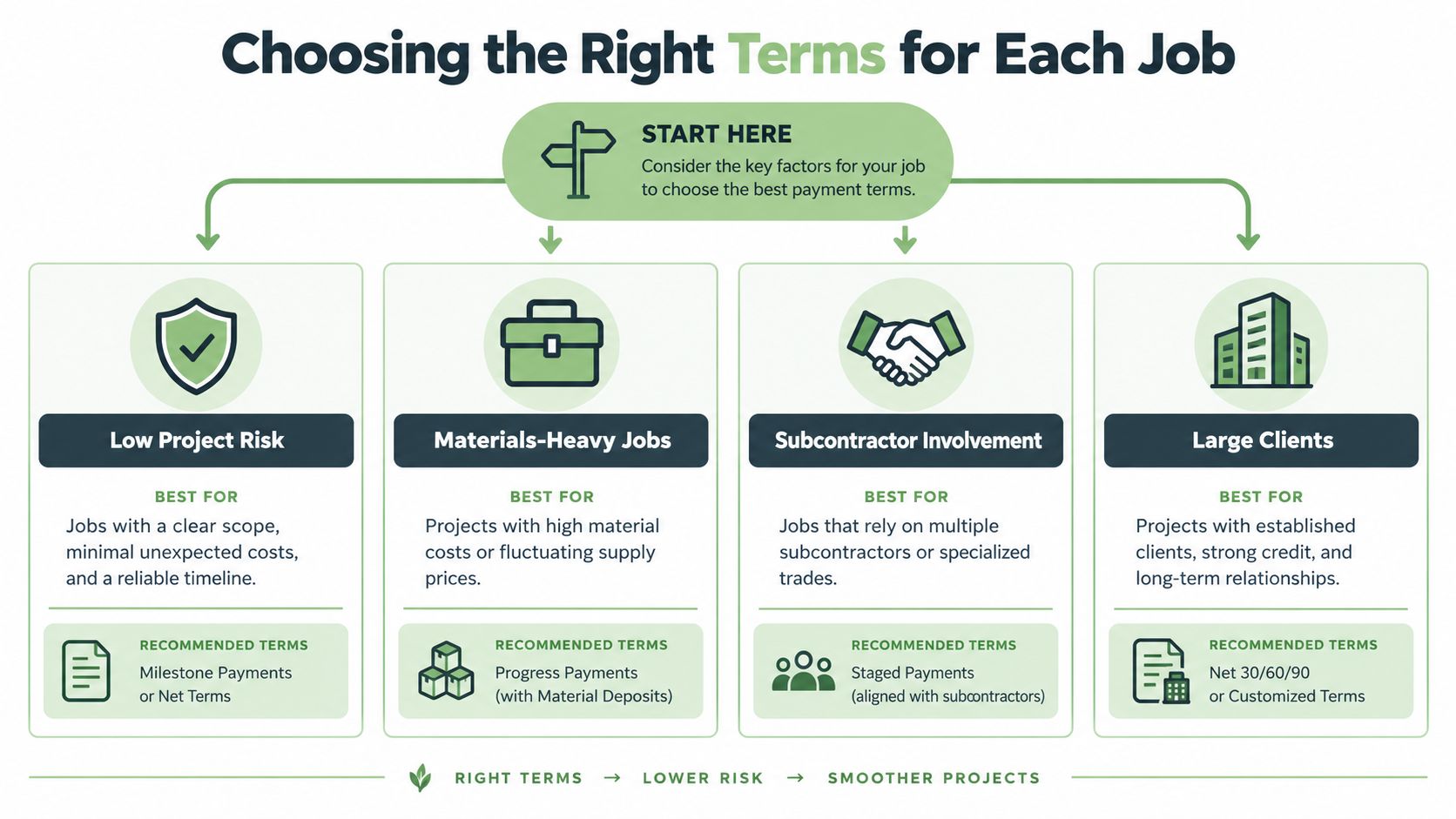
Before writing the estimate, total the costs that must be paid before collection, then compare them with available cash reserves. Consider the client's payment history and size, but don't assume a large organization will pay faster or that a small client will pay promptly. For a new customer, a deposit or shorter term can limit exposure; for a reliable repeat client, a longer schedule may be a reasonable concession if the business can carry it.
Applying Your Terms in Estimates and Invoices
Payment terms belong in the estimate because that's when the client decides whether to accept the price and schedule. If the invoice later introduces a deposit or deadline the client hasn't agreed to, the provider may face a dispute just as the work is ready to begin.
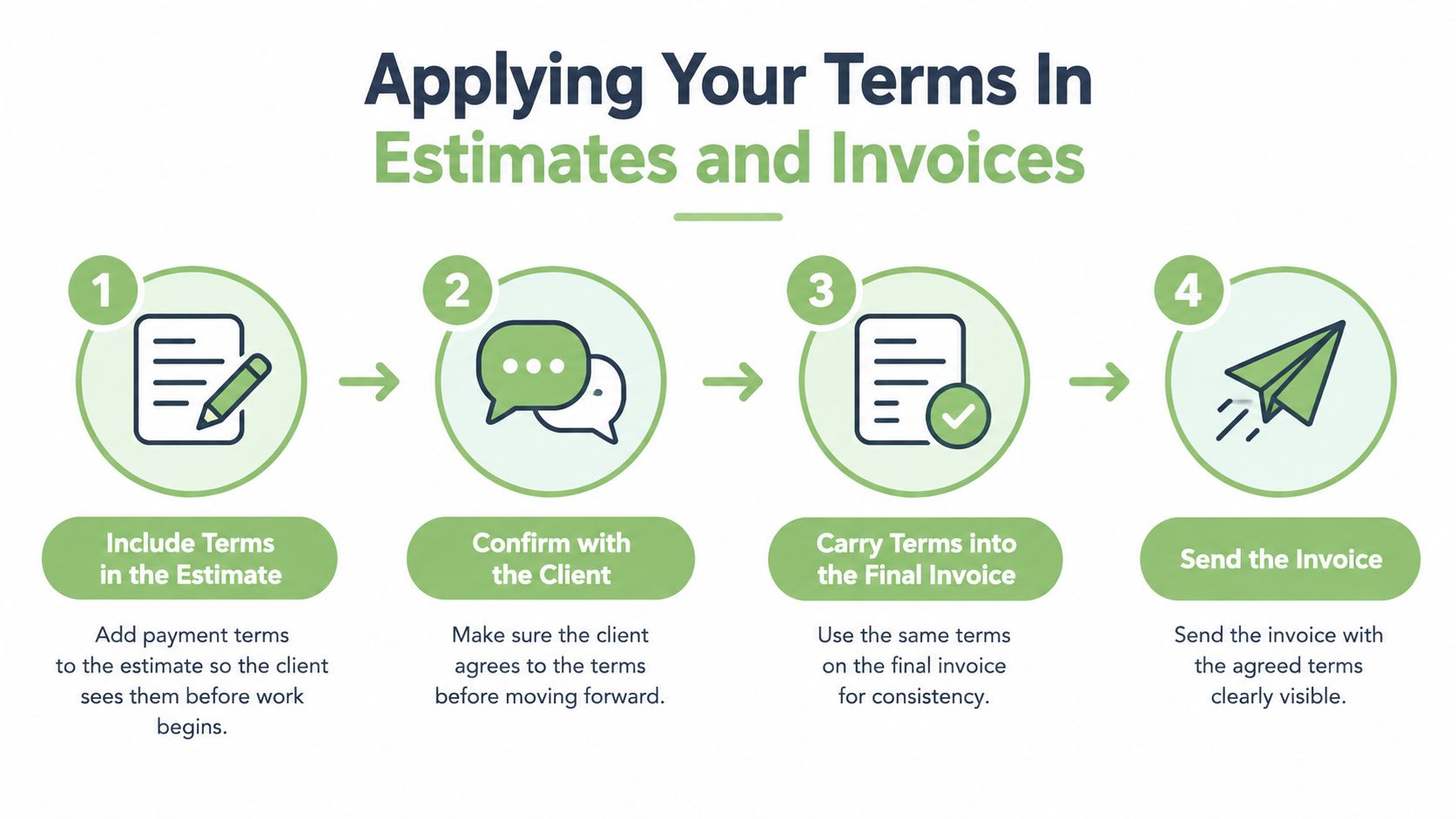
A simple workflow keeps the documents aligned:
- Include the schedule in the estimate. Show the deposit, milestone amounts, and final-balance trigger. For example, a handyman can list a materials deposit and state when the remaining labor charge is due.
- Get agreement before work starts. Confirm the accepted estimate or contract includes the same payment schedule and due-date trigger.
- Carry the terms into the invoice. Reference the accepted estimate or contract and state the exact due date.
- Show the accounting clearly. List the full amount, payments already received, and remaining balance so the client can see what's still owed.
Suppose a photographer's estimate includes a deposit and a balance due when the edited images are delivered. After the client accepts, the photographer should reference that accepted estimate on the deposit invoice, then show the deposit as paid and the remaining balance on the final invoice. The amount owed should be visible without requiring the client to reconstruct earlier payments from email.
Cross-Border Invoicing and Currency Considerations
A U.S. service provider working for a client in another country needs to make more than the payment deadline explicit. The invoice should identify which currency is due, what payment method the client can use, and who bears conversion or transfer costs. If the client disputes part of an invoice, the agreement should say how and when the dispute must be raised and whether the undisputed balance remains payable.
A jurisdiction-neutral checklist helps surface the decisions:
- Invoice currency: Identify the currency that controls the amount due.
- Tax treatment: Confirm the applicable tax obligations for the provider, service, and customer location.
- Payment rail and fees: Specify accepted methods and clarify responsibility for bank or payment fees.
- Conversion date: State when an exchange rate is determined, if conversion is needed.
- Disputes and partial payments: Set a notification process and explain how partial payments are allocated.
- Late charges: Verify local limits before relying on an interest or fee clause.
European e-invoicing requirements and payment rules are changing. A PwC overview discusses proposed EU policy changes, including shorter maximum B2B payment periods, late-payment compensation, payment-practice disclosures, and expanded e-invoicing and reporting measures (European payment-term and e-invoicing changes). The details depend on the relevant jurisdiction and implementation, so a U.S. business shouldn't treat a proposal as an existing rule that applies everywhere.
The operational point is straightforward: terms should work both as readable prose and as invoice data. Structured e-invoicing standards such as EN 16931 define invoice fields for automated processing, making clear dates, payment details, and references useful beyond the PDF.
Setting Terms in the Contract Before Work Begins
The estimate or contract is the right place to negotiate payment timing. Once the work is finished, a newly added invoice term can look like a change in the deal rather than a reminder of what the client accepted.
Consider a contractor who agrees to Net 30 but learns that the client's accounts-payable process typically takes longer. If the contractor has already bought materials and paid a subcontractor, the gap comes out of the contractor's cash reserves. A deposit or milestone schedule agreed upfront could have reduced that exposure without changing the agreed project price.
When a client requests longer terms, the provider can negotiate structure rather than accept or reject the request. A materials deposit, a smaller first milestone, or a cap on the amount outstanding may preserve the relationship while limiting how much of the job the provider finances. Any concession should be weighed against the cost of carrying the balance and the client's payment history.
The estimate should also state what happens if the scope changes. If added work changes the price or payment schedule, document the revised terms and get approval before proceeding. A clear guide to writing an estimate can help small service businesses present scope and charges for client review.
Checking Your Invoice Before You Send It
An invoice that lacks the buyer's required details can be delayed or rejected, even when the work is complete. For U.S. federal agencies, a proper invoice must include required information such as the contractor's name and address, invoice date and number, contract and order details, payment terms, and payment recipient information (U.S. Treasury prompt-payment FAQs). For invoice payments covered by the general FAR rule, the due date is the later of 30 calendar days after receipt of a proper invoice or 30 calendar days after Government acceptance, subject to the applicable exceptions.
Use this pre-send checklist for every service invoice:
- Client details: Verify the legal name and billing address.
- Work performed: Include the service period and itemized description.
- References: Add the purchase-order or contract number when required.
- Dates and terms: Check the invoice date, exact due date, and agreed trigger.
- Balance: Subtract deposits or partial payments and show the remaining amount.
- Taxes and charges: Include applicable tax details and any agreed charges.
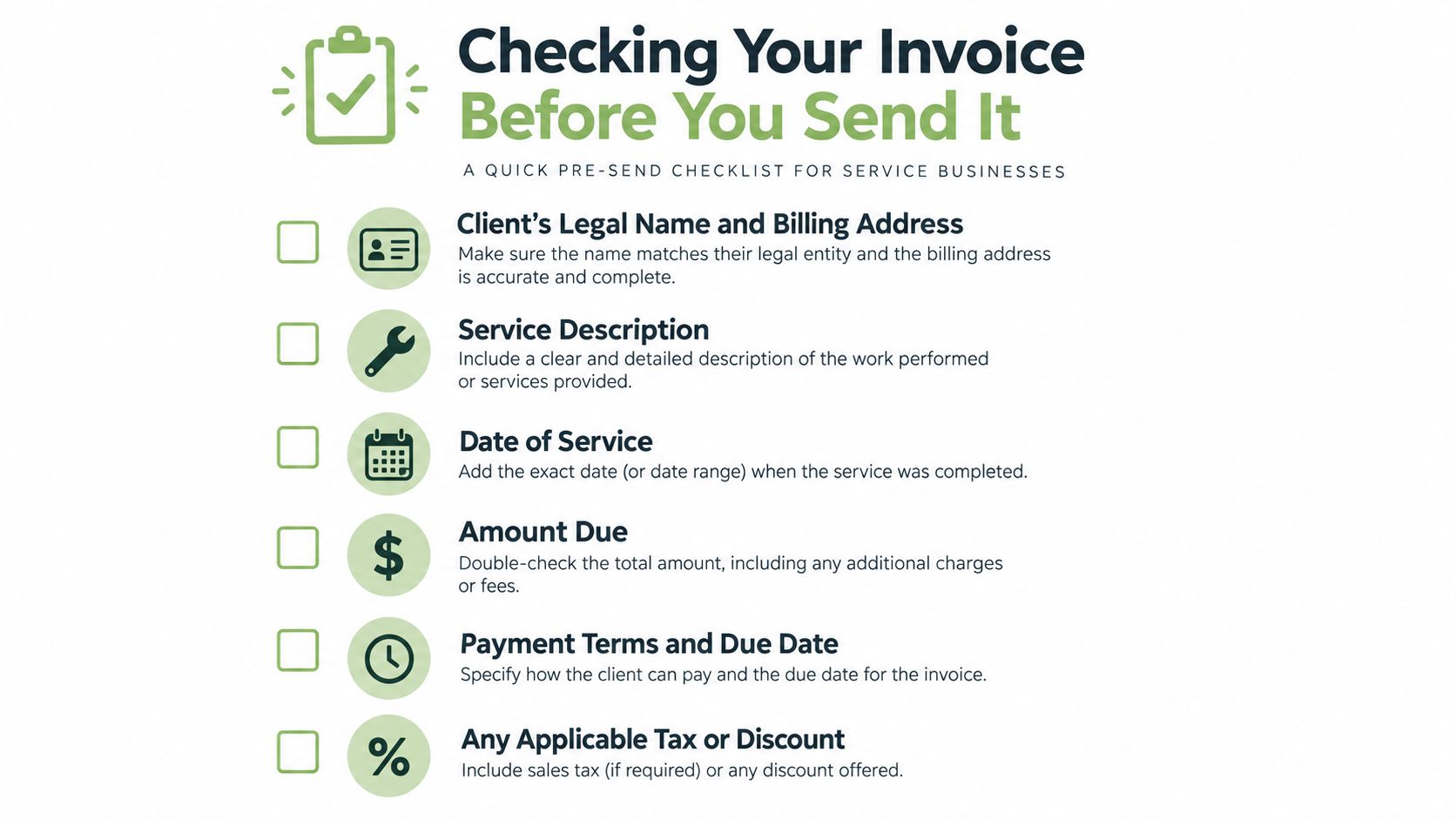
Before sending, compare the invoice with the accepted estimate or contract. A mismatched due date or payment schedule can create confusion over when the payment clock starts.
Putting Your Invoice Terms into Practice
Review recent jobs and identify where cash was committed before payment arrived. For upcoming work, choose terms that fit the actual exposure: immediate payment for a small, simple service; a deposit for up-front costs; or milestones when the work spans multiple stages. Keep the wording consistent from estimate to contract to invoice, and use a clear reminder process when a deadline passes.
U.S. service businesses shouldn't mistake the FTC's Rule on Unfair or Deceptive Fees for a general invoice-pricing rule. The rule took effect May 12, 2025, and covers live-event tickets and short-term lodging, not ordinary invoices from handymen, cleaners, consultants, or photographers (FTC rule FAQ). Service providers should instead clearly disclose their own prices, required materials or travel charges, deposits, taxes where applicable, and other fees in estimates and invoices, while checking the laws that apply to their business.
For follow-up, a practical reminder to pay guide can help a provider keep collection messages direct and professional. The goal is not to make every client pay upfront. It's to set terms that fit the job and make the amount and due date easy to understand.
GetBill helps independent professionals and small service businesses create itemized estimates and invoices, convert accepted estimates into invoices, and record deposits or partial payments with the remaining balance. Visit GetBill to see whether its billing workflow fits the way your business agrees on and collects payment.