


An itemized billing statement lists each service, quantity, rate, applicable tax, payment, and remaining balance instead of presenting only a single total. For a small service business, it gives the client a clear way to check the charges against the agreed work.
For a cleaner, contractor, photographer, or consultant, that missing detail is rarely a paperwork problem. It's the reason a client pauses a payment, questions a deposit, or asks for proof the owner has to reconstruct from texts and receipts.
Table of Contents
- What an Itemized Billing Statement Is and Why It Matters
- The Core Components Every Itemized Statement Needs
- How to Build an Itemized Statement for a Service Job
- Choosing How to Create and Send Itemized Statements
- Using Line Items to Track Payments and Remaining Balances
- When More Detail Hurts and How to Review a Statement
- Best Practices for Clarity, Compliance, and Record Keeping
- Putting Itemized Billing to Work in Your Business
What an Itemized Billing Statement Is and Why It Matters
A handyman finishes a repair, sends a single total, and gets a reply asking what part covers labor, what part covers parts, and whether the deposit was already deducted. There's no line to point to. The owner rewrites the explanation from memory, and payment waits while both sides compare different versions of the job.
An itemized billing statement prevents that scramble by showing each service or product, quantity, unit price, discount, tax, deposit, payment, and remaining balance separately. It's not a receipt for money already settled and it's not just a prettier invoice. It's a control document that lets the client recompute the amount owed and lets the business connect every charge to an agreed scope, work log, or receipt.
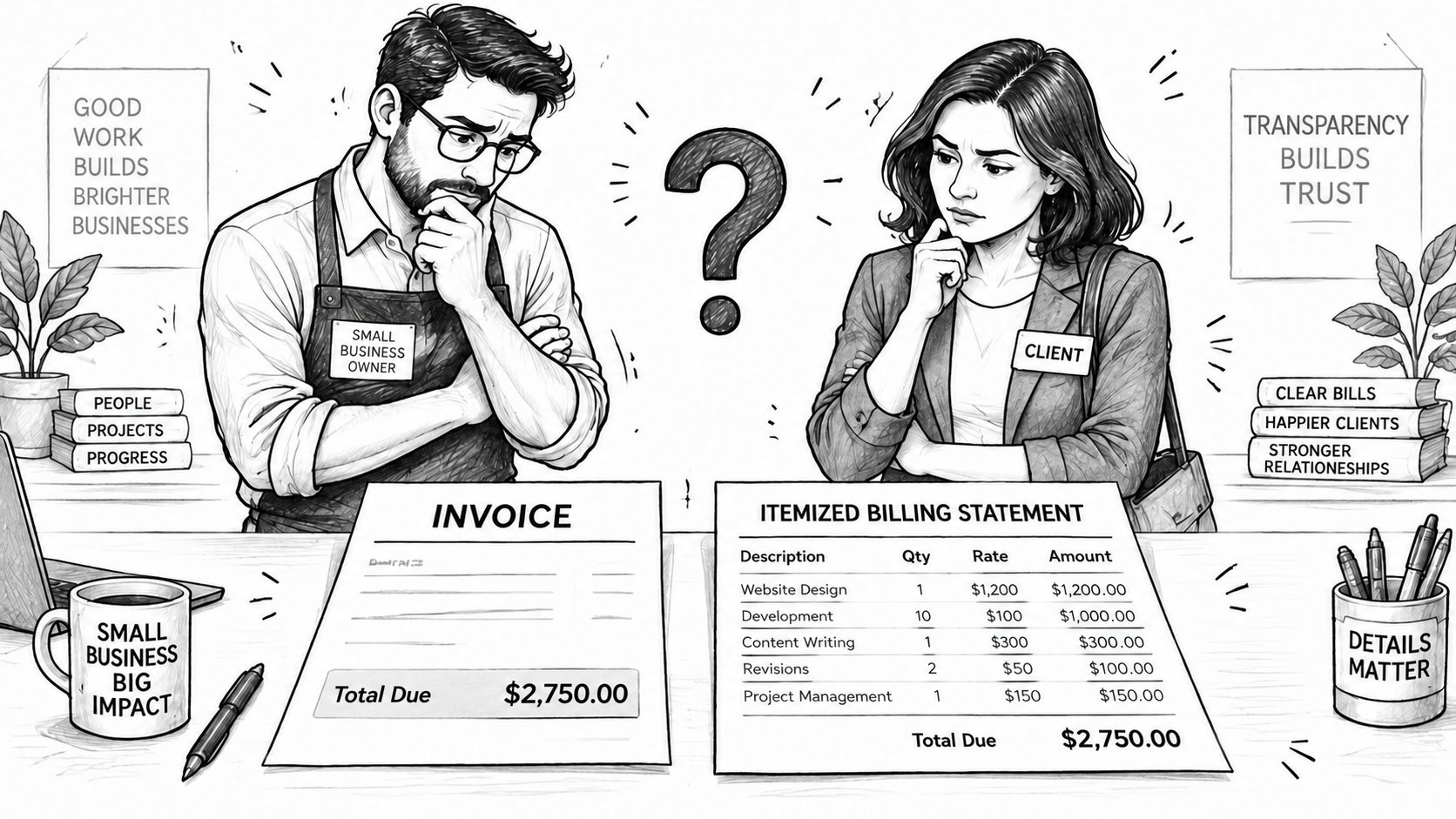
For example, if agreed charges total $300 and a $100 deposit has already been recorded, the statement should preserve the original $300 in charges, list the deposit as a payment, and show $200 remaining. The client can check the balance without treating the deposit as a discount.
Why the Timing Matters for Small Businesses
In the 2025 U.S. Intuit QuickBooks small-business survey, 56% of small businesses surveyed said they were owed money from unpaid invoices. Businesses with outstanding invoices were owed an average of $17,500. The report also says 47% of businesses surveyed had some invoices more than 30 days overdue. These findings describe the survey respondents; they do not show that itemization alone causes faster payment.
That doesn't mean itemization guarantees collection. It means a dispute stays narrow. A client can question travel without blocking undisputed labor, and the owner can verify one line without reopening the whole job. Owners who want the broader client workflow around terms and follow-up can also review guidance on how to invoice a client from Suby.
The Core Components Every Itemized Statement Needs
A useful statement works like a data record, not a paragraph with a total at the bottom. Each line carries enough inputs for a stranger to rebuild the math without asking the owner what was meant.
The European Commission guidance on VAT invoicing requirements identifies core fields that translate well as a practical model, even for businesses outside the EU. Those fields include the invoice date, a unique sequential identifier, supplier and customer identity, a service or product description, quantity or measurable extent, unit price before tax, discount or rebate, applicable tax rate, tax amount, and line total. A transaction or payment date belongs on the record when it differs from the invoice date.
How Each Line Should Compute
Quantity multiplied by unit price produces the pre-tax line amount. A discount then reduces that amount, and tax is calculated by the applicable rate rather than inferred from the grand total. That sequence matters when labor and materials receive different tax treatment, or when part of a job is exempt. Subtotals grouped by tax rate or exemption make the result reviewable at a glance.
Practical rule: If a client can't recompute a line from the quantity, rate, discount, and tax shown on that line, the statement isn't finished.
Core Fields of an Itemized Billing Statement
| Field | What It Records | Why It Matters |
|---|---|---|
| Invoice ID and date | Unique number and issue date | Matches payments and revisions to one record |
| Supplier and customer | Legal or business identities | Shows who charged whom |
| Description | Service or product supplied | Connects the charge to agreed scope |
| Quantity and unit price | Extent supplied and pre-tax rate | Lets the client verify the line math |
| Discount or rebate | Reduction applied to the line | Separates price cuts from payments |
| Tax rate and amount | Rate charged and resulting tax | Prevents guessing from the total |
| Line total | Final amount for that item | Supports dispute of one line only |
| Payments and balance | Deposits, credits, amount still due | Shows settlement status clearly |
National rules can add fields beyond this model, so the table is a starting structure, not a universal legal format. The nonnegotiable part is traceability. Every total should be the visible result of smaller, checkable inputs.
How to Build an Itemized Statement for a Service Job
Start from the accepted estimate, not from a blank page. The estimate already holds the scope the client approved, so converting it preserves descriptions, quantities, and rates while removing re-entry errors.
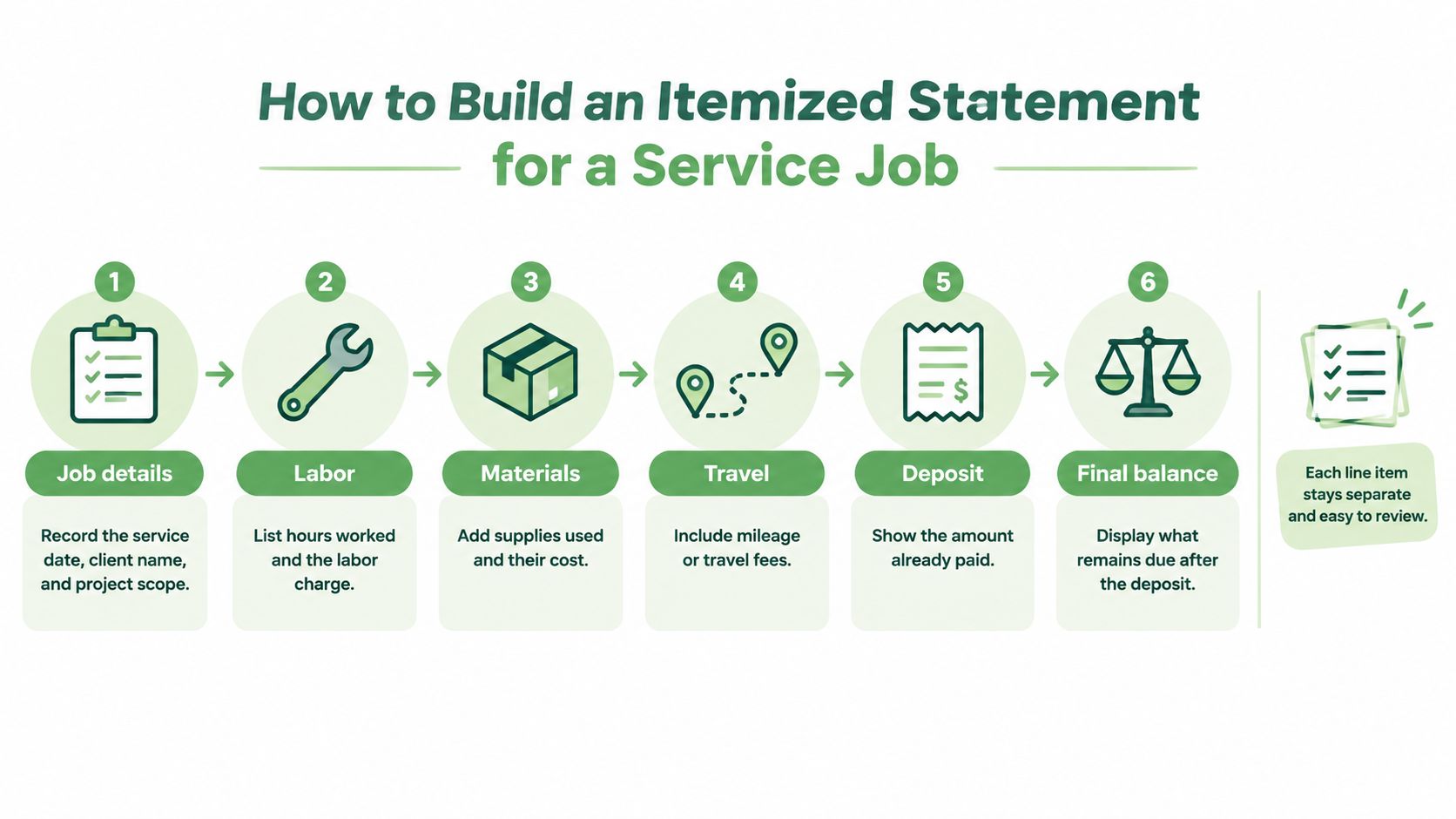
Consider a cleaning business closing a move-out job that grew beyond the original walkthrough. Labor belongs on its own lines by date or task, cleaning supplies bought for the property belong under materials, and mileage or parking belongs under travel or reimbursable expenses. Mixing those categories into one service line makes later review harder, especially if materials are taxed differently from labor.
Write Descriptions a Client Can Verify
Vague wording creates the disputes itemization is meant to avoid. Compare these approaches:
- Weak description: Cleaning services, with no date, property area, or unit
- Verifiable description: Move-out cleaning, kitchen and two bathrooms, billed by hour on the service date
- Weak materials line: Supplies, with no item or supporting receipt reference
- Verifiable materials line: Oven cleaner and replacement filters, with quantity and unit cost
The unit matters as much as the label. Hours, visits, rooms, square feet, sessions, and flat-rate tasks shouldn't be swapped between the estimate and the final statement without a note explaining the change.
Show Deposits as Payments, Not Discounts
A deposit isn't a price reduction. It's money already received against the total. List the full charges first, calculate tax on the correct lines, then show the deposit credit, any later payments, and the final balance due. Treating a deposit as a discount understates revenue and can distort the taxable amount.
Notes should support lines without burying them. A work order number, property address, session date, or receipt reference can sit in a notes field or attachment list. The statement itself stays readable, while supporting evidence remains one step away when a client asks how a charge was derived.
Choosing How to Create and Send Itemized Statements
Manual documents, accounting software, and dedicated invoicing tools can all produce an itemized statement. They differ in how much discipline the owner has to supply manually.
A spreadsheet or word processor gives full layout control and costs little to start. It also invites copied totals, skipped invoice numbers, and old client details left in a reused file. Owners who keep paper work orders or supplier receipts can reduce that filing gap by scanning paperwork with your phone from PDFWix, then storing the scan with the invoice record.
General accounting software centralizes invoices, expenses, and reports in one system. That's valuable when bookkeeping volume grows, but it can be heavier than a solo operator needs for sending a clear statement from a job site. Setup, user permissions, and chart-of-accounts decisions may matter more to the bookkeeper than to the person trying to bill before leaving a property.
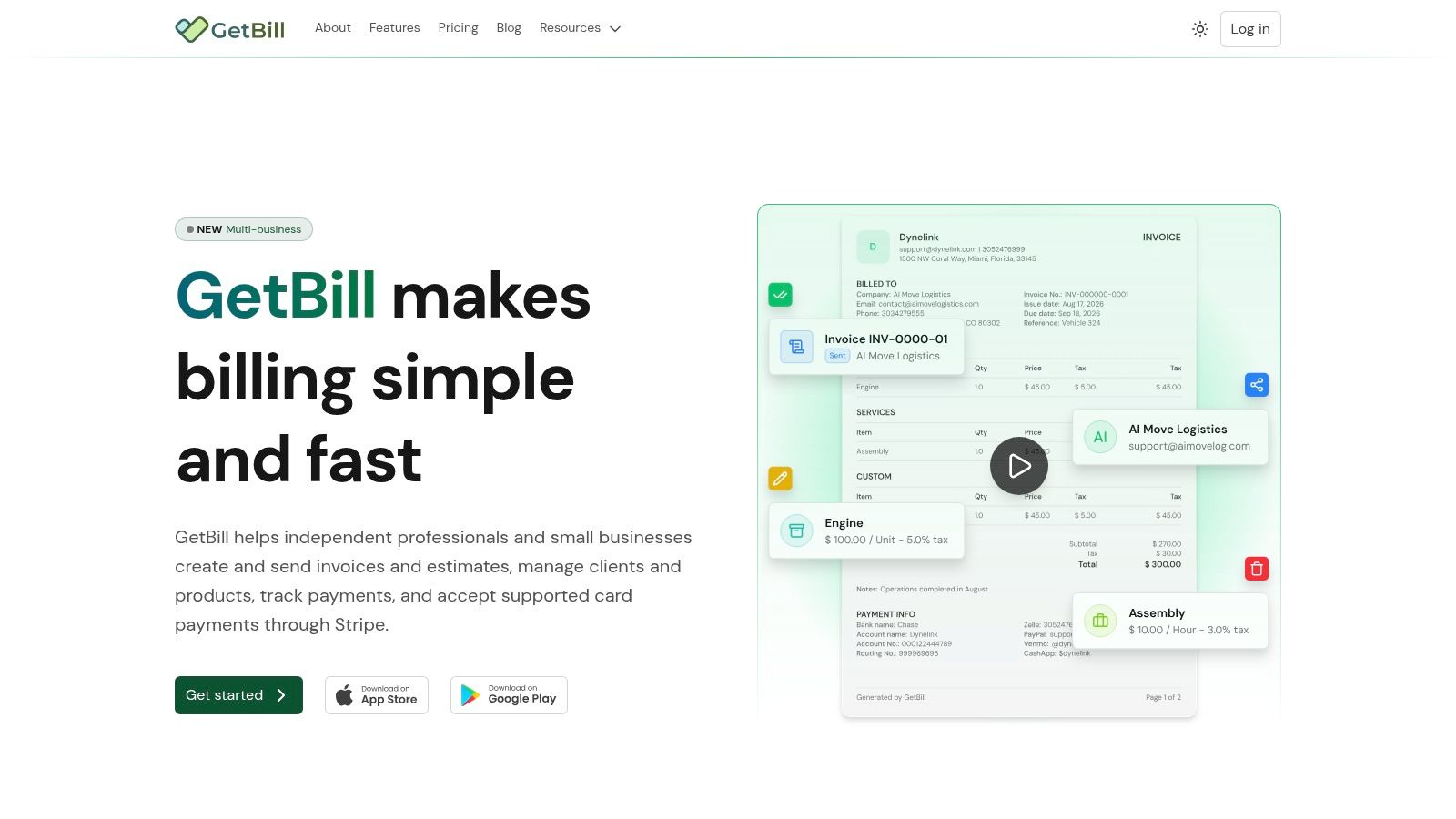
A dedicated tool such as GetBill sits between those options. It creates itemized invoices and estimates, reuses client and product or service records, converts estimates into invoices, generates branded PDFs, and shares documents by email or public links. It also records deposits and partial payments with remaining balances and supports online card payments through a connected Stripe account, with availability depending on Stripe and the user's account and region. It isn't a full accounting, payroll, or tax-filing platform. Readers comparing that narrower workflow can review the estimate and invoice app overview.
Ways to Create an Itemized Billing Statement
| Approach | Strengths | Trade-offs |
|---|---|---|
| Manual document | Full control, minimal setup | Re-entry errors, inconsistent numbering |
| Accounting software | Central records and reporting | More setup than simple billing requires |
| Dedicated invoicing tool | Reusable items, estimate conversion, balance tracking | Separate system from full bookkeeping |
The right choice depends on volume and revision risk. A business sending a few stable invoices may tolerate a template. A business juggling deposits, materials, and partial payments usually benefits from software that preserves line items and balances automatically.
Using Line Items to Track Payments and Remaining Balances
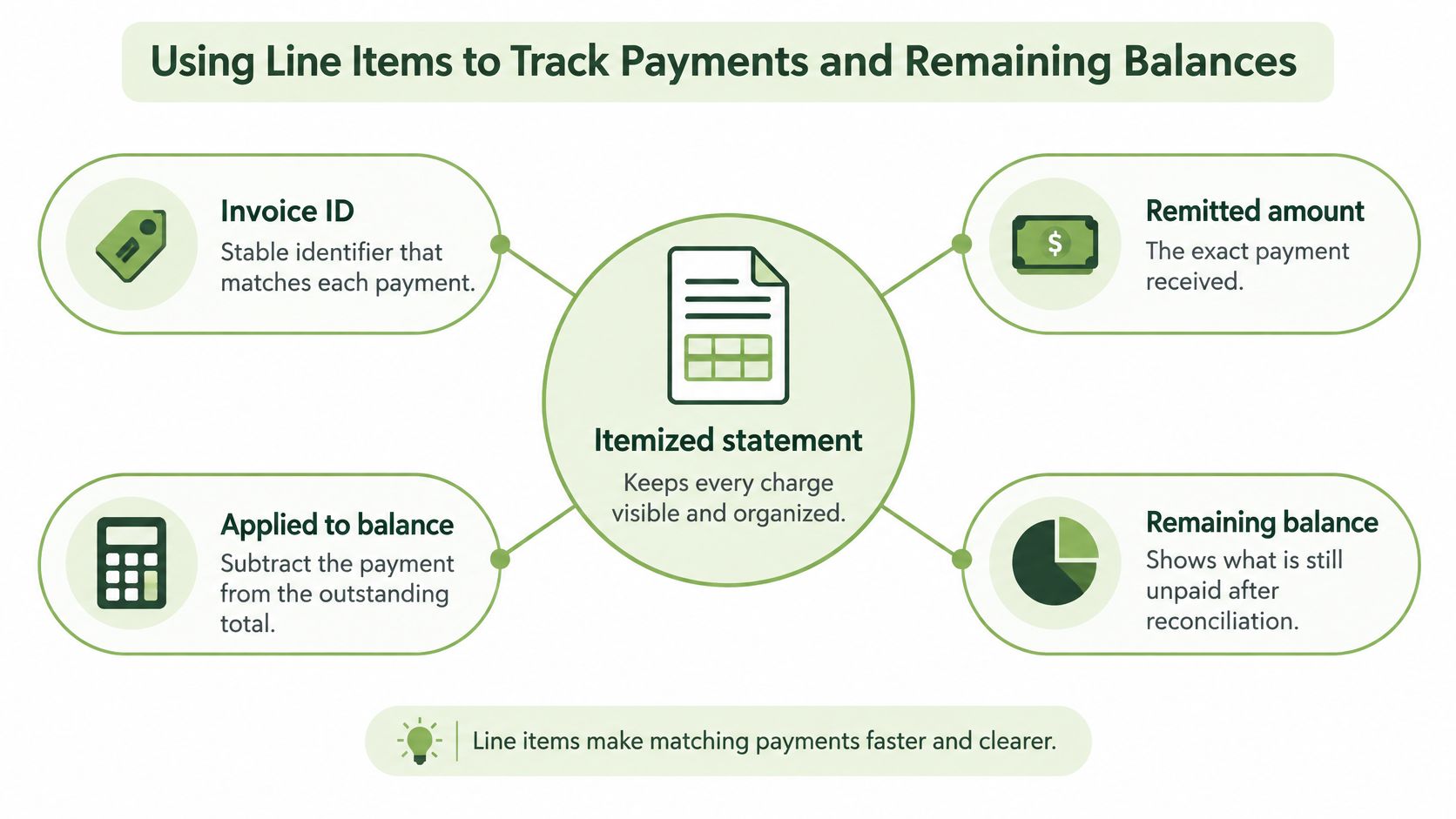
Reconciliation fails when money arrives without a reliable reference. A bank deposit that roughly matches an invoice total isn't enough when a client pays a deposit, settles two jobs together, or pays all but one disputed line.
ISO 20022 remittance guidance summarized by X9 treats invoice number, invoice date, amount due, tax amount, discounts, adjustments, credit notes, remitted amount, creditor reference, and document line-item details as distinct data elements. That distinction is practical. A payment carrying a stable invoice identifier and the exact remitted amount can be matched to the correct receivable without guesswork.
Record Every Payment as Its Own Event
The remaining balance should be a calculation, not a typed number. It equals total due minus allocated payments and credits. Each payment event needs its own date, amount, method, and processor reference, even when several payments settle one staged project.
- Deposit received: Apply it to the invoice and reduce the balance, but keep the original charges intact
- Partial payment: Note which stage or lines the client intended to cover when that allocation is known
- Combined transfer: Split one receipt across the relevant invoice IDs instead of forcing it onto a single job
- Credit or adjustment: Create a linked record that points back to the originating invoice rather than overwriting history
That history protects both sides during a dispute. The client can see that a deposit was credited, and the owner can show why an invoice remains open after money arrived. A detailed walkthrough of tracking partial payments and invoice balances covers the allocation workflow in more depth.
For U.S. federal tax recordkeeping, the IRS lists supporting business documents such as invoices, paid bills, receipts, deposit slips, and canceled checks. Keep the itemized charges and their payment evidence together so the records support the entries in your books.
When More Detail Hurts and How to Review a Statement
More lines don't automatically create more clarity. A long statement with shifting units, duplicate descriptions, or inconsistent tax treatment can generate more questions than a shorter, disciplined one. Detail helps only when each line is accurate, understandable, and traceable to evidence.
For a service invoice, review whether the same visit or material appears twice, whether the quantities match the work record, and whether the agreed rate was used. Compare any deposit or partial payment with its confirmation before deciding how much remains due.
A Recipient Review That Actually Works
Each line should be compared against one source document. Estimates and contracts verify scope and rate. Work logs and delivery records verify date and quantity. Receipts verify materials and expenses. Payment confirmations verify deposits and credits already applied.
Don't silently edit a disputed statement. Mark the disputed line, preserve the original, and request a corrected version.
That approach also separates disagreement from nonpayment. A client can identify one travel charge as disputed while paying undisputed labor and materials. The business then corrects, explains, or credits that line through a linked adjustment, and the rest of the receivable doesn't stall behind a single question.
Payment terms add another trade-off. In the QuickBooks late-payment data referenced earlier, 60% of surveyed businesses using longer payment terms reported cash-flow problems, compared with 40% using immediate terms. Shorter terms aren't always realistic for larger projects, though. Deposits, milestone statements, and clearly dated balances offer a practical middle ground without pretending itemization alone solves late payment.
Best Practices for Clarity, Compliance, and Record Keeping
Consistency beats elaborate formatting. Use sequential invoice numbers, keep service names stable across estimates and final statements, and preserve the original invoice number when a revision is issued. A corrected document should show what changed rather than replacing the first version.
Separate Client Charges From Contractor Records
A client-facing statement and an internal payment log serve different purposes. Keep the payment date, amount, payer or payee, method, invoice reference, and supporting evidence in your internal records. The IRS guidance on supporting business documents explains how records support income and expense entries; the documents needed depend on the transaction and business. This is separate from any applicable information-return filing requirement.
For U.S. federal reporting, IRS guidance on reporting payments to independent contractors explains that Form 1099-NEC reporting generally applies when a business pays a nonemployee for services in the course of business and payments reach the applicable threshold. IRS materials state the general threshold is $600 for payments made through December 31, 2025, and $2,000 for payments made after December 31, 2025. The invoice doesn't replace that information return, and those federal mechanics don't create a universal invoice format.
Businesses hiring subcontractors should also check the IRS answers on Form 1099-NEC for independent contractors, which distinguish nonemployee compensation from other payment categories. Contractor identity, payment dates, amounts, and service descriptions belong in internal records, separate from what the end client sees.
Check Jurisdiction Before Treating a Rule as General
The FTC frequently asked questions on the Unfair or Deceptive Fees Rule state that the rule became effective May 12, 2025, and covers live-event tickets and short-term lodging. It isn't a general itemized-invoice mandate for handyman, cleaning, photography, or consulting work.
State and local sales-tax, licensing, and record-retention rules may still dictate how charges appear. Owners using tax-inclusive formats should verify their treatment against an invoice template with VAT fields and local requirements rather than copying another jurisdiction's layout.
Putting Itemized Billing to Work in Your Business
The standard is simple to test. Both parties should be able to recompute the amount owed from observable inputs, trace each payment to a stable invoice ID, and isolate one disputed line without reopening the entire job.
A practical first step is to rebuild one recent job as a clean itemized statement. Separate labor, materials, travel, tax, deposit, payments, and balance due. Compare every line against the estimate, receipts, and payment confirmations, then use that structure as the template for the next client.
Keep the Weekly Habit Small
- Before sending: Check descriptions, units, tax grouping, and deposit credits
- When money arrives: Record the payment event and allocation the same day
- When scope changes: Add a distinct line instead of inflating an existing one
- At month end: Match open balances against deposits, credits, and bank records
Businesses that prefer outside help maintaining those underlying records can review bookkeeping by Nanak Accountants and Associates as one example of ongoing record support. Itemization won't guarantee that every client pays on time. It will make the amount, the evidence, and the next conversation much harder to misunderstand.
Build the next statement with separate lines for labor, materials, tax, deposits, and partial payments, then share it as a branded PDF or link. GetBill supports itemized estimates and invoices with remaining balances, so visit the site and create one statement before the next invoice goes out.