


The job is finished, the client approved the estimate, and a deposit has already arrived. Now the invoice needs to show the completed work without making the client wonder whether the deposit was credited or whether the amount at the bottom is another charge.
Knowing what to include in an invoice means treating it as both a payment instruction and a durable business record. The client needs enough detail to approve and pay it, while the business needs a clear trail from the estimate to the invoice and the money received.
Table of Contents
- Required Invoice Fields at a Glance
- Client and Business Details That Prevent Rejected Invoices
- Itemizing Services So Clients Can Approve Them
- Totals, Deposits and Balance Due After a Partial Payment
- Payment Terms and Due Dates That Get Paid
- Tax and Legal Fields That Depend on Your Location
- Build a Reusable Invoice Template Before Your Next Job
Required Invoice Fields at a Glance
A complete service invoice brings together identification, charges, and payment instructions. The following checklist covers the core fields, although tax requirements must be checked for the applicable jurisdiction.
Core invoice fields and what each one does
| Field | What to enter | Why it matters |
|---|---|---|
| Invoice number | A unique identifier from a consistent numbering sequence | Lets both parties track and reconcile the document |
| Issue date | Date the invoice is created and sent | Anchors the record and date-based payment terms |
| Business legal name and address | Name and address as registered | Identifies who is owed payment |
| Client legal name and address | Legal entity and billing address used for payables | Prevents misrouted approval |
| Tax registration number | Sales tax, VAT, or GST ID when required | Identifies the registered supplier under applicable rules |
| Service description | Specific work tied to the estimate or contract | Connects the charge to the agreement |
| Quantity or hours | Units billed for each line | Lets the client verify the charge |
| Unit price and line total | Rate and extended amount for each item | Makes the subtotal checkable |
| Tax rate and tax amount | Applicable rate and tax charged | Shows the tax calculation |
| Deposits and payments received | Amount and date of each payment | Helps prevent duplicate payment |
| Balance due | Amount still owed after payments and credits | States exactly what remains payable |
| Due date and payment methods | Absolute due date, accepted methods, and currency | Clarifies when and how to pay |
Organize the fields into readable blocks
The identification block establishes who issued the invoice and who owes payment. A consistent invoice numbering system makes follow-ups and reconciliation easier than identifiers invented separately for each job.
The charge block explains the work and calculation. As a jurisdiction-specific baseline, the European Commission's VAT invoicing guidance identifies full-invoice fields including the issue date, unique sequential number, supplier and customer details, description and quantity, pre-tax unit price, VAT rate and amount, and applicable VAT breakdown. That's a useful design model, not a universal legal template.
The payment block should make the next action obvious. For businesses already using QuickBooks, Jumpstart Partners' guide to customize QuickBooks invoice templates offers a focused resource for adapting the layout rather than rebuilding the workflow elsewhere.
Approval test: Someone who never spoke with the service provider should be able to match the invoice to the approved estimate and understand how to pay it.
Client and Business Details That Prevent Rejected Invoices
An invoice can stall even when the price is correct. The client's accounts payable team may be unable to match the supplier name, identify the purchasing entity, or locate the purchase order authorizing the work.
The UK Small Business Commissioner's invoicing guidance recommends practical processing fields including the invoice number, purchase-order number, work completed, due date, agreed terms, and bank details. This is UK business guidance, but the routing discipline is useful for service businesses elsewhere.
Match the names to the agreement
The supplier's legal name should match the business identity used in the contract and vendor setup. A trade name can appear in parentheses so the client recognizes the brand without losing the legal connection.
The client field should identify the entity responsible for payment, not merely the employee who booked the service. For example, a property management company may pay for repairs performed at a tenant's address, so the invoice should distinguish the billing address from the service location.
Before issuing the invoice, the business should confirm:
- Billing destination: The accounts payable email, mailing address, or required submission portal.
- Approval references: The purchase-order number, contract or project reference, and accepted estimate number.
- Billing contact: An email address and phone number for questions about the invoice.
- Service location: The property, office, or job site where work occurred, when relevant.
A U.S. contractor handling a client's Form W-9 request should use the client's secure collection process rather than casually placing sensitive tax identification information on every invoice. The invoice's tax-registration fields and a separate vendor tax-information request serve different purposes.
A purchase-order reference should be copied exactly as supplied, including prefixes and punctuation. A nearly correct reference can still send an invoice to the wrong approval queue.
Itemizing Services So Clients Can Approve Them
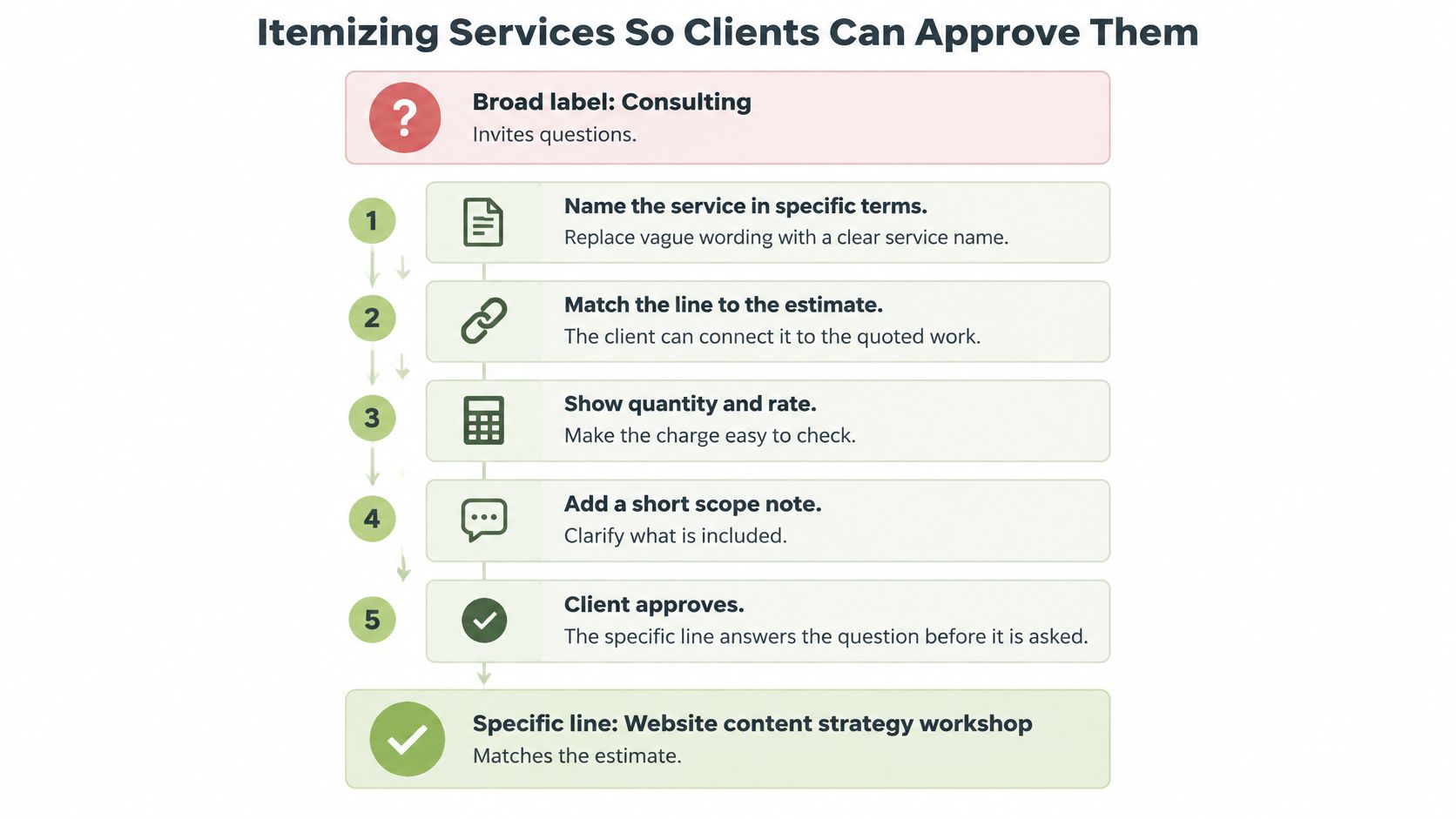
A broad description such as consulting or repairs leaves the client to reconstruct the agreement. A specific description lets the approver connect the charge to a deliverable, service visit, or accepted scope.
Detail should explain the price, not bury the client in internal notes. A fixed-price photography package doesn't need a fictional hourly breakdown, while time-based repair work should show the actual billable hours.
Build each line from the approved scope
- Name the service in recognizable language. Kitchen cabinet installation is clearer than general labor because it identifies the work the client authorized.
- State the billing unit, such as hour, visit, room, or project. The unit should match the pricing basis in the estimate.
- Enter the quantity being billed. For staged work, the description should distinguish the completed portion from work still outstanding.
- Add the agreed unit price. Any changed rate should be supported by an approved change rather than appearing unexpectedly on the invoice.
- Multiply quantity by unit price to calculate the line total. The client should be able to reproduce the calculation without guessing.
- Separate supplied materials from labor. This allows both charges to be checked and supports any different tax treatment established under applicable rules.
The following visual shows how specific descriptions help connect invoice lines to the approved work.
Worked cabinet installation example
Consider a hypothetical cabinet installation job with the quantities and prices below. These are illustrative charges, not market rates.
Worked example of itemized line charges
| Description | Quantity | Unit price | Line total |
|---|---|---|---|
| Kitchen cabinet installation, labor | 12 hours | $85.00 per hour | $1,020.00 |
| Cabinet hardware, supplied by contractor | 24 pieces | $4.50 per piece | $108.00 |
| Site cleanup after installation | 1 job | $150.00 per job | $150.00 |
| Subtotal of line items | Not applicable | Not applicable | $1,278.00 |
The cleanup charge belongs on the estimate if it's part of the original scope. If the client requested it later, the invoice should identify the approved change order instead of making the addition look like an unexplained surcharge.
A lump sum isn't wrong. For a fixed-price project, a clear deliverable description and contract reference can be more useful than unnecessary detail, but a bare total with no scope makes later adjustments harder to explain.
For clients that reconcile invoices against purchasing records, BankStatementWizard's discussion of avoiding duplicate invoice payments provides additional context for purchase-order controls. On the supplier's side, every billed line should remain traceable to an estimate, contract, or authorized change.
Totals, Deposits and Balance Due After a Partial Payment
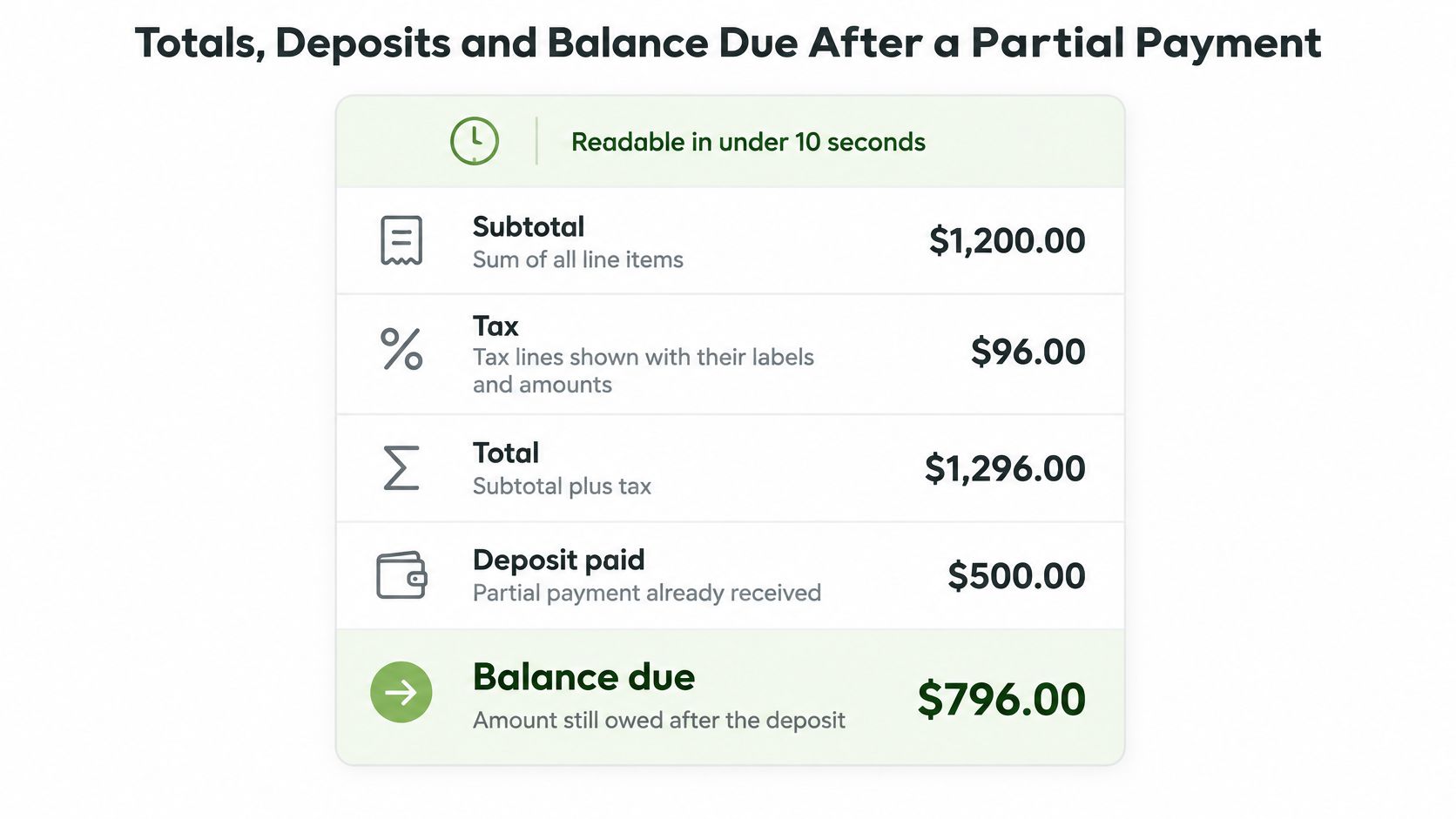
The summary block is where the client decides what to pay. It should distinguish the value of the work from the amount currently outstanding, especially when money changed hands before completion.
Queensland Government cash-flow and payment guidance supports clear service descriptions, agreed prices, payment terms, and payment records. For a service business collecting deposits, those details need to carry through to the final balance rather than disappearing when the work ends.
Keep the original total visible
Continuing the hypothetical cabinet job, assume no tax is added solely to keep this arithmetic example simple. That assumption doesn't establish whether cabinet installation or materials are taxable in any actual location.
| Summary entry | Illustrative amount |
|---|---|
| Line-item subtotal | $1,278.00 |
| Tax | None added in this example |
| Total project price | $1,278.00 |
| Deposit received June 1, representing 25% | Less $319.50 |
| Balance due | $958.50 |
The original total answers what the project cost. The dated deposit answers what has already been received, and the balance identifies the current payment request.
On an actual invoice, applicable tax lines should show their labels, rates, and amounts before the total. Discounts and credits should also appear explicitly rather than being subtracted.
Connect each payment to the invoice
Each partial payment should have a record tied to the invoice number, whether it arrived by cash, card, or bank transfer. The record should identify the date, amount, and payment reference, with a receipt or other evidence retained alongside it.
A practical partial-payment and invoice-balance workflow helps keep those entries connected. A deposit request must also be distinguished from confirmation that the deposit was received.
When an amount changes, the business should preserve the original document and reference its invoice number on the correction. Where local rules require a corrected invoice, replacement document, or credit note, that process should govern the numbering and labeling rather than overwriting the original.
Balance check: The client should see the original total, payments credited, and remaining amount without doing arithmetic or interpreting a payment-history attachment.
Payment Terms and Due Dates That Get Paid
Wording such as pay promptly expresses a preference, not an actionable deadline. An absolute due date gives the client a date to enter into its payment schedule, while clear instructions identify the next step.
The Australian Government's payment-terms guidance recommends covering payment timing, methods, installment conditions, and overdue-debt procedures in contracts and invoices. It's Australian guidance, not a statement of U.S. legal deadlines, but the operational approach is useful for drafting clear terms.
Replace shorthand with instructions
The following wording continues the hypothetical invoice issued June 1, 2026. Its dates and amounts illustrate agreed terms, not statutory requirements.
Weak and clear payment wording compared
| Weak wording | Clear wording | Why the clear version works |
|---|---|---|
| Pay promptly | Payment due by July 1, 2026 | Gives a fixed scheduling date |
| Net 30 | Due July 1, 2026, 30 days after the June 1, 2026 invoice date | Identifies when the period starts |
| Pay by check | Checks payable to the legal business name, mailed to the billing address on this invoice | Names the payee and destination |
| Late fees apply | Late fee stated in the signed contract, charged only where local law permits | Connects the fee to the agreement and applicable rules |
| Deposit paid | Deposit of $319.50 received June 1; remaining $958.50 due July 1, 2026 | Separates the received payment from the scheduled balance |
Payment instructions should list only methods the business accepts. Checks need a payee and destination, bank transfers need usable instructions delivered through an appropriate channel, and online payments need the correct payment link.
Keep fees and dispute procedures consistent
The currency should be explicit, particularly for cross-border clients. If an accepted payment method carries a customer-facing fee, its disclosure and handling should match the agreement, applicable law, and payment-provider rules.
Late-payment wording deserves the same care. A business shouldn't introduce a new penalty on the final invoice merely because the client is slow to pay; any fee or interest should be supported by the signed agreement and permitted locally.
The terms should also identify the billing contact and the agreed time allowed for raising a question. Matching wording on the contract and invoice gives the client a consistent procedure without implying that a short administrative query period eliminates legal rights.
Tax and Legal Fields That Depend on Your Location
Tax fields start with the applicable authority, not a preferred template design. The following comparison separates invoice-content rules from recordkeeping and transmission requirements.
Invoice rules by jurisdiction or source
| Jurisdiction or source | What it sets for invoices | Limit of its reach |
|---|---|---|
| EU VAT rules, Council Directive 2006/112/EC | Full VAT invoice fields, including VAT rate, amount, and breakdown | Applies to VAT-registered supplies; national rules add detail |
| U.S. federal tax records, IRS Publication 583 | Supporting documents retained with transaction and payment evidence | Federal recordkeeping, not a nationwide invoice template |
| U.S. state and local sales tax | Applicable tax treatment, rates, and invoice wording | State and local rules require separate verification |
| Structured e-invoicing requirements | Machine-readable data for covered transactions | Country, transaction, and buyer requirements control acceptance |
Distinguish tax content from tax records
For EU VAT transactions, the directive identified in the table was adopted November 28, 2006, establishing the full-invoice framework described earlier. Businesses handling relevant supplies should check national implementation, customer tax status, exemptions, and reverse-charge wording before adapting an invoice template with VAT.
For U.S. federal purposes, the IRS recordkeeping guide identifies invoices as supporting documents and says gross-receipts records should show amounts received and their sources. An invoice should therefore remain connected to deposit information, card records, canceled checks, or other payment evidence.
IRS Publication 583, revised December 2024, explains that supporting documents supply information for the books. That federal guidance doesn't establish a single invoice format for every U.S. state or service industry; sales-tax treatment and required wording need checking with the relevant state revenue agency.
Check the required delivery format
A readable PDF and a structured e-invoice aren't interchangeable. The OpenText global e-invoicing guide describes structured invoicing requirements that use defined data models and processing rules, so businesses should ask enterprise and public-sector clients whether a particular submission format is required.
For uncertain tax treatment, the Hire CPA directory from HireAccountants can be a starting point for finding professional assistance. Advice should address the actual service, business location, customer location, and transaction rather than merely reviewing the appearance of a template.
The issuing business remains responsible for the underlying goods or services, payer relationship, payouts, chargebacks, refunds, disputes, taxes, and compliance. GetBill doesn't warrant that its invoices, estimates, reports, calculations, templates, payment links, tax settings, or business records will meet legal, tax, accounting, or regulatory obligations.
Build a Reusable Invoice Template Before Your Next Job
A reusable template is most useful when it supports a repeatable job workflow. Copying an old invoice without checking its client details, service dates, or payment history can carry yesterday's errors into the next project.
Carry the approved information forward
- Set up the fixed information. The template should contain the business identity, numbering approach, billing contact, and standard payment instructions. The core-field checklist should be used to test completeness before the template becomes the default.
- When a client accepts an estimate, its approved descriptions and pricing should carry into the invoice rather than being retyped. In GetBill, an accepted estimate can be converted into an invoice with one click without re-entering data; each invoice also receives a unique access link that clients can use to view and pay without creating an account.
- Record payments against the invoice number. Each receipt or payment record should be saved with the job documentation so reconciliation doesn't depend on searching messages or remembering a cash payment.
- If the billed amount changes, the business should issue the appropriate clearly labeled correction referencing the original invoice. The previous version should remain in the records, with the replacement or adjustment relationship made explicit.
- Save the final invoice together with the accepted estimate, authorized change orders, and payment evidence. A consistent job folder makes the full transaction easier to retrieve for a client question or bookkeeping review.
The illustration shows the basic reuse pattern: establish the template, then apply it to a new job without treating the previous client's invoice as the master document.
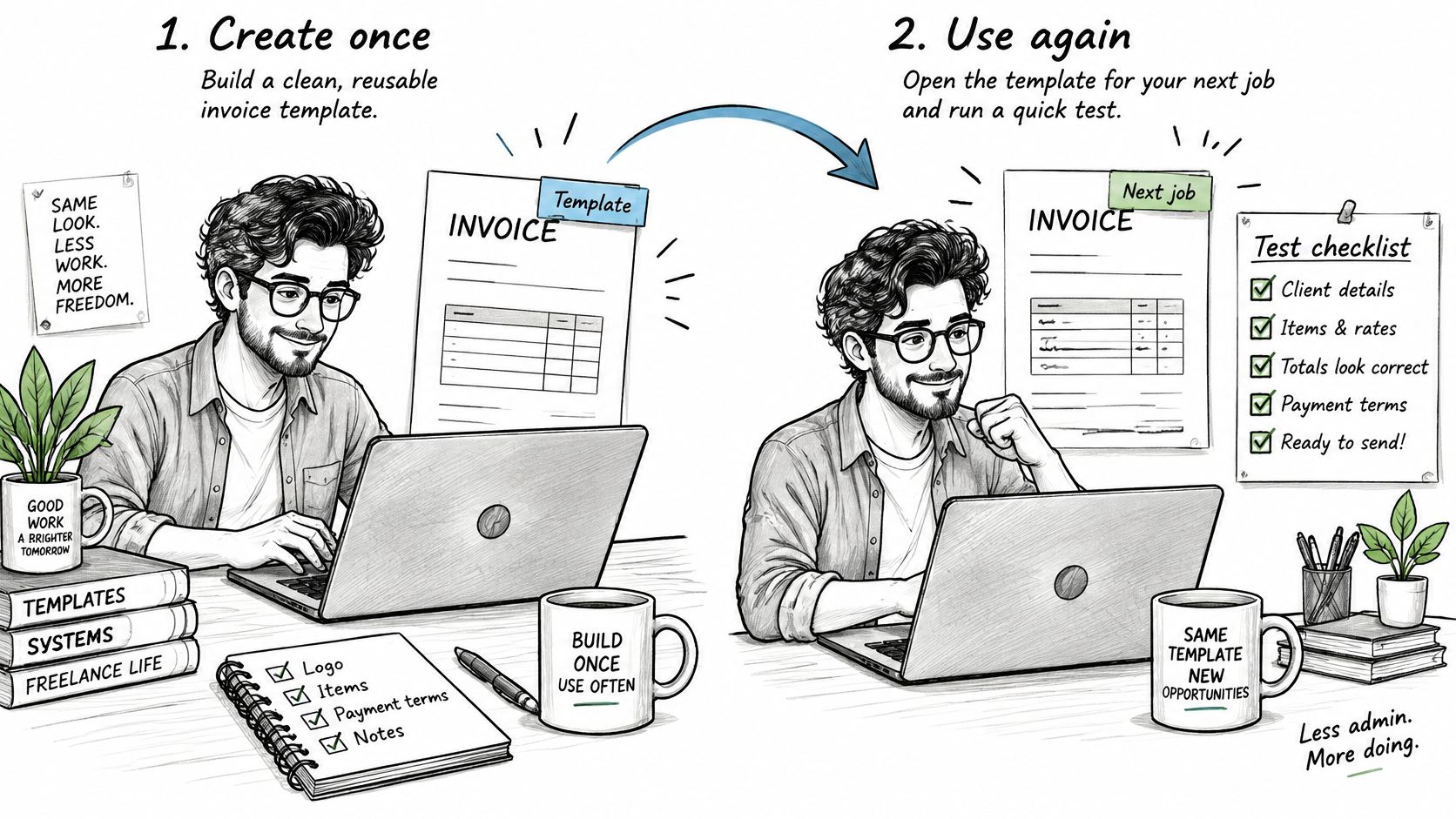
Before sending: The final review should check the client entity, approved scope, calculations, credited payments, payment destination, and current amount due.
The next job provides a practical test. Its invoice should pass the same independent-reader check: the client can identify the work, connect it to the agreement, and pay the correct balance without asking for clarification.
GetBill offers itemized estimates and invoices, estimate-to-invoice conversion, and partial-payment recording with updated balances. Small service businesses can visit GetBill to put the estimate, invoice, and payment-record workflow into practice.