


The client just replied “looks good” on a bathroom quote that is one round number. Tomorrow the supplier wants the vanity paid in full, and the helper booked for Thursday expects to be paid whether any deposit has cleared or not. That tidy total doesn't show either outflow, and it doesn't say what happens if the client picks a different faucet after the order goes in.
A construction quotation template should be the cash baseline and the scope baseline, not a prettier lump sum. It shows when money has to leave the account, which lines are firm, which amounts are allowances, and it keeps a numbered record when the job changes. For a small trade or service business, that same document is the start of the estimate you send, the invoice you issue, and the partial payments you record. Without those blocks, a job that looks profitable on paper can still strand payroll.
Table of Contents
- The Blocks on a Construction Quotation Template
- How to Price the Quote from the Site Notes
- Payment Stages and Clear Fee Labels
- Assumptions Allowances and Written Changes
- Invoice the Deposit Only After Acceptance
The Blocks on a Construction Quotation Template
Say the owner of a small bath remodel emails a single price. The client accepts. Two weeks later they ask why the tile, the shower valve, and the dumpster were “inside” that number, and the thread has no answer. The form below is the document order to copy so that question doesn't come up empty.
Copy the document in this order
Put the client's legal name, the service address, a phone or email, a quote number, and the date at the top. Next, write the basis of the price: the drawing or specification revision, or the date of the site visit, plus the inclusions. After that come the item table, allowances, exclusions, a contingency you can explain, tax treatment for the state where the work happens, a validity date, payment stages, and a written change rule. If a block is empty on purpose, type None or show zero and say why. A blank cell looks like a cost you forgot.
For that bath, the client-facing lines can stay short while the working sheet stays split.
Demolition. One lump, a unit rate, and a line total. Labor hours, the dumpster, and a waste factor on damaged board stay visible on the internal row.
Rough plumbing. The valve set as its own quantity. Material, any short equipment rental, and a subcontract each have a column, even if the PDF later rolls them into one phase.
Tile. Square feet taken from the site notes, a unit rate, and a line total. Waste stays on the working row so cut loss doesn't disappear into “tile.”
Fixtures. Vanity, faucet, and toilet as separate quantities when the client might swap one of them.
Cleanup. A flat line, not a hope that haul-off will be absorbed.
Early prices carry real uncertainty. Site conditions and unfinished selections move the final number, so a lump sum with no audit trail is the wrong default. You can't revise one assumption without reopening the whole price. A second pass against a remodel checklist, such as the East Texas remodel estimate review guide, catches scope gaps before those lines get locked.
Why the empty fields stay on the form
A 2013 survey of construction-industry professionals found that 66% said overlooked costs such as scaffolding frequently contributed to estimating errors, 51% cited miscalculated transportation costs, and 50% cited miscalculated contingency costs. Those categories stay on a small-job form even when the amount is zero. Transport, an allowance, and contingency are easier to defend at zero than to invent after the client has accepted one total.
Practical rule: If a cost was considered and set at zero, write the zero. A missing row reads as an oversight.
| Block | What to enter | Blank only if |
|---|---|---|
| Client and job | Legal name, site address, contact, quote number, date | Never |
| Basis of price | Drawing or spec revision, or site-visit date, plus inclusions | Never |
| Item lines | Item code, description, unit, quantity, unit rate, labor, material, equipment, subcontract, waste, line total | Never on priced work |
| Allowances | Provisional amounts labeled as not firm prices | You write None |
| Exclusions | Permits, disposal, delivery, concealed conditions, owner-supplied items | You write None |
| Contingency | A job-specific risk amount, not a copied flat percent | You show zero and why |
| Tax | Work state, included or extra, and the rate you are applying | Never |
| Commercial terms | Validity date, payment stages, written change approval | Never |
Paste that block list into a spreadsheet or an estimating workbook before the next job gets priced. The pricing pass fills rates. It shouldn't have to invent the columns.
How to Price the Quote from the Site Notes
The weeks after acceptance are when cash leaves first. The price you build from the site notes has to survive that sequence, not only look complete on the day you send it.
Texas A&M's quantity-takeoff guidance describes quantity takeoff as a detailed list of planned work quantities, which are then costed by resource category, and it recommends explicit risk and contingency planning. Use that measure-then-cost order on the bath, or on a similar repair, and don't skip ahead to a round number.
Nine passes, in order
- Freeze the basis. Record the drawing revision or the site-visit date, who measured, and what was shown. A later “I thought the wall was square” argument dies if the date and the person are on the sheet.
- Write inclusions and exclusions before any rate. Say whether permits, haul-off, and delivery are in or out. Pricing first and scoping second is how a dumpster fee gets lost.
- Sort the work into a stable breakdown. Mobilization, demolition, installation, testing, and closeout is enough for a small bath. The same headings should appear on the next repair so lines stay comparable.
- Measure from the drawing or the site notes. Keep the source date beside the quantity. Square feet of tile and the count of fixtures come from that note, not from memory a week later.
- Price each quantity in parts. Labor hours, material, equipment, subcontract, and a waste factor, then a line total. The client PDF can show phase totals. The internal sheet stays more granular so a swapped faucet doesn't force a full reprice.
- Name the risk, then add contingency. Tie it to this stage and this job type. Don't paste last month's percentage onto a bath that has open walls and a client who hasn't picked tile.
- State sales tax for the state of the work. Say whether tax sits inside the rates or is added at the bottom. There isn't one national construction tax rule, so the quote has to name the state.
- Add the commercial close. Validity date, the payment stages you'll invoice against, and a rule that changed work needs a written price before it starts. A short guide to written proposals and deposit rules is a useful check that those sentences are on the page.
- Reconcile, then send. Every site note maps to a line, quantities get a second check, and only then does the quote go out. The same discipline shows up in a plain walkthrough of how to write an estimate when the job is smaller than a remodel.
A total that still traces to quantities is the point. If a line can't be tied back to a note, a unit, and a rate, it isn't ready to send.
Payment Stages and Clear Fee Labels
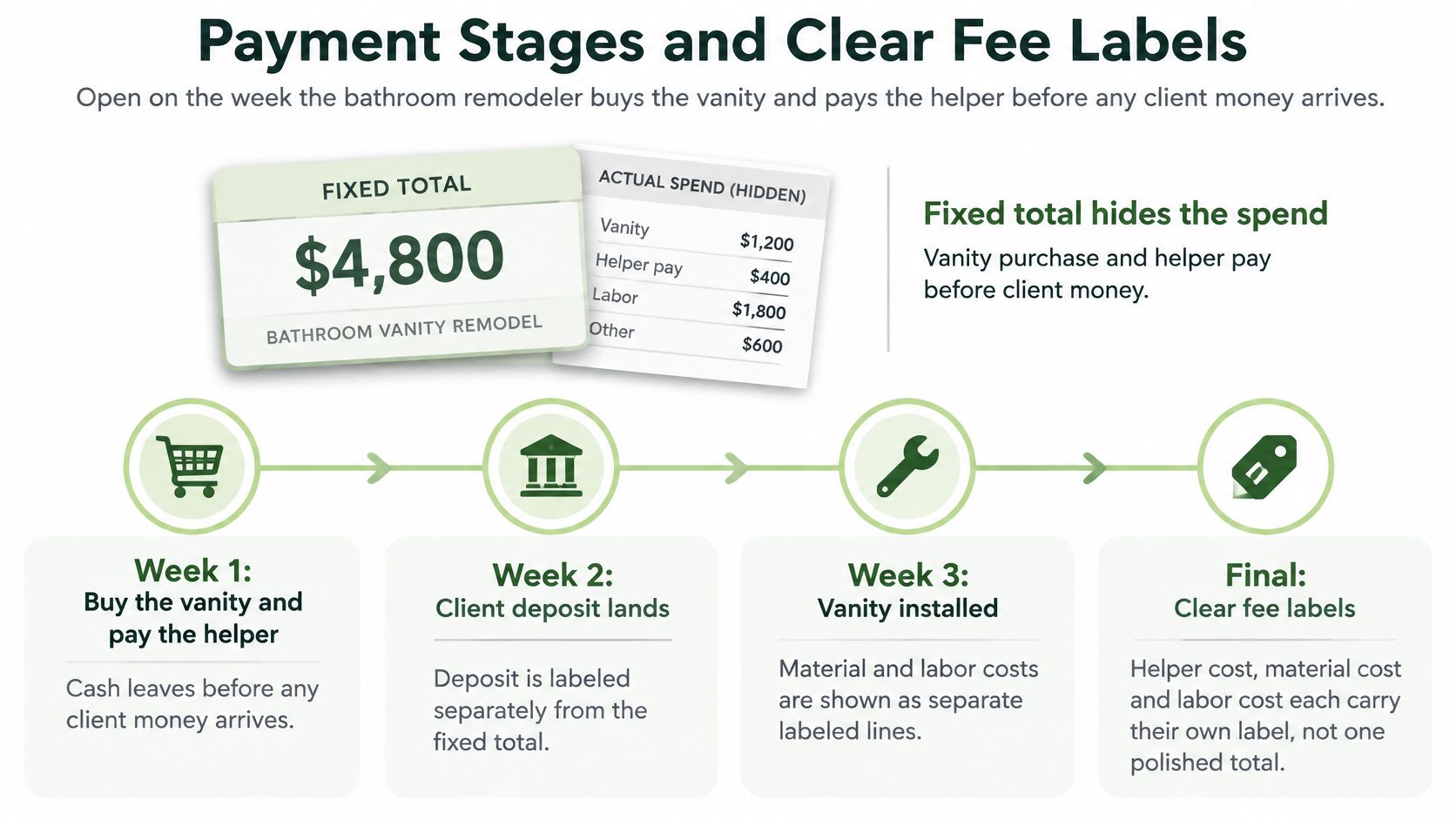
The week the vanity has to be bought, and the helper has to be paid, can arrive before any client money does. A polished fixed total hides that spend. Stages fix the timing. They don't replace a legal review of deposits in the state where the work sits.
A sample stage split for a small renovation
Use labeled shares as a starting pattern for a material-heavy remodel, then rewrite the dollars for the actual job. A handyman repair often needs only a deposit plus completion. A renovation needs a procurement stage because materials leave the account before labor does.
| Stage | Trigger | Sample share | Invoice when | Cash is for |
|---|---|---|---|---|
| Deposit | Quote accepted and procurement has not started | 30% | Before materials are ordered | Mobilization and the first material buy |
| Progress | Named milestone done, such as rough-in | 40% | The day that milestone is complete | Labor and subcontract already on site |
| Balance | Substantial completion as defined in the quote | 30% | At that completion point | Remaining price after the deposit and progress sums are credited |
Fill six fields on every stage: the stage name, the trigger, the share or dollar amount, the invoice date, the payment deadline, and the balance left. “30% deposit due at acceptance,” “40% progress payment after rough-in,” and “30% balance due at substantial completion” each say what the money is for. An unexplained “fee” doesn't.
SouthRay Kitchen & Bath payment guidance is a practical reminder that milestone language has to match how a kitchen or bath gets bought and built, not a generic draw schedule copied from a larger contract.
Acceptance is not cleared funds
An email that says yes is not money in the account. Don't order the vanity on that email. Invoice the deposit, wait until the funds clear, and only then buy. If the balance is on net 30, spell out the due date the way a net 30 billing setup would, so “when you're done” doesn't become a silent extra month.
A 2025 survey of construction professionals reported that 51% identified high upfront costs as a leading payment challenge, 38% cited waiting for payment, and 56% said they had turned down projects because of cash-flow or payment risks. Of projects affected by late payments, 76% lost at least one week, and 38% experienced delays of more than three weeks. Those figures describe construction payment pressure, not a promise about any one small job. They do explain why a quote that hides the spend week can look professional and still leave payroll short.
Name the state that governs the deposit, any retainage, and refunds. Say whether the deposit is credited against the contract price, refundable, or subject to that state's cancellation rules. Don't imply a nationwide deposit statute.
What the fee rule does not cover
Under 16 C.F.R. Part 464, effective May 12, 2025, the FTC Rule on Unfair or Deceptive Fees targets businesses offering live-event tickets and short-term lodging. It is not a general all-in pricing mandate for contractors, handymen, or other service invoices. Separate state consumer, advertising, licensing, or contract rules may still apply where the work is performed. Label the deposit by function and timing because the client should see what they are paying, not because that federal rule reaches a bath remodel.
Show a cost you considered and rejected as zero. Keep allowances off the firm-price lines so a provisional sum isn't read as a promise. Don't start extra work from a text message.
Assumptions Allowances and Written Changes
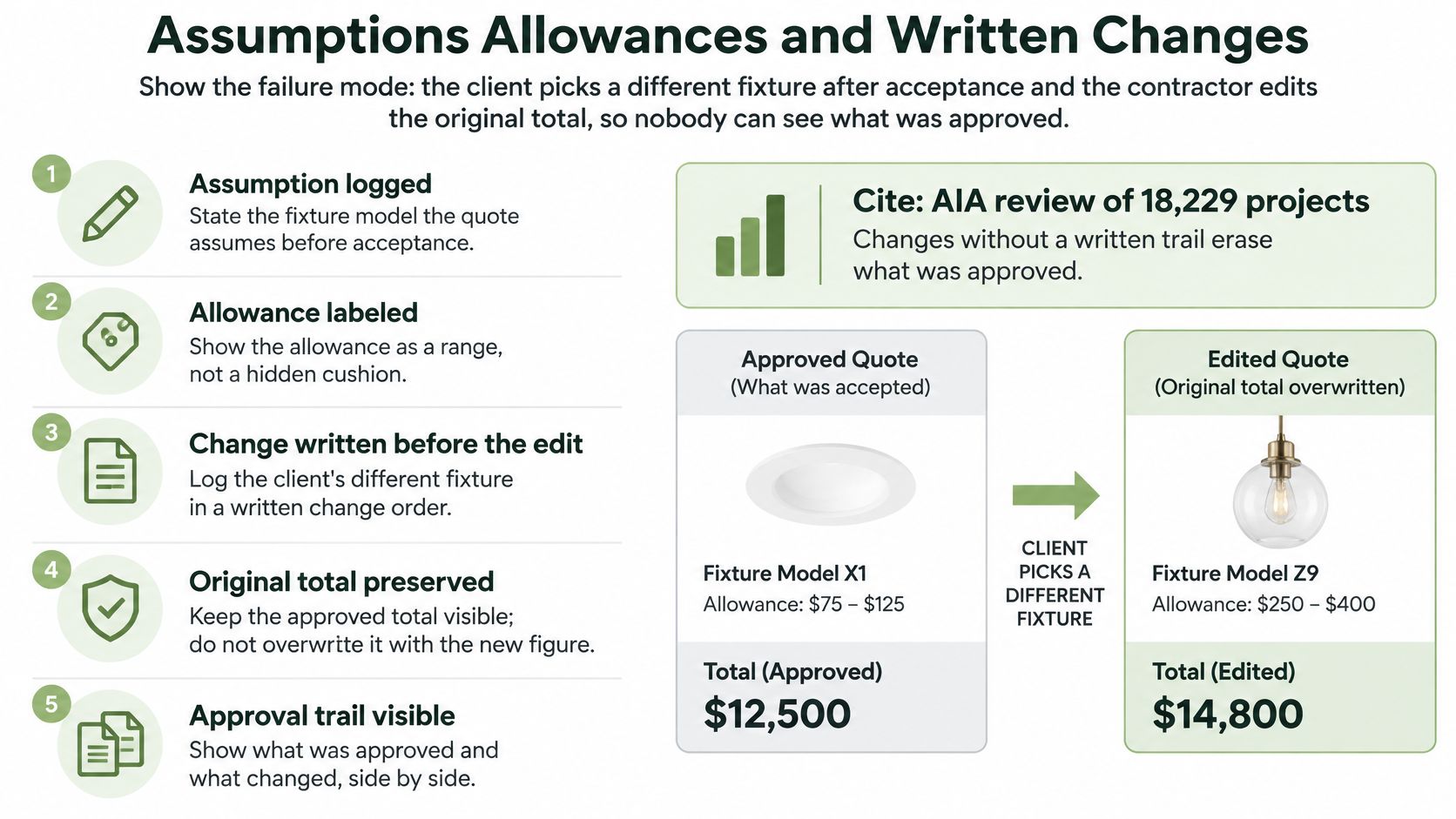
The failure mode is quiet. The client picks a different fixture after acceptance, and the contractor edits the original total. Nobody can see what was approved, what the allowance covered, or what the new price bought.
An AIA review of 18,229 projects found that average change orders ranged from 1.7 on the smallest projects to 11.18 on the largest, while cumulative change-order value generally averaged about 4% to slightly above 5% of contract value. Those are project averages across a large set of jobs, not a forecast for one bath. They are enough reason to freeze a baseline before anyone swings a hammer.
Freeze a baseline the client can still read
The quote should lock the drawing or specification revision, the pricing assumptions, the schedule basis, and who carries quantity risk. An allowance or provisional-sum schedule sits apart from firm-priced lines. Label it as not a committed price, or the client will treat the allowance as a promise.
Say in plain language whether permits, disposal, taxes, delivery, and concealed conditions are included. List owner-supplied items by name. If the client is bringing the faucet, the fixture line should say so, with a labor-only amount beside it.
The clauses that make this stick belong in the estimate terms, not in a side email. A short set of estimate terms and conditions is the right place to park validity, exclusions, and the rule that changed work waits for a written price.
Open a numbered change instead of editing the total
Keep the accepted quotation intact. Open change record 01 with a written description, the price impact, and the schedule impact. Do the extra work only after the client approves that record. The original total stays readable. The new total is original plus approved changes, not a silent overwrite.
Run this review with the client before work starts.
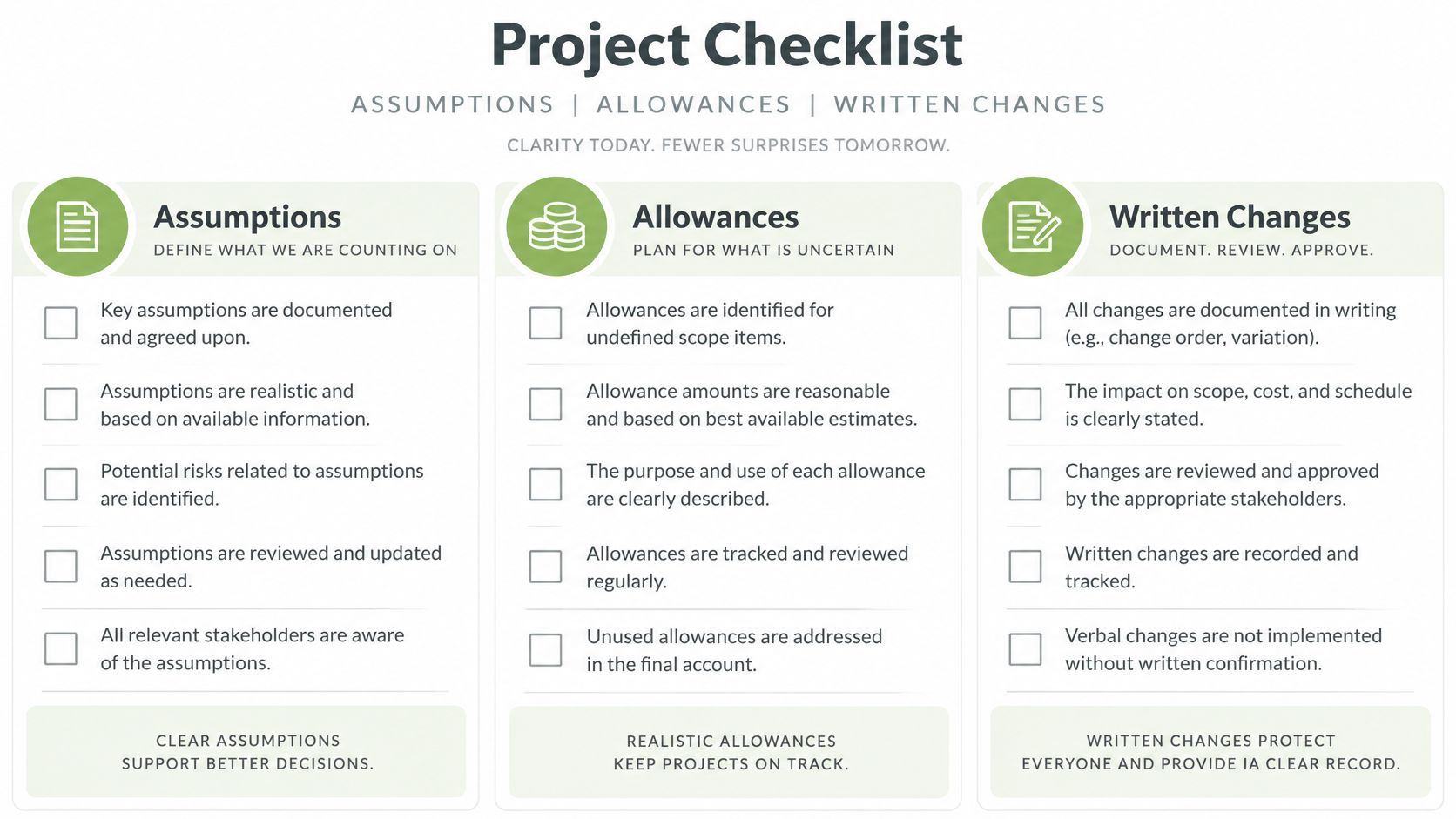
- Map every note to a line. A drawing callout with no quoted row is a gap, not a detail.
- Check quantities independently. A second measure on tile and fixtures catches the first takeoff.
- Test labor and lead times. If the vanity is three weeks out, the schedule basis has to say so.
- Put a dollar figure on exclusions. “Concealed conditions excluded” means more when the client sees what a typical repair would add.
- Name the gaps that remain. Unpicked tile, an unknown subfloor, or a permit you haven't priced yet.
That review fits on one page: an assumptions-and-changes schedule the client can initial. It is the artifact you keep when the fixture changes, not a new lump sum with the old one deleted.
Invoice the Deposit Only After Acceptance
Don't retype the job. Invoice the stage that is due, credit anything already received, and leave the original scope readable on the quote the client accepted.
Match the invoice lines to that accepted quote. Put the deposit or progress amount in the terms already printed on the quote, not in a new story written on invoice day. Record a partial payment against the balance so the open amount is what's left, not the whole contract again. When the client adds work, open a change record instead of overwriting the quote. An online “accept” is still not the same thing as cleared funds. A practical layout for that first bill is an invoice deposit template that names the stage, the credit, and the balance.
Where the handoff can stay in one file
GetBill fits that handoff and not the estimating judgment above it. An accepted estimate can be converted into an invoice in one click without re-entering the lines. The client can accept or reject the estimate online, which leaves a digital approval record. The service generates a PDF the client can download or print. Payment links depend on Stripe and on the user's account and region. The conversion steps themselves are laid out in the quote to invoice workflow. None of that files taxes, sends automatic reminders, or decides whether a deposit is legal in a given state.
Price one live small job on this template this week. Send the first invoice only for the deposit stage, and only when you're ready to buy, not for the whole contract on day one.
GetBill lets a small service business send an itemized estimate, record an online acceptance, and turn that accepted estimate into an invoice without retyping the lines. That handoff keeps the deposit, the original scope, and the remaining balance in one place when a construction quotation template becomes a bill. Visit GetBill to build the next estimate and invoice the stage that is due.