

You finish the work, send the invoice, and move on to the next client. Then payroll arrives before the customer's accounts-payable team has even approved the bill. The invoice says Net 30, but your bank balance experiences something closer to “we'll process it in the next payment run.”
That gap is why net 30 billing deserves more attention than a line in an invoice template. The term gives your customer useful payment flexibility, but it also turns your completed work into accounts receivable that you must finance. If you treat it as a label, late payments will surprise you. If you treat it as a working-capital decision, you can design deposits, reminders, and partial payments around the cash your business actually needs.
Table of Contents
- What Net 30 Billing Really Means
- How the 30-Day Clock Works in Practice
- Benefits and Tradeoffs for Your Cash Flow
- When Net 30 Invoices Actually Land
- Setting and Enforcing Net 30 on Your Invoices
- Managing Cash Flow When Net 30 Slips
- A Simple Net 30 Playbook for Small Businesses
What Net 30 Billing Really Means
Net 30 means the buyer must pay the full invoice within 30 calendar days of the invoice date. The clock generally starts when the invoice is delivered, not when the work finishes, the customer opens the email, or a project manager gets around to approving the deliverable. Allianz Trade's explanation of trade credit also places net 30 within a wider range of trade-credit periods and explains how terms such as 2/10, net 30 can offer an early-payment discount.
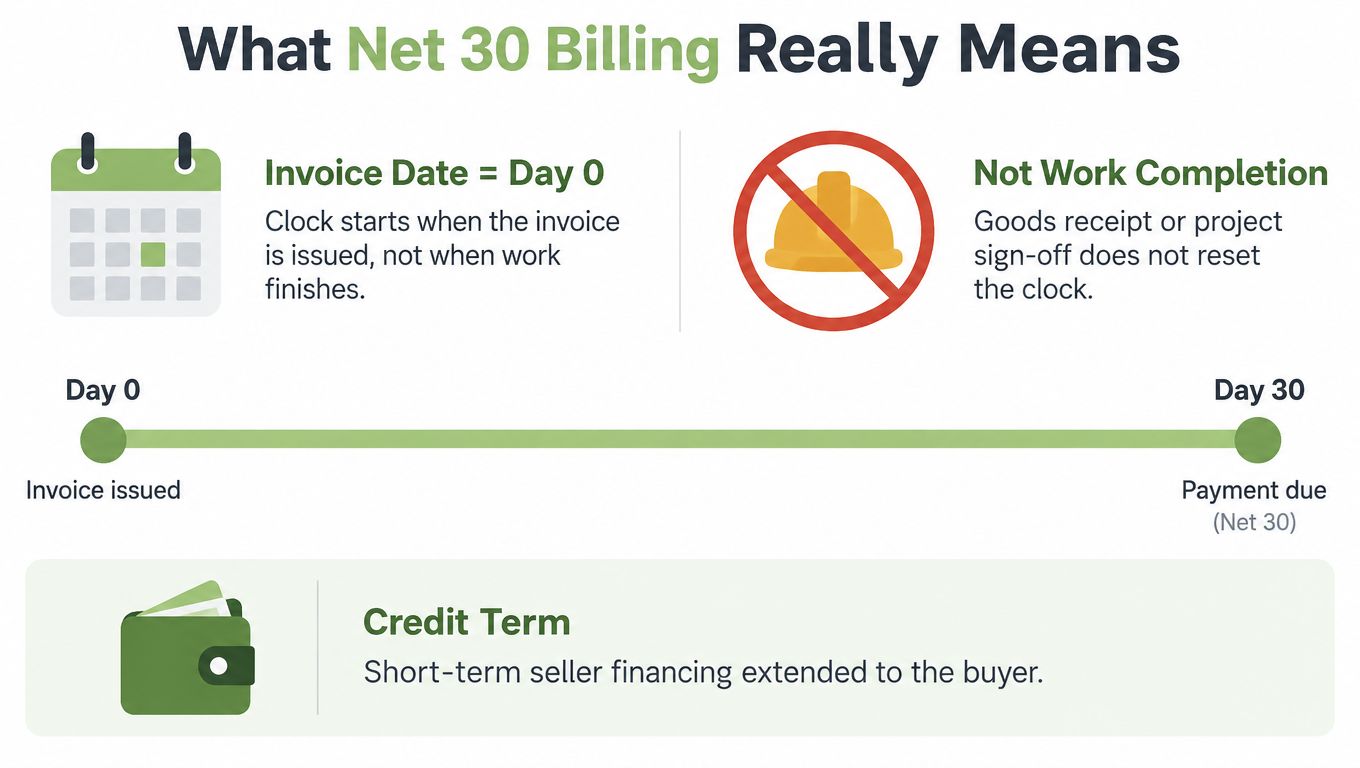
The important distinction is that net 30 is a credit term, not a payment guarantee. You deliver a service or product now, while the customer keeps the cash until the due date. During that interval, you may still need to fund wages, contractors, software, supplies, tax obligations, and your own living costs.
The stated term also isn't the same as the cash-in date. A recent benchmark reported that net-30 invoices in most B2B industries were effectively paid in about 42 to 52 days, which means a practical delay beyond the contractual term. The same benchmark source reported average U.S. B2B days sales outstanding of 34 days, with 29% of invoices paid past due and an average delay of 8 days beyond terms. The accounts-receivable benchmark makes the operational point clearly: your forecast should include customer behavior, not just the printed term.
The term is negotiated, not imposed
A seller can offer net 30, a buyer can request it, and both parties can negotiate something else. Common alternatives include net 15, net 60, due on receipt, and early-payment structures such as 2/10, net 30. The right choice depends on the buyer relationship, the size of the engagement, and how much unpaid work your business can carry.
Practical rule: Treat every net-30 invoice as a short-term loan to the customer. Before offering it, decide how much of that loan your cash position can safely support.
Net 30 can help remove friction from a B2B sale, particularly when the buyer's procurement process expects standard trade credit. But a familiar label doesn't make the arrangement harmless. It determines when your revenue becomes available cash, so choose it with the same care you'd apply to a credit limit.
How the 30-Day Clock Works in Practice
Start with the invoice date. Unless your contract says otherwise, day zero is the date printed on the invoice, and the due date falls 30 calendar days later. Weekends and holidays can create disputes, so specify in writing whether payment moves to the next business day when the due date lands on a non-working day.
A contract, purchase order, or accepted estimate may define the terms before you invoice. The invoice should repeat them in plain language, including the exact due date. A verbal promise from a buyer or project manager shouldn't override written terms unless you document the change and both sides accept it.
This guide to invoice dates and due dates is useful when you need to make the trigger date unambiguous. The wording should answer one question without interpretation: which date starts the clock?
Early-payment discounts change the economics
The notation 2/10, net 30 means the buyer may take a 2% discount if payment arrives within 10 days. Otherwise, the full balance is due by day 30, as explained in Amazon Business's overview of invoice payment terms.
| Discount Terms | Days Saved | Effective Annual Return |
|---|---|---|
| 2/10, net 30 | 20 calendar days | A highly attractive implied return for a buyer with available cash |
For the buyer, giving up the discount can be expensive because the business retains cash for only a limited additional period while paying the full invoice. For the seller, the discount can accelerate collection, but it reduces the amount received. Run the decision against your borrowing cost, margin, and cash urgency rather than offering a discount automatically.
Disputes and grace periods need written rules
A grace period can preserve goodwill, but it shouldn't create a second unofficial due date. State whether it affects late fees, collection activity, or only the tone of the first reminder.
A dispute should pause resolution of the disputed item, not erase the original timeline for everything else. Put a response window and a partial-dispute rule in your agreement. If the buyer challenges one line, request payment of the undisputed balance while you resolve the question.
Benefits and Tradeoffs for Your Cash Flow
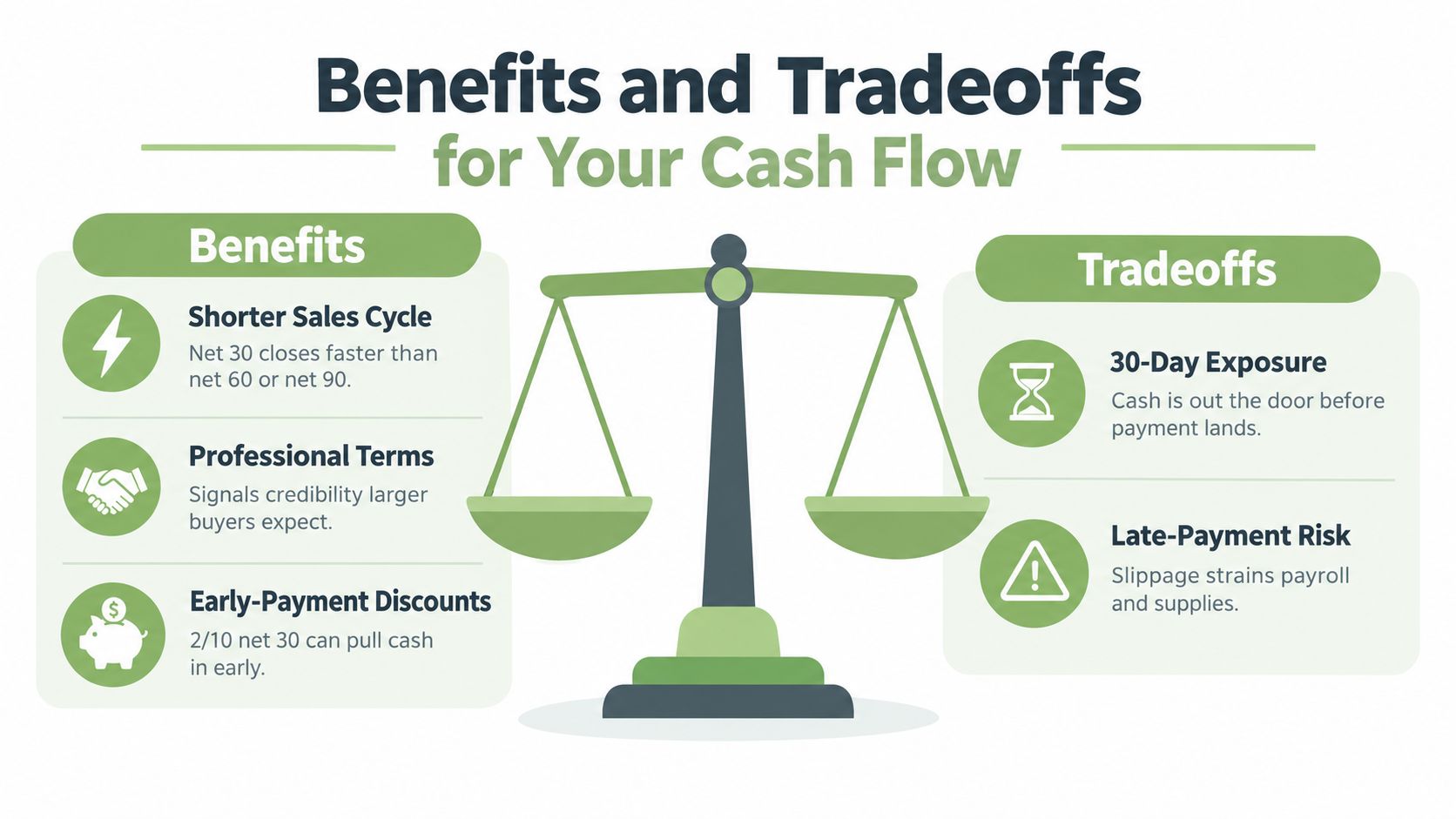
Net 30 can be commercially useful, but it shouldn't become your default because other businesses use it. The seller gives up immediate access to cash in exchange for a payment structure that may make the purchase easier for the buyer.
The upside is straightforward. Compared with net 60 or net 90, net 30 limits the formal financing period. It can also signal that you understand normal B2B procurement, which matters when a larger customer won't pay before its approval process is complete. An early-payment option can pull cash forward without forcing every customer onto immediate payment.
Why sellers offer the term
Trade credit can function as a relatively low-friction financing arrangement for the buyer. The customer receives the service or goods and keeps cash available for its own operating needs until the due date. That flexibility may help you win a valuable account or make a larger engagement easier to approve.
Net 30 also gives both sides a predictable framework. The buyer knows when the obligation falls due, and the seller can include the receivable in a cash forecast. The framework only works, however, when the seller sends an accurate invoice promptly and follows up consistently.
Where the exposure becomes uncomfortable
The cost appears when expenses arrive before payment. Payroll, supplier bills, tax payments, and operating overhead don't wait for the buyer's approval queue. If the customer pays late, the seller carries both the original credit period and the delay.
A single large client can make this worse. Customer concentration turns one slow approval process into a company-wide cash problem. You may appear profitable on an accrual basis while lacking enough cash to accept new work or meet routine obligations.
Net 30 is reasonable when your cash runway can absorb the receivable. It's dangerous when you need the invoice to fund the work that produced it.
Assess the term against your own operating cycle. A repeat customer with a strong payment record may justify flexibility. A new buyer, a large project, or a thin reserve may call for a deposit, milestone billing, a smaller credit limit, or payment before delivery. Industry habit is not a cash-flow policy.
When Net 30 Invoices Actually Land
The due date is a contractual marker. The cash-in date is an operational event shaped by invoice quality, approval steps, payment batches, banking time, and the customer's discipline.
Recent benchmarks illustrate the difference. One 2026 benchmark placed practical payment for net-30 invoices in most B2B industries at 42 to 52 days. Another reported 34 days of average U.S. B2B DSO, with 29% of invoices paid past due and an average delay of 8 days. The published receivables benchmark supports a more realistic forecast than writing “due in 30 days” beside every expected receipt.
Billbooks' invoice study found that about 65% of paid invoices arrived after the due date, with a typical delay of 11 days. It also reported that one in four late invoices was 28 or more days late, while invoices due on receipt were paid in 15.9 days on average compared with 47.2 days for net 30. The Billbooks invoice payment study shows why the term printed on the document doesn't always predict the behavior behind it.
What changes the timing
A client with automated accounts payable may approve and schedule an invoice quickly. Another may require a purchase-order match, departmental approval, and a fixed payment run. Month-end processing can add another wait even when nobody intends to delay you.
| Client Type | Stated Term | Typical Actual Days | Main Delay Source |
|---|---|---|---|
| Automated AP buyer | Net 30 | Near the agreed window | Routine approval and payment scheduling |
| Procurement-heavy buyer | Net 30 | Beyond the agreed window | PO matching and multiple approvals |
| Chronic late payer | Net 30 | Materially beyond the due date | Missed commitments and weak follow-up |
| Buyer on immediate terms | Due on receipt | Often earlier than net 30 | Payment requested at delivery or invoice issue |
The seller can compress the avoidable part of this window. Include the purchase-order number, send the invoice to the correct AP address, use a clear subject line, and show the due date prominently. Ask for the approver and payment contact before work starts. A clean invoice won't fix a customer that chooses to pay late, but a rejected or misrouted invoice gives the customer an avoidable reason to start the clock again.
Setting and Enforcing Net 30 on Your Invoices
Write the term for an accounts-payable clerk who doesn't know your conversation with the project lead. “Net 30” alone leaves room for arguments about receipt, acceptance, delivery, or month-end rules. Put the trigger and the date together:
Payment due on [specific date]. Net 30 from invoice date.
That line gives the customer a usable deadline instead of asking someone to calculate it. GetBill's practical invoicing guidance also reflects the broader principle that an invoice should contain enough information to be processed without a follow-up email.
Remove the reasons AP rejects invoices
Before sending, verify the details that commonly stop an otherwise valid bill:
- Purchase-order reference: Use the exact PO number and match the buyer's requested format.
- Remit-to details: Show the payment email, bank information, or approved checkout route.
- Approver contact: Identify one person who can confirm acceptance and resolve a dispute.
- Scope and evidence: Attach the estimate, acceptance record, timesheet, milestone approval, or delivery record when relevant.
- Balance clarity: If the invoice includes a deposit or prior payment, show the amount already received and the remaining balance.
Use a short late-payment clause that fits the law governing the transaction. Don't insert a made-up universal rate. State the exact percentage only when it has been reviewed, agreed, and permitted where the buyer is located.
Follow up before the account becomes old
A polite reminder before the due date gives the customer a chance to correct a missing PO or approval. When the due date passes, ask for a specific payment date rather than accepting “it's in process.”
A practical escalation path looks like this:
- Send a brief written reminder and attach the invoice again.
- Ask the AP contact to confirm the reason for the delay and the scheduled payment date.
- Refer to the agreed late-payment language if the account remains unpaid.
- Escalate to a formal collections letter when promises stop producing action.
- Pause new work if the overdue balance exceeds the credit exposure you approved.
Keep the tone factual. You're protecting the relationship by making the process predictable, not by pretending the overdue balance doesn't exist.
Managing Cash Flow When Net 30 Slips
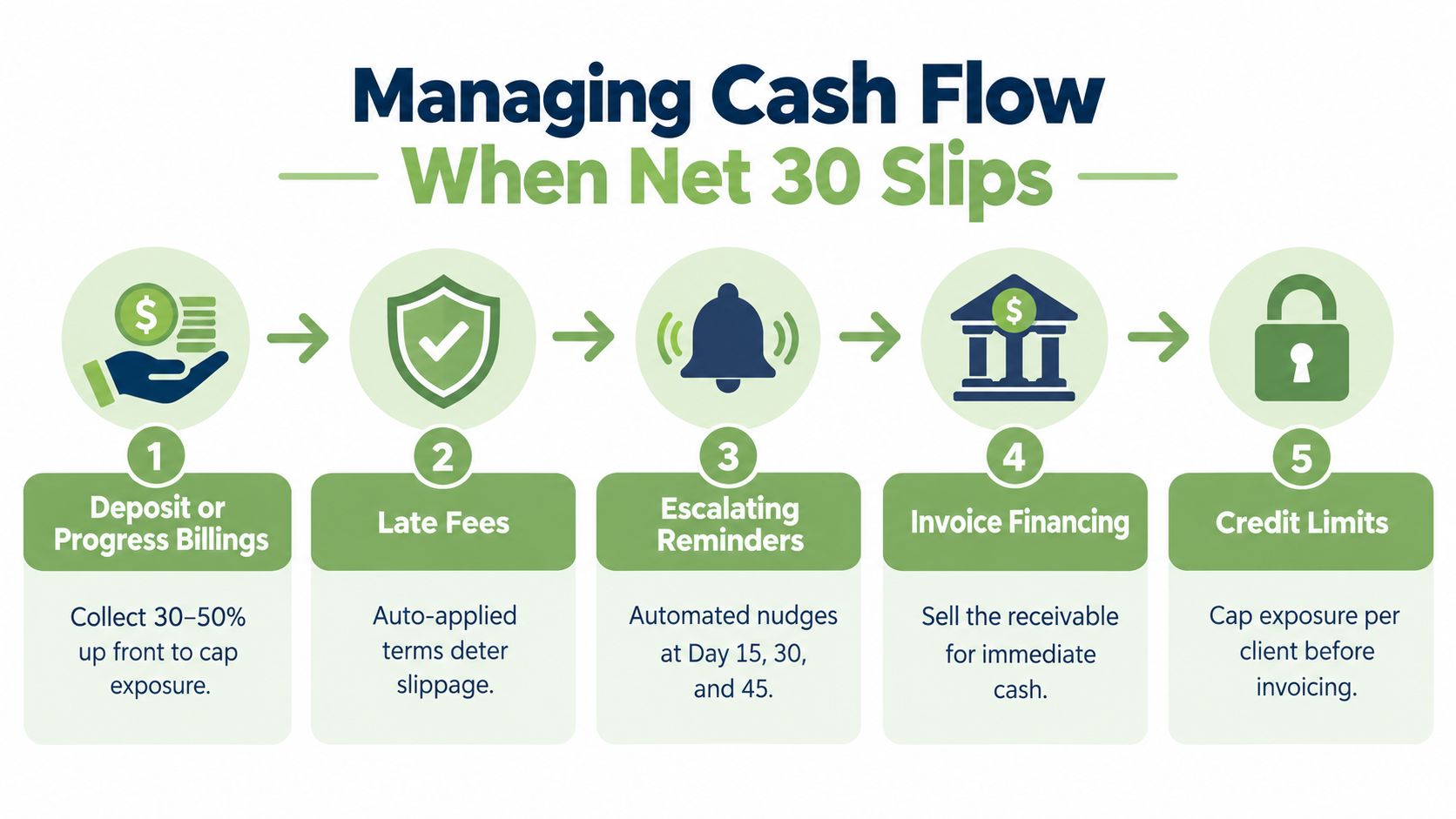
A late net-30 invoice is a working-capital exposure. More reminders may improve visibility, but reminders alone won't fund payroll. The durable fix is to change how much cash reaches you before the final delivery and how much unpaid work any one customer can accumulate.
For larger engagements, use a deposit or progress billing. The customer still receives a reasonable payment window on the balance, while you avoid financing the entire project from your own reserves. The arrangement must appear in the proposal and accepted scope, not arrive as a surprise after the work is complete.
Split the receivable before it becomes a problem
Milestone invoicing can turn one large delivery invoice into several smaller collection points. A structure such as 33/33/33 may divide billing across commencement, an approved midpoint, and final delivery. Those percentages are a commercial example, not a universal rule. Choose milestones that correspond to real value and clear acceptance events.
A partial-payment workflow can be even more precise. You might request 70% on net 30 and the remaining balance on net 10, then release final files or handover materials after the cleared balance arrives. Put the split, due dates, and delivery condition on the original invoice and contract. Never introduce the rule only after the customer has received the work.
Use incentives and limits deliberately
An early-payment offer such as 2/10, net 30 can be cheaper for the buyer than other short-term funding options, but the seller pays for that speed through the discount. A structure such as 1.5/15, net 30 offers a different balance between the concession and the time saved. Compare the discount with your actual cost of capital and the value of receiving cash earlier.
Your credit policy should also set a maximum unpaid balance by client. Stop extending fresh work when the customer reaches that limit. A buyer that wants more capacity can make a deposit, clear an overdue invoice, or agree to a revised billing structure.
Track the result in a rolling 13-week cash forecast. List expected receipts by realistic cash-in date, not merely by invoice due date. Then add payroll, taxes, supplier payments, and essential overhead. That view tells you early whether to negotiate a deposit, delay discretionary spending, or escalate a collection.
A Simple Net 30 Playbook for Small Businesses
A workable policy should fit beside your invoicing tool and survive a busy week. Use the following routine for every new customer and adjust it only when you've made a conscious commercial decision.
Build the process before the project
- Confirm terms before work starts. Get the payment trigger, due date rule, deposit, milestones, late-payment language, and dispute process accepted in writing.
- Invoice on day zero. Send the invoice as soon as the billable event occurs. Display the exact due date, balance, PO number, and payment method.
- Automate the reminders. Schedule a friendly check-in before the due date, then follow up when the invoice becomes overdue. The message should include the invoice and a direct payment path.
- Escalate without improvising. Ask for a payment date when the invoice is late, call the responsible contact when written reminders stall, and pause new work when the account exceeds your limit.
- Review the ledger weekly. Examine the aging schedule every Monday, flag invoices approaching the due date, and decide whether to nudge, negotiate, or escalate that same morning.
Skip net 30 when the buyer has no credible payment history, when the project is too small for the administration to make sense, or when the customer is showing signs of financial distress. A new client can start with a deposit or a limited first engagement. A repeat client can earn broader terms through consistent payment behavior.
A billing system should preserve the agreement rather than rely on memory. Tools such as software for small businesses can help centralize invoice creation, payment status, client details, and follow-up tasks. GetBill provides invoice and estimate creation, online payment links, partial-payment tracking, and balance updates, which can support a documented net-30 workflow.
The central operating question is simple: how much unpaid work can the business carry without putting essential cash at risk? Set net 30 around that answer, then make every invoice and reminder reinforce it.
GetBill helps independent professionals and small service firms create and send invoices, accept online card payments through Stripe, and track deposits and partial balances in one billing workflow. If you want clearer net-30 due dates and less manual payment follow-up, visit GetBill and build the process around the cash your business needs.