


Three quotes sit half-finished in a notes app, a client has asked twice for the final number, and last week's job ran forty minutes past the hours written on the paperwork. None of that feels like a pricing problem until the month closes and the bank balance says otherwise.
Cleaning services estimates fail in predictable places: drive time nobody counted, soil nobody defined, and an invoice that doesn't match what the client approved. The repair isn't a higher headline rate. It's an estimate built from measured minutes, where every line traces to a cost and the client can see exactly what changes the number after they say yes.
Table of Contents
- Choosing Hourly, Flat-Rate or Per-Visit Pricing
- Line Items Every Cleaning Estimate Needs
- Turning Job Time Into a Minimum Viable Price
- Scope Limits and Change Triggers Clients Should See
- Converting an Accepted Estimate Into a Paid Invoice
- Keeping Estimate, Invoice and Receipt Records
- Sending Your First Itemized Estimate This Week
Choosing Hourly, Flat-Rate or Per-Visit Pricing
Four pricing models cover most cleaning jobs. The model you choose determines who carries the risk of a long day. Start with your measured time and costs, then decide how to present the price to the client.
| Model | Best fit | Main risk | How to set the price |
|---|---|---|---|
| Hourly | First-time clients, post-construction and uncertain scope | Client cannot predict the total cost | Estimated hours by area multiplied by your loaded rate |
| Flat rate per visit | Recurring standard cleans with a stable scope | Underpricing long jobs and travel time | Measured job minutes converted at your minimum hourly rate |
| Per square foot | Large commercial floors with uniform scope | Ignores soil level, fixtures and access | Your tested rate, checked against the hours it produces |
| Tiered packages | Repeat clients who want clear choices | Tiers that hide what is included | Named tiers with each included task listed |
Where each model breaks down
Hourly suits the first visit to a home nobody has cleaned in a year, or a post-construction handover where debris volume is unknown. The client can't see a total, so quote an hour range, name the rate, and print the minimum charge beside it. Without that minimum, a two-hour booking forty minutes away rarely pays.
Flat rate per visit works once the same scope has been timed three times. The risk sits entirely with the operator. A flat rate copied from a competitor, or built from a guess about how long a three-bedroom takes, is how a full schedule turns into a thin margin.
Per square foot prices large uniform floors cleanly, but area says nothing about fixture count, soil level or access. Test any square-foot number against the hours it produces before it reaches a client.
Tiered packages give repeat clients a clear choice, provided each tier lists the tasks it includes. A tier labeled "deep clean" with no task list is a dispute waiting for a slow week.
Rule of thumb: time the first three visits, then convert measured minutes into a rate. A competitor's headline number says what they charge, not what your job costs.
If the scope is known and repeatable, price flat. If it isn't, quote hourly with an estimated range and a stated minimum, then reprice once the minutes are on record.
Line Items Every Cleaning Estimate Needs
A two-bedroom apartment gets a flat $120 quote during a phone call, and the client accepts before the call ends. The address turns out to be twenty-five minutes each way, the kit needs restocking before the job, and the only parking is a metered spot. That's 50 minutes of round-trip travel before restocking and parking. If those costs weren't included in the $120 quote, they reduce the job's margin.
Itemizing separates those drivers so the client sees what each dollar buys and the owner can defend the total without renegotiating it on the doorstep.
| Line item | What it covers | How to price it |
|---|---|---|
| Base cleaning labor | Hands-on time for each room or area | Estimated hours multiplied by your loaded hourly rate |
| Travel | Drive time and mileage to the property | Flat trip fee or billed minutes, stated on the estimate |
| Setup and supply loading | Time to load, unload and prepare your kit | Fixed minutes added to each visit |
| Consumables | Cleaning products, cloths, liners and bags | Cost plus a markup you set, or included in the rate |
| Access and parking | Key pickup, gate codes, paid parking | Passed through at actual cost, with receipts |
| Optional add-ons | Inside oven, interior windows, baseboards, inside fridge | Separate fixed price for each add-on |
| Heavy-soil contingency | Conditions beyond the stated scope | Triggered rate or revised estimate, defined in advance |
Three habits that make the line items hold
- Name the tasks inside the base scope. "Standard clean" means whatever the client imagines until the line reads: vacuum all floors, mop hard floors, sanitize bathrooms, wipe kitchen counters and appliance exteriors, empty waste. A named list is also what the invoice gets checked against later.
- Price travel and loading as their own lines. Folding drive time into the hourly rate hides it, then pushes the rate above local competitors. A separate trip fee keeps the labor rate honest and gives the client a lever: they can book a closer date or combine visits.
- State the soil assumption in writing. The estimate covers normal soil and the access described. Anything beyond that is a change order, not an argument.
The test for a finished estimate is short: every dollar traces to a line, and every line traces to a measured minute or a receipt. Keeping the invoice built from the same line set removes a category of client question, and a cleaning invoice template that mirrors your estimate is the simplest way to enforce it. GetBill estimates can be sent instantly and can include custom items, taxes and notes, so scope lines, a travel fee and an exclusion note travel as one document instead of three emails.
Turning Job Time Into a Minimum Viable Price
Labor is usually the largest cost in a cleaning job. Use your own timed jobs to estimate labor, then account for travel, setup and supplies in the price.
The sequence below compresses the whole calculation into four moves, from counting rooms to a price that survives a slow month.
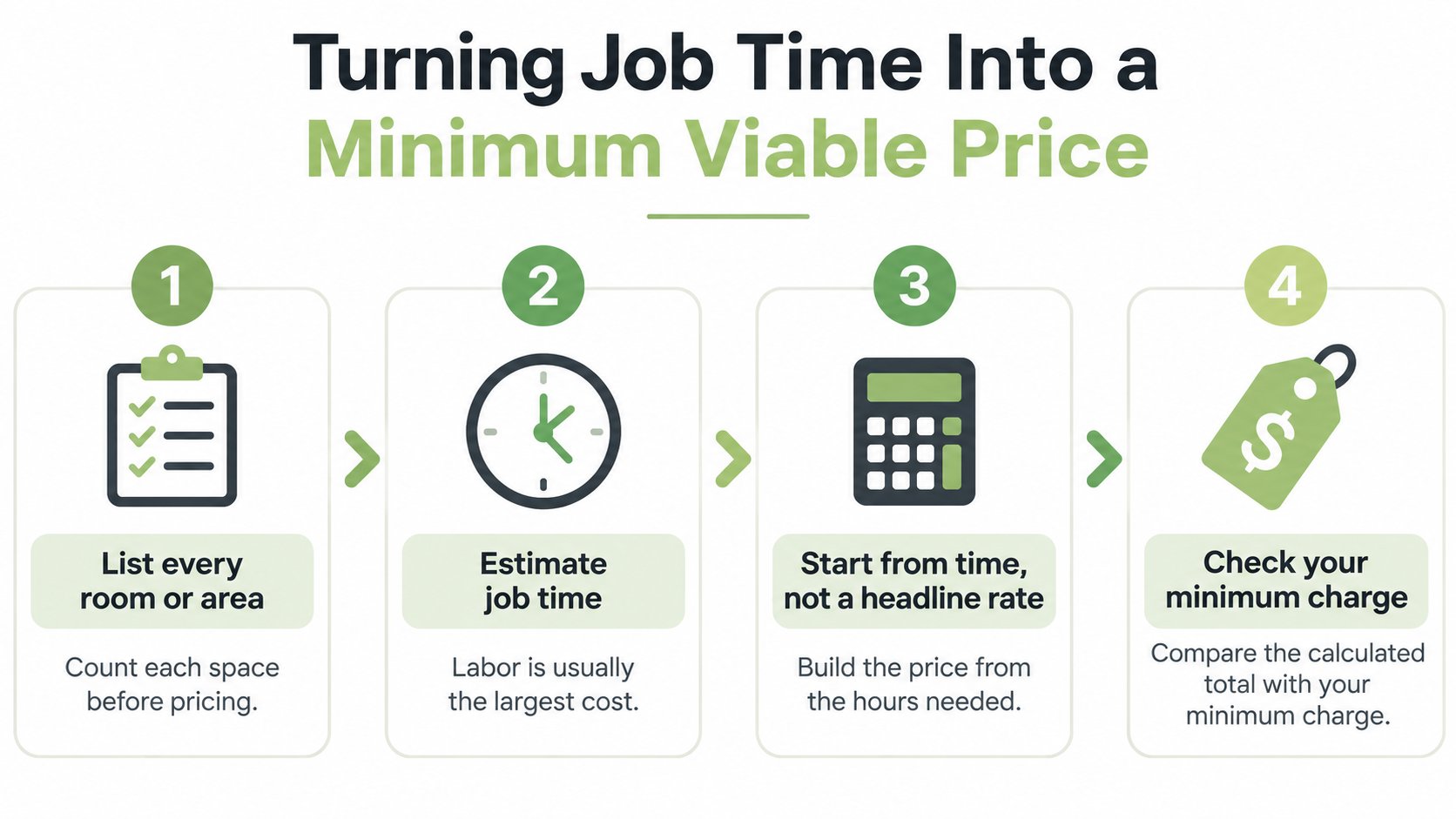
- List every room or area and its fixtures. Work from a walkthrough or client photos and count space by space: kitchen, two baths, three bedrooms, hallway, stairs. Pricing "a three-bedroom" from memory is the common slip, because a home with two bathrooms and a utility room is a different job from the same square footage without them.
- Estimate minutes per area from your own timed cleans. Time the same room type using your products and your dwell times, then write the number down. How long a job "should" take is guesswork with a decimal point.
- Add travel, setup and loading as separate blocks. Thirty minutes between two jobs can't be billed at the labor rate to either client, so it has to exist somewhere in the price. Forgetting drive time is the most common reason a packed week still loses money.
- Multiply total hours by a loaded rate. Loaded means wages, payroll taxes, workers' compensation and liability insurance, vehicle running costs, phone, software and general overhead. A rate built only on the wage leaves nothing behind after a quiet fortnight.
- Add consumables and pass-throughs. Products, liners, cloths, parking meters and gate fees. Pass-throughs belong at cost with receipts attached, never buried inside the labor line.
- Add a heavy-soil contingency decided in advance. Set the amount before the job and define the conditions that trigger it, so the price holds up without a negotiation in a client's hallway.
- Compare the total against your minimum charge. If the computed price lands below the minimum, reprice or decline. A short job far from home rarely clears a realistic minimum once travel is in the calculation.
Here's a hypothetical example for one cleaner: two hours of cleaning, 20 minutes of setup and loading, and 30 minutes of round-trip travel total 2 hours and 50 minutes. At a rate of $42 per hour that includes your labor costs, overhead and profit, that time comes to $119. Add $8 for supplies and $5 for parking to get $132 before any applicable tax. If your minimum charge is $125, quote $132 before tax. Include each cost once.
Scope Limits and Change Triggers Clients Should See
The dispute rarely starts with the total. It starts with a sentence like "I assumed the inside of the oven was included," and by then the client has paid a deposit and the van is packed.
The first thing an estimate must answer is what changes the price after acceptance. That starts with the document type. A firm estimate follows a walkthrough or a set of client photos and can be held to its number. A budgetary estimate given from a phone description is a placeholder, and it should say so in its first line rather than in a footnote.
| Trigger | Price effect | Wording to include on the estimate |
|---|---|---|
| No site visit or photos | Estimate is budgetary, not firm | Marked as pending a walkthrough or photos |
| Soil beyond the stated standard | Extra time billed | Excessive soil defined, with photos where possible |
| Clutter that must be moved | Extra labor | Item count or moving rule stated |
| Lockout or no access on arrival | Trip charge | Fee amount and waiting window stated |
| Cancellation inside the notice window | Cancellation fee | Notice period in hours stated |
| Change from one-time to recurring | Rate changes | Recurring and one-time prices on separate lines |
| Wait time at the property | Billed minutes | Waiting rate per 15 minutes, if you charge for waiting |
Defining excessive soil without arguing about it
Grime that needs a second pass, a dwell time longer than the product label allows, or a scrubber on fixtures falls outside a normal clean. Ordinary dust and light kitchen grease don't. Photos taken at the walkthrough settle most of these conversations before they start, and a written definition gives the cleaner something to point at other than personal judgment.
Excluded tasks belong in the same written scope: appliance interiors, exterior windows, carpet shampooing, furniture over a stated weight, and disposal of anything the client left behind. Each is either a priced add-on or it isn't happening.
When a trigger appears on site, send a short revised estimate before the work continues. A change approved in a message beats a change argued about after the invoice.
Minimum charges, lockout fees and cancellation windows need an amount and a notice period attached, not a vague mention. Recurring visits and one-time deep cleans sit on separate lines, because a deep clean is not a discounted standard visit, and pricing it as one teaches the client to expect the wrong number forever. Putting those terms in writing is what the estimate terms and conditions guidance covers.
Converting an Accepted Estimate Into a Paid Invoice
Acceptance is where accuracy leaks. A job gets rekeyed into a fresh invoice, a line gets dropped, and the client who approved $310 receives a bill for $355.
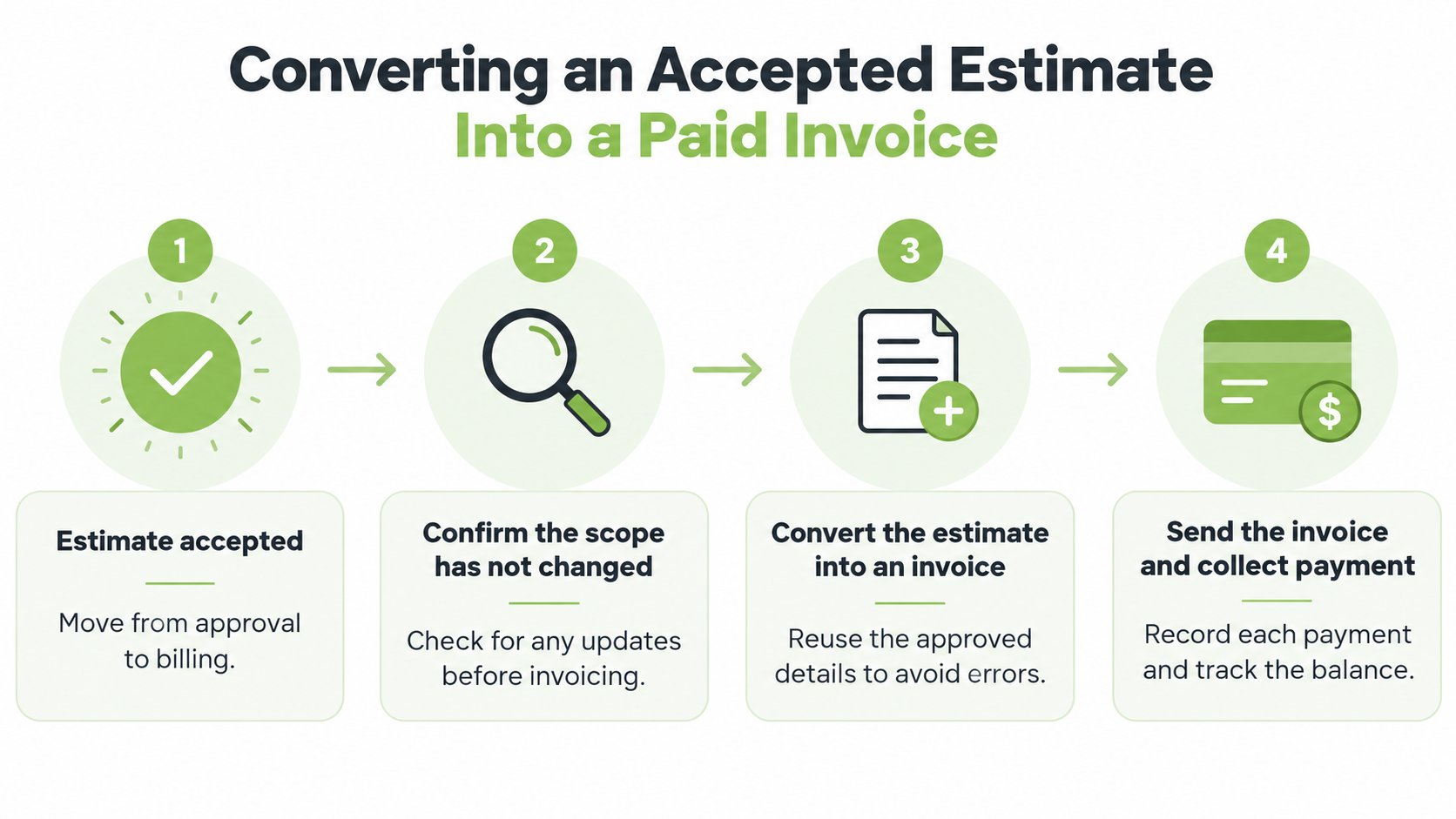
Ask the client to confirm the scope and price in writing, and keep that confirmation with the estimate. Once approved, check that the scope hasn't changed and convert the estimate into an invoice in GetBill. Check the applicable tax, notes and due date before sending. If online payments are enabled on your plan and connected Stripe account, the client can pay through Stripe Checkout.
Where tax and payment terms actually come from
Whether cleaning services are taxable, and at what rate, depends on the state and sometimes the city or county, so the state tax agency's own guidance is the only reliable answer. Confirm it before a tax line appears on any document.
For a private cleaning job, state the payment deadline on the estimate and invoice. Examples include payment on receipt or within 15 days, subject to the terms you agree with the client and the rules that apply where you work.
For a deep clean or a multi-visit job, collect a deposit before scheduling and record every later payment against the invoice so the balance never depends on memory. The IRS guidance on documenting deposits recommends depositing daily receipts into the business account and noting the source, which matters when three clients pay $150, $225 and $300 on the same day and $675 arrives as one deposit. Keep the three payment records and reconcile them to that deposit. The distinction between a quote and an estimate decides what was approved, and the difference between a quote and an estimate is worth settling before the next job is quoted.
Keeping Estimate, Invoice and Receipt Records
A job folder is protection, not paperwork. When a client questions a travel charge six weeks later, the folder either answers it in ten seconds or the charge becomes a goodwill write-off.
The IRS guidance on supporting documents lists invoices, receipts, deposit slips, canceled checks, sales slips and paid bills as the records backing a small business's transactions, kept orderly and safe so they support the entries in the books and the tax return. For expenses, supporting documents should collectively show the payee, the amount paid, proof of payment, the date, and a description of the service received. Those details matter most on an invoice carrying labor, supplies, travel, add-ons and a partial payment.
For U.S. federal tax records, the IRS recordkeeping rules let a business choose any system that clearly shows income and expenses, and the retention period depends on the action, expense or event documented. Set the schedule from current guidance rather than deleting files once a client pays.
Build each job folder around one reference number:
- The original estimate and any revised scope, including the version the client approved.
- The invoice built from those same lines, with tax and notes visible.
- Receipts for supplies, parking and any pass-through charged at cost.
- Deposit records and payment confirmations for every partial payment, matched to the bank deposit.
- The service date and a description of the work performed, in enough detail to answer a query months later.
Reconcile payments against the bank line while the job is fresh, not at quarter end when the memory of which client paid cash has gone.
Sending Your First Itemized Estimate This Week
Pick one current client or open inquiry and send a single itemized estimate: the pricing model, measured minutes per area, the change triggers, the deposit and the payment deadline, all on one document. Record the minutes estimated for each area while they're still in mind, because that note is the only thing that makes the next comparison possible.
After three jobs, compare estimated minutes with actual minutes, including travel and loading. That gap is the most useful number in the business, since it shows whether the prices protect margin, and a consistent gap is a signal to adjust the rate or the minimum charge rather than absorb the loss. The aim isn't a persuasive pitch. It's a number that can be defended line by line when someone asks why the total is what it is, and GetBill's Starter plan includes 50 invoices, 50 estimates and 50 emails per monthly cycle if a first month of testing a new format is the goal. Send that one estimate before the week ends.
With GetBill, you can prepare an itemized estimate with taxes and notes, share it by email or link, and convert it into an invoice after the client approves it in writing. Record deposits and partial payments against the balance. On eligible plans with online payments enabled, clients can pay through your connected Stripe account. Visit GetBill to prepare your first itemized estimate.