


Payment due on receipt means the outstanding balance is due when the client receives the invoice, if that is the payment term you agreed to. Completion or acceptance of the work can be a separate payment trigger when specified in the agreement.
A repair is finished, the customer is satisfied, and the invoice has been emailed. Yet the owner still has materials to pay for and no confirmed payment from the customer. The useful distinction is between when payment becomes due and what must happen before the business receives it.
Table of Contents
- What Payment Due on Receipt Means
- What an Invoice Must Show for Due on Receipt
- Choosing Due on Receipt Over Other Payment Terms
- Why Payment Often Arrives After the Due Date
- Late Fees, Enforceability and Governing Law
- Tax Timing and Records for Immediate Payments
- Confirm the Payment Terms on Your Next Estimate
What Payment Due on Receipt Means
The buyer is expected to pay the remaining balance when they receive the invoice. Record when you sent it and, if timing matters or delivery is uncertain, confirm when the client received it.
The U.S. Treasury’s Invoice Processing Platform guidance uses “Due Upon Receipt” in a specific federal vendor payment context tied to the end of the service period or the receipt of goods. For a private service invoice, follow the payment trigger agreed with your client.
A completed-job example
Say a plumber finishes a $480 drain repair on Tuesday morning and emails the invoice that afternoon. These are hypothetical billing details: if the accepted estimate makes payment due when the invoice arrives, receipt starts the payment obligation.
The customer paying at the counter illustrates the simplest version of that exchange.

An immediate obligation doesn't mean an immediate bank deposit. Email delivery, client review, payment processing, and weekends can separate those events. Keeping the invoice date and due date distinct helps prevent the document's issue date from being mistaken for proof of receipt.
Practical test: The owner should be able to describe the payment trigger in a sentence the client would understand.
For example, payment becomes due when the final invoice is received after the agreed repair is complete. If completion, acceptance, and invoice receipt point to different events, the estimate needs clearer wording before work begins.
What an Invoice Must Show for Due on Receipt
A payment term works best when the invoice also explains what was delivered, what was already paid, and what remains outstanding. A customer shouldn't need the original email conversation to reconstruct the balance.
Assume a $2,000 invoice total for a bathroom repair under Estimate 1042. The $2,000 includes any applicable tax in this example. A $500 deposit received on February 20, 2026 leaves a $1,500 balance due when the customer receives the invoice.
Invoice fields that support a due on receipt term
| Invoice Field | What to Write | Example Entry |
|---|---|---|
| Payment terms | Due on receipt, in plain words | Payment due on receipt of this invoice |
| Invoice date | Date the invoice is issued | March 3, 2026 |
| Scope reference | Estimate or agreed scope number | Estimate 1042, bathroom repair |
| Line items | Labor and materials listed separately | Labor $1,200; materials $800 |
| Tax | Applicable rate and amount, or documented exemption | Any applicable tax is included in the assumed $2,000 total |
| Deposit applied | Amount received and date | $500 received February 20, 2026 |
| Balance due | Remaining amount after deposits | $1,500 due on receipt |
| Payment methods | Accepted options and a fallback | Card online, bank transfer, or check payable to Smith Repairs |
| Late-payment statement | Only if agreed in writing | Only if stated in the signed estimate |
The payment-terms line belongs near the balance, not hidden in a footer. An owner could adapt this wording for the hypothetical repair:
Payment is due on receipt of this invoice. Balance of $1,500 after the $500 deposit received February 20, 2026.
Check the easily missed fields
The deposit line and late-payment statement deserve a separate review. When an owner builds the invoice from a job description, earlier receipts and contractual conditions are easy to overlook. A missing deposit makes the bill look overstated; an improvised late charge creates a different problem.
Include a late-payment line only when the charge was agreed in writing and checked for legality. Otherwise, leave it off rather than inventing a penalty.
The payment methods must also match actual capabilities. If card payment fails, provide usable bank-transfer instructions or the correct check payee and delivery address. A consistent process for setting up an invoice helps keep those operational details beside the amount owed.
Choosing Due on Receipt Over Other Payment Terms
| Term | When Payment Is Due | Best Fit | Main Trade-off |
|---|---|---|---|
| Due on receipt | When the client receives the invoice | Completed one-time jobs for homeowners and small clients | Client approval can still delay payment |
| Net 15 | Fifteen days after the invoice date | Clients with a short, scheduled approval cycle | The business finances the work during that period |
| Net 30 | Thirty days after the invoice date | Larger organizations with monthly accounts-payable runs | A longer credit period delays collection |
| Deposit plus balance | Deposit before work; balance at the agreed milestone | Materials, reserved dates, or long lead times | The deposit must be distinguished from the final balance |
| Payment in advance | Before work starts | New clients or custom orders | Some clients resist paying before seeing results |
These are illustrative contract structures, not mandatory deadlines. Payment terms balance collection speed against client friction, and the right choice depends on who authorizes payment and how much the owner must spend before delivery.
The Federal Reserve Banks’ 2024 Report on Payments analyzed responses from small U.S. employer firms to the 2023 Small Business Credit Survey. Payment in full at the time of service or purchase was the most common arrangement among respondents. Choose terms that fit your own job and customer.
When immediate terms fit the job
For a cleaning visit or repair, send the invoice at completion and make the balance due on receipt if the client agreed to that term. If a photography agreement makes payment due upon delivery of the files, name delivery as the payment trigger in the estimate and on the invoice.
The key is a completed, understandable obligation. If the customer can identify the deliverable and authorize payment, a separate credit period may serve little practical purpose.
A deposit solves a different problem. For a first project requiring substantial materials, payment due on receipt of the final invoice leaves the owner funding the purchases beforehand. Collecting a properly documented deposit shifts part of that exposure earlier.
When another structure works better
A corporate contact may approve the work but lack authority to release funds. If the organization pays suppliers on a fixed schedule, an immediate invoice deadline can conflict with the process the owner accepted when taking the job.
Before quoting, establish:
- The approver: Who confirms that the work meets the agreed scope?
- The submission route: Does the invoice need a purchase-order reference, portal upload, or designated billing address?
- The funding exposure: Which materials, subcontractor costs, or reserved dates must the owner finance before collection?
Multi-phase projects need defined milestones rather than a vague final payment trigger. Advance payment offers stronger protection before delivery, but it can discourage customers who haven't established trust in the business.
The more work the business finances before the client sees a result, the more useful a deposit or staged billing becomes.
A written selection of terms for invoices should reflect those commercial choices. A client accustomed to a credit period shouldn't discover an immediate-payment requirement only after the work is finished.
Why Payment Often Arrives After the Due Date
An immediate due date is an expectation, not a dependable collection date. The owner may have sent a valid invoice while the customer still needs someone else to approve it. Treating those events as interchangeable makes cash planning unreliable.
The Billbooks discussion of invoice payment timing raises this distinction between stated terms and actual payment. The practical response is to examine the stages rather than assume that a shorter label fixes the process.
The timeline separates the handoffs that an owner needs to manage.
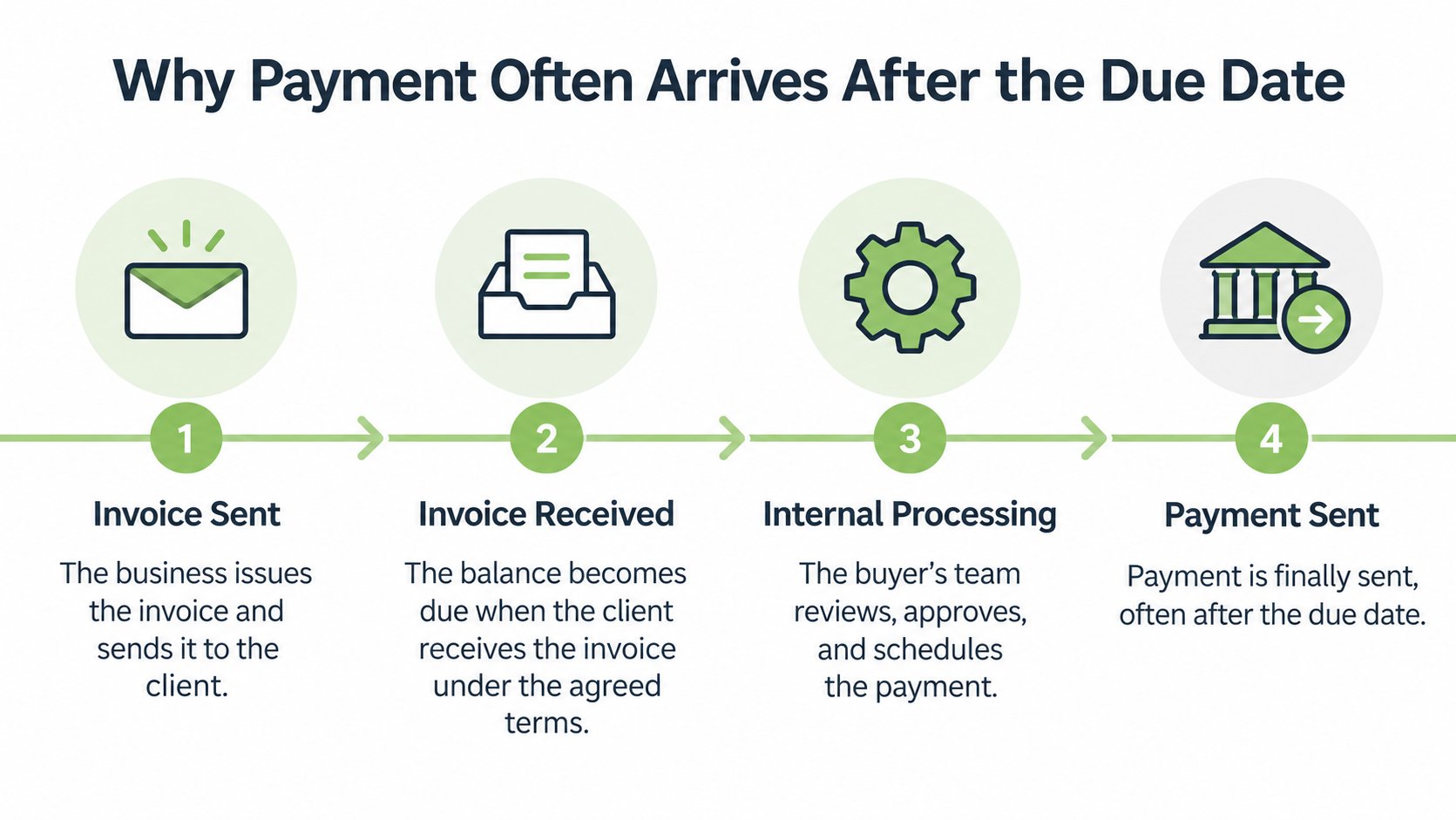
Controls at each handoff
- Invoice sent: Billing waits when the owner postpones paperwork. Prepare the document while the completion details are available and send it when the agreed work is accepted.
- Invoice received: An incorrect address or missed portal submission can stop progress. Confirm the billing destination and ask for acknowledgment when receipt is uncertain.
- Internal processing: Review and approval are separate tasks. Identify the reviewer, supply the scope reference, and resolve questions about completion or materials.
- Payment sent: Authorization isn't confirmation of receipt. Check the transaction or bank record before recording the balance as paid.
For a service business, the approval path matters as much as the deadline. An invoice that reaches the wrong employee won't become easier to pay because its terms are stricter.
Follow up without creating confusion
For a due-on-receipt invoice, confirm receipt if you need to establish the due date. A reminder should identify the invoice, outstanding balance, available payment methods and how the client can confirm when they will pay.
For owners developing an escalation process, Kons Law's discussion of preventing late payments with clear terms provides useful context for documentation and collection planning. A polite progression from receipt confirmation to payment-status inquiry is more actionable than repeatedly resending the same invoice without asking what is blocking approval.
Late Fees, Enforceability and Governing Law
An invoice stating payment due on receipt doesn't automatically create a right to charge interest or a late fee. A business owner should distinguish the underlying payment obligation from any additional charge for delay.
For a private U.S. service business, the accepted agreement and applicable state law need review before a charge is imposed. The owner shouldn't assume that wording added to the final invoice overrides an accepted proposal, engagement letter, or customer purchase order.
Review the agreement before adding charges
The contractual review should address:
- The payment trigger: Whether the obligation starts at delivery, acceptance, invoice receipt, or another defined event.
- The customer category: Whether the payer is a consumer or another business.
- The charge provision: Whether the amount, calculation method, start date, and any grace period were agreed in advance.
- The governing jurisdiction: Which law applies, particularly when the business and customer are in different places.
The MyInvoiceTemplate overview of invoice payment terms highlights jurisdictional differences, including UK-specific treatment of invoice receipt and delivery. That overview isn't a basis for applying a UK statutory late-payment rule to a U.S. handyman or photographer.
Purchase orders also deserve attention before acceptance. Owners facing customer-issued purchasing documents can browse purchase order conditions guidance from By Design Law Firm & Legal Consultancy, PLLC to identify issues for discussion with counsel, rather than assume the invoice alone controls.
Software doesn't transfer legal responsibility
Cross-border jobs add practical questions about time zones, currency conversion, bank-processing delays, and tax treatment. State an explicit deadline and obtain appropriate governing-law language when the engagement warrants it.
A billing template is a document tool, not a legal determination.
The issuing business remains responsible for the underlying goods or services, payer relationship, payouts, chargebacks, refunds, disputes, taxes, and compliance obligations. GetBill does not warrant that invoices, estimates, reports, calculations, templates, payment links, tax settings, or business records generated through the service meet legal, tax, accounting, or regulatory obligations.
A qualified local attorney should review proposed late-fee terms and advise on collection disputes before the owner applies contested charges.
Tax Timing and Records for Immediate Payments
For a U.S. service business using the cash method, the invoice due date doesn't by itself determine federal taxable-income timing. Cash-method income is generally included when received or constructively received, meaning funds are credited or made available without restriction; IRS Publication 334 illustrates this with a check mailed December 30 but received January 4, which belongs to the later tax year.
The operational sequence remains straightforward: prepare the estimate, perform the work, issue the invoice, and record the receipt using the applicable accounting rules. An overdue invoice and a received payment are different records.
Keep the receipt trail intact
- Invoice: Retain the itemized document and its client reference.
- Payment confirmation: Preserve the transaction evidence or check-receipt details.
- Deposit record: Identify the customer, project, and amount already applied.
- Correspondence: Keep messages that help establish receipt timing or explain adjustments.
Advance payments require separate attention. IRS Publication 538 generally places advance payments for goods or services in income in the year received, while allowing qualifying accrual-method taxpayers limited deferral under specific conditions, no later than the following tax year.
For a hypothetical $2,000 estimate with a $500 deposit, record the deposit against the client and project. The later invoice should show the full project amount, the payment applied, and the remaining balance, not request the full amount again.
Accrual accounting differs from cash-method treatment. AmbitionCFO's sample accrual accounting entries offer a practical comparison, not a substitute for tax advice. State taxes, other countries' rules, and business-specific exceptions need local review.
Confirm the Payment Terms on Your Next Estimate
- Write the term plainly. Include any deposit and whether it reduces the final balance.
- Obtain written acceptance. Preserve the client's approval before work begins.
- Carry the agreement forward. Repeat the term, scope reference, and remaining balance on the invoice.
- Bill at completion. Send the invoice the same day the agreed work is complete and accepted.
- Schedule follow-up. Calendar the due date and send a reminder if payment hasn't arrived.
- Record every receipt. Apply deposits and partial payments so the outstanding amount stays accurate.
GetBill lets you convert an accepted estimate into an invoice, share it by email or link, and record deposits and partial payments to track the remaining balance. Supported card payments use Stripe and depend on your connected account, currency and region.
GetBill offers estimating, invoicing, and payment-recording tools for small service businesses that need a clear path from agreed work to the remaining balance. Visit GetBill and apply this workflow to the next estimate, starting with a payment term the client can understand before the job begins.