

The total amount due is the invoice total minus payments already received, plus any rounding adjustment, and it shows what remains unpaid. The due date tells the client when to pay. On an invoice totaling $4,601.00, with a $1,500.00 deposit already received, that figure is $3,101.00.
A photographer finishes a Saturday shoot, or a cleaner wraps a weekend job, and the estimate in the client's email still says one price. A deposit already cleared. The invoice that follows shows another number, and the reply comes back the same day: which figure do I pay? Until the document answers that, the money sits. The total amount due is a payment instruction the client can verify line by line, especially when tax, an approved extra, or a deposit makes the invoice differ from the quote.
Table of Contents
- Total Amount Due Compared With Subtotal and Invoice Total
- How to Calculate the Total Amount Due, Step by Step
- Reconciling Deposits, Rounding and Quote Differences
- When the Amount Due Becomes Payable
- Tax Timing and Records Behind the Amount Due
- Confirm the Amount Due Before You Send Each Invoice
Total Amount Due Compared With Subtotal and Invoice Total
A handyman's kitchen-refresh invoice may show three different figures, each answering a different question. The subtotal adds the line items after discounts, before tax and payments. The invoice total adds applicable tax and approved fees. The total amount due is the part of the invoice total that remains unpaid.
| Figure | What It Includes | How It Changes |
|---|---|---|
| Subtotal | Sum of line items after discounts, before tax and payments | Changes when items or discounts change |
| Invoice total | Subtotal plus tax and approved fees | Changes if the invoiced items, tax, or fees change |
| Amount already paid | Deposits and partial payments received | Increases as payments are recorded |
| Total amount due | Invoice total minus payments received, plus any rounding adjustment | Decreases as payments are recorded, until it reaches zero |
| Balance due | Remaining amount shown on statements or reminders | Often the same as total amount due; check the label used |
Balance due is commonly another label for the unpaid amount. The wording can differ between documents, so make sure the client can identify which figure is the payment instruction.
For example, if a handyman's invoice total is $1,200 and the client has paid a $400 deposit, the total amount due is $800. The subtotal and invoice total explain how the bill was built; the amount due tells the client what remains to pay.
Late payment is common, so a clearly displayed balance and due date can help prevent confusion and make it easier for the client to pay on time. An itemized billing statement keeps the charges and payment history visible. Before sending an invoice, check that you can explain the subtotal, invoice total, payments received, and amount due from the document itself.
How to Calculate the Total Amount Due, Step by Step
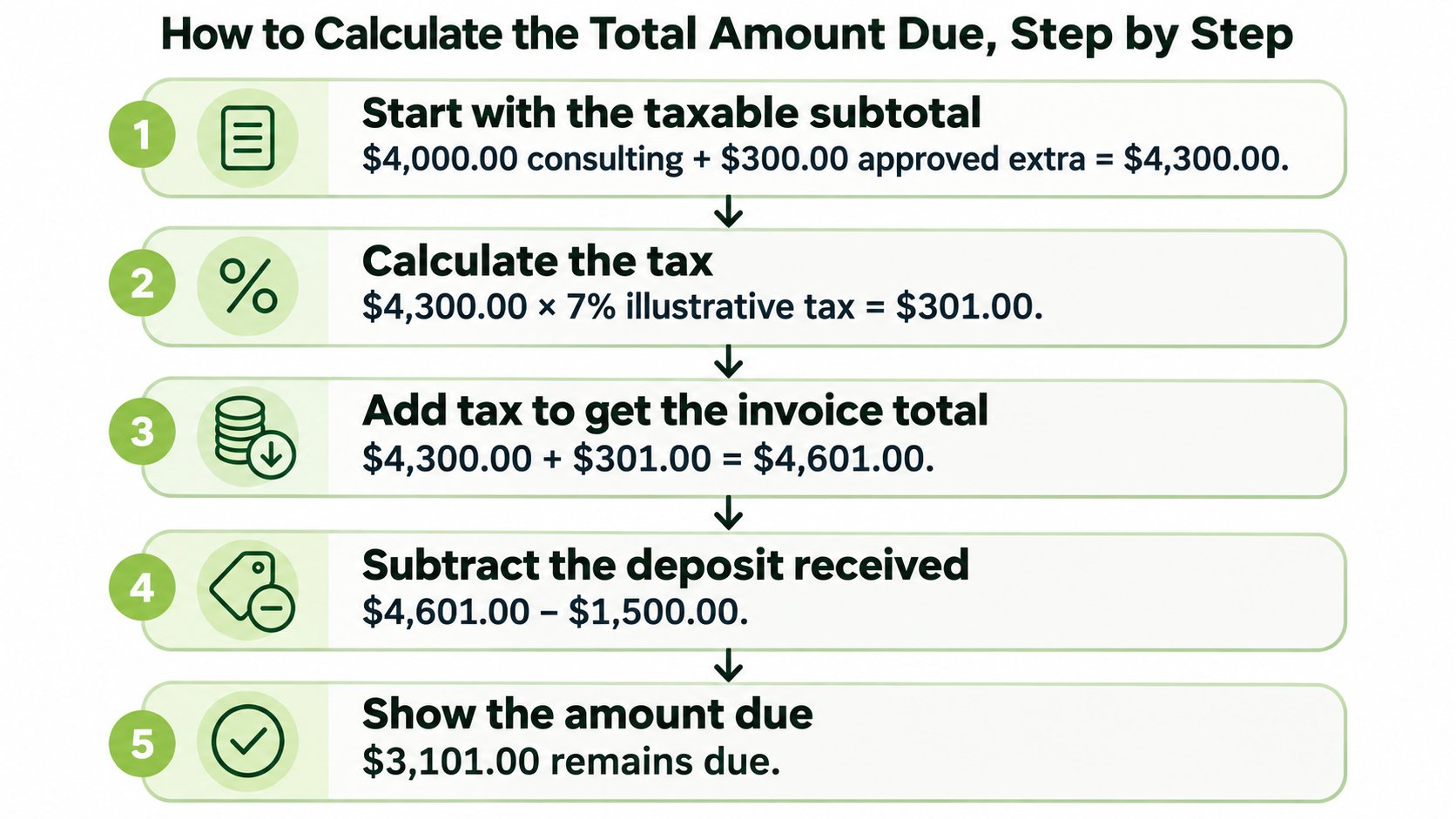
The total amount due is built in a fixed order, and each step can be checked against the one before it. Say consulting services are $4,000.00 and an approved extra is $300.00. Sales tax at an illustrative 7% applies to the taxable $4,300.00. Real rates, and whether a service is taxable, depend on the jurisdiction and the transaction. Tax comes to $301.00, so the invoice total is $4,601.00. A $1,500.00 deposit leaves a total amount due of $3,101.00.
- List each line item at its agreed price.
- Apply discounts only to the lines they cover.
- Add approved extras the client has accepted in writing.
- Calculate tax on the taxable portion under the rules that apply to the transaction.
- Add tax and fees to reach the invoice total.
- Subtract each deposit or other payment already received.
- Add any rounding adjustment and show the result to two decimal places.
| Line | Amount (USD) |
|---|---|
| Consulting services | 4,000.00 |
| Approved extra | 300.00 |
| Taxable amount | 4,300.00 |
| Sales tax at 7% (illustrative rate) | 301.00 |
| Invoice total | 4,601.00 |
| Deposit received | 1,500.00 |
| Total amount due | 3,101.00 |
Where the order gets reversed
For electronic invoices validated under Peppol BIS Billing, rule BR-CO-16 defines the amount due as the invoice total including VAT, minus the paid or prepaid amount, plus any explicit rounding amount. A service invoice with a VAT-inclusive total of 1,250.00, a recorded deposit of 300.00, and a rounding adjustment of 0.01 has a remaining amount due of 950.01. An invoice submitted for validation under this profile can fail that check if the arithmetic does not reconcile. Preserve the original gross total, store payments separately, and calculate the outstanding balance from those fields rather than overwriting the invoice total.
The common slip is adding tax after the deposit instead of before it. Tax on $4,300.00 is $301.00. Tax calculated only on the $2,800.00 left after a $1,500.00 deposit is $196.00. Those two paths don't produce the same total amount due.
Reconciling Deposits, Rounding and Quote Differences
A $4,601.00 invoice with a $1,500.00 deposit has $3,101.00 left to pay. If the client later pays another $1,000.00, the balance becomes $2,101.00. Keep the invoice total intact and show each payment separately, with its date and method, so the client can follow how the payment instruction was calculated.
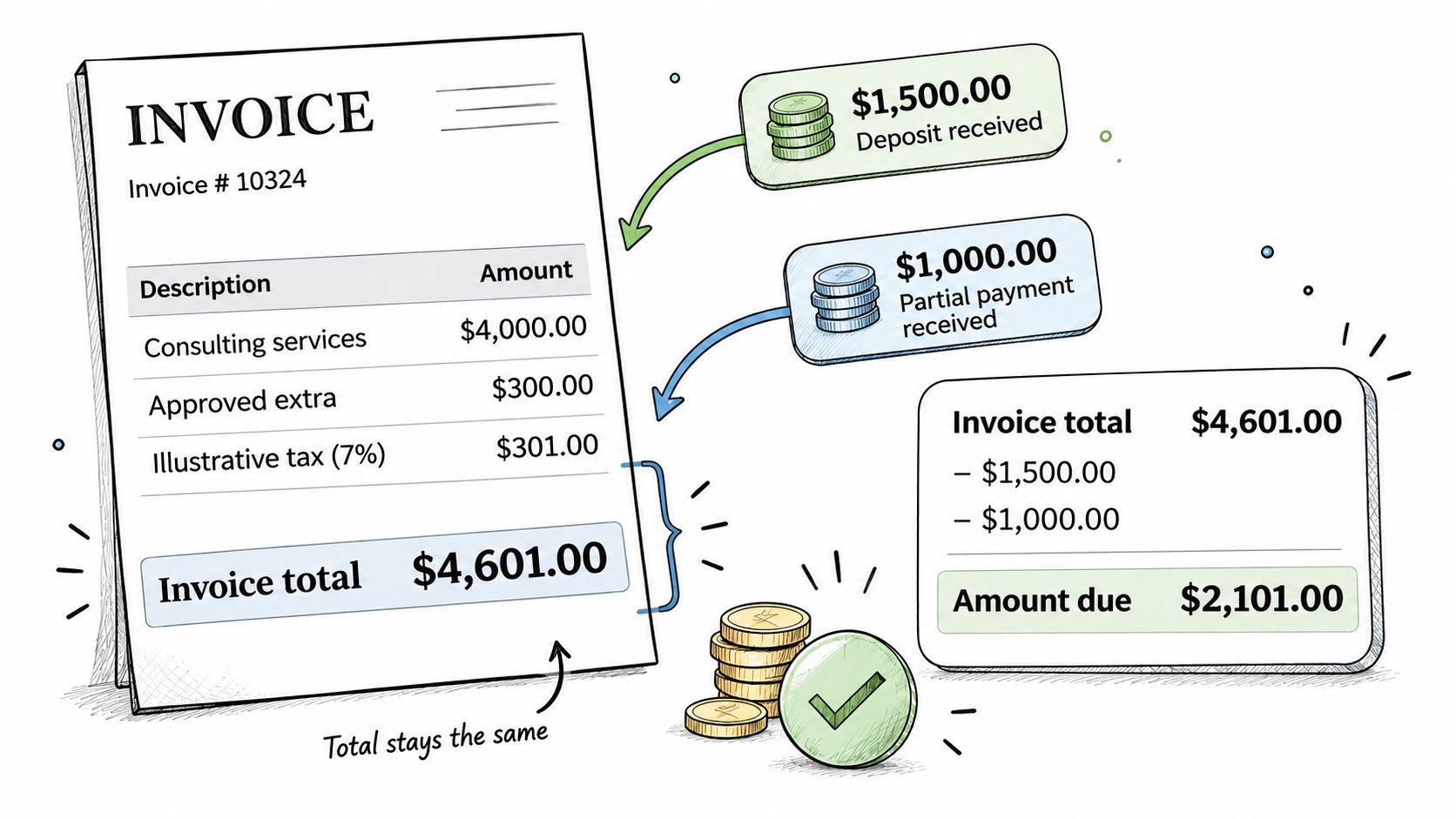
Keep paid line items visible. A payment lowers the outstanding balance, not the value of the work or the invoice total. The client should be able to see the original services, tax, and payments together.
Cents that change the payable amount
Rounding can shift the amount due by a cent or more when an invoice has several taxable lines, discounts, or multiple tax rates. A practical approach is to calculate line amounts and taxes consistently, then present amounts to two decimal places. If a rounding adjustment is needed, show it as a separate positive or negative line so the client can reconcile the final figure. Rounding rules can vary by jurisdiction, so use the method that applies to your business and apply it consistently.
Why the invoice is higher than the $4,000 estimate
A client may question the difference between a quote and the amount due even when the arithmetic is correct. Common reasons include:
- Sales tax added at invoicing, when the estimate was prepared before tax.
- Approved extras, such as the $300.00 change, especially if the approval and date are not shown.
- A discount discussed but not applied, or applied to the wrong line.
- The deposit, which reduces the balance payable but not the invoice total.
- A card processing charge, which may be optional or conditional. Check applicable law, card-network rules, and payment-provider terms before adding one.
- Currency conversion on a payment page when its currency differs from the invoice currency.
Show the subtotal, discounts, taxable amount, tax, approved extras, deposits, credits, any processing charge, and final amount due as distinct entries. State the currency and whether tax is included. This gives the client a clear path from the quote to the payment instruction.
Practical rule: The total amount due equals the invoice total minus payments already shown on the document, with any rounding adjustment stated separately. If the figures do not reconcile, correct the invoice before sending it.
When the Amount Due Becomes Payable
The amount is only half of the payment instruction. The other half is when it becomes payable. UK government research, cited here as UK context only, found that 54% of businesses with business customers used 30-day terms, while 22% of microbusinesses expected payment within seven days. In that research, 49% of small businesses said customers paid later than their typical agreed terms, compared with 36% overall.
Four lines the client should see
Put the instruction in one block:
Total: $4,601.00
Deposit received: $1,500.00
Amount due: $3,101.00
Due date: December 15, 2026 (illustrative)
For a single unpaid balance, show one agreed due date. If the client will pay in installments, show each installment amount and its own due date. Write down the due date, any grace period, what happens after the due date, and how a partial payment is applied. The relationship between the invoice date and due date should be obvious without a phone call.
Shorter terms help cash flow, and they can also collide with a client's procurement process. The invoice should make both the amount and the timing unmistakable rather than forcing one side to guess. Late-fee rules in the United States depend on the contract and on state law, so don't invent a percentage on the invoice that the agreement never stated.
Tax Timing and Records Behind the Amount Due
The total amount due is a billing figure. It isn't the date income is taxed. For U.S. federal income tax, a service business on the cash method generally reports income when it is actually or constructively received, and generally deducts expenses when paid, under IRS Publication 538. A cleaner who issues a $2,400 invoice in December 2025 and first has access to the payment in January 2026 generally reports that amount as 2026 income under the cash method. The invoice tracks what the client owes. It doesn't set the federal recognition date.
Businesses that carry inventory can face different accounting-method rules. The IRS states that inventory generally requires accrual treatment for purchases and sales, subject to small-business exceptions. Confirm which accounting method applies to your business and any changes with a qualified tax adviser. An invoice template with VAT is a layout aid for businesses that must show tax. It doesn't decide which U.S. state rate applies, and VAT itself is not a U.S. federal sales tax.
What to keep with the invoice
IRS Publication 583 identifies invoices, receipts, deposit slips, canceled checks, sales slips, and paid bills as supporting documents, and it says records of gross receipts should show the amounts and sources of business income. For a handyman who issues a $5,000 estimate, converts it to a $5,000 invoice, takes a $1,500 deposit, and later collects $3,500, keep:
- The estimate or agreement, including any written change and its date.
- The invoice, with itemized services, tax or fees where they apply, and the total amount due.
- Payment evidence for the deposit and the balance, including date and method.
- The calculation that ties the remaining balance to those payments, credits, and approved changes.
The business that issues the invoice remains responsible for the underlying services, the payer relationship, payouts, chargebacks, refunds, disputes, taxes, and compliance. A billing record supports that work. It doesn't guarantee tax compliance, and it doesn't replace state sales-tax or invoicing rules, which differ by jurisdiction. Confirm the details with a tax professional.
Confirm the Amount Due Before You Send Each Invoice
Every invoice comes down to the same check before it leaves.
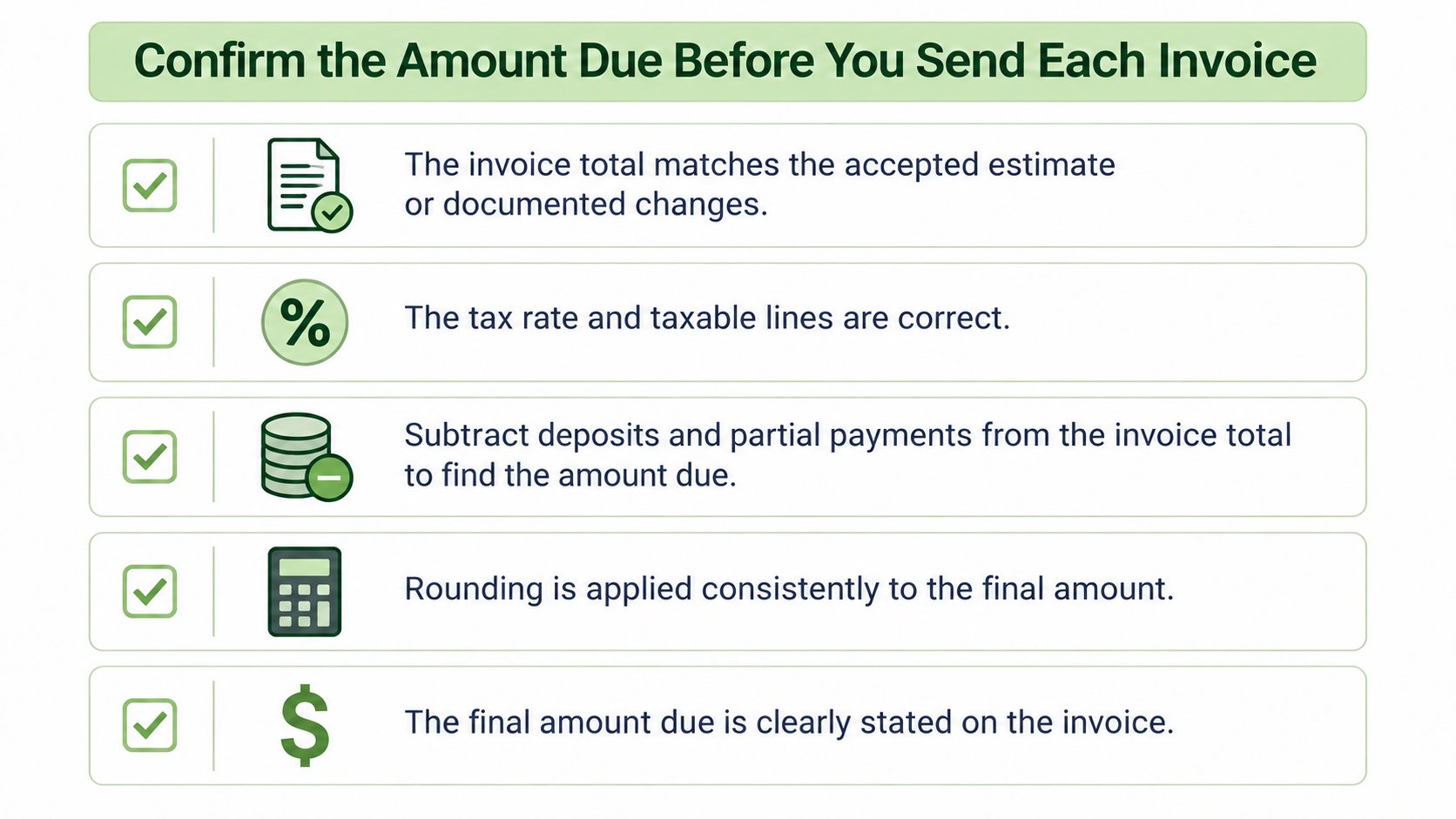
- Match the source. The invoice total matches the accepted estimate, or it matches documented changes.
- Check the tax. Verify the rate and the taxable lines under the rules that apply to the transaction.
- Record every payment. Each deposit and partial payment has a date. Partial payments can be recorded from cash, cards, or bank transfers, and the balance stays updated.
- Show the balance and due date. If payment is split, show the amount and due date for each installment.
- State the terms of the number. Currency is named, and the invoice says whether tax is included.
- Reconcile. The total amount due equals the invoice total minus payments received, plus or minus any documented rounding adjustment.
Run the list on one live invoice this week and fix any line that fails before it goes out. An accepted estimate can be converted into an invoice with one click, without re-entering the lines, which removes one place where a quote and an invoice drift apart.
GetBill lets a small service business prepare estimates, turn an accepted estimate into an invoice, and record deposits and partial payments so the total amount due stays visible to the client. It is built for freelancers, consultants, photographers, cleaners, and contractors who invoice clients directly, with card payments available when online payments are enabled on the plan and connected Stripe account. Visit GetBill to set up that workflow on the next invoice you send.